
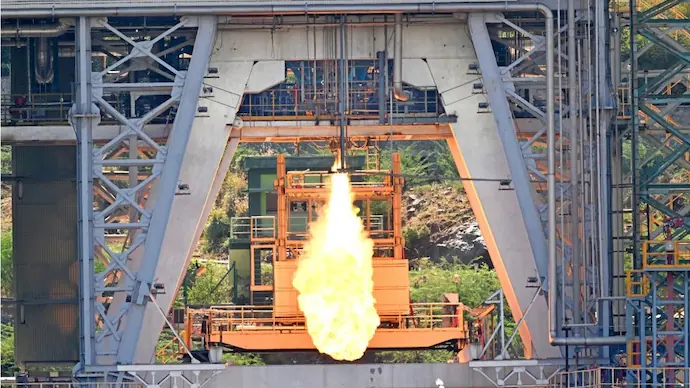
The Indian Space Research Organisation (ISRO) has achieved a major breakthrough in its quest for heavier and more capable launch vehicles, successfully completing a full-thrust, sea-level hot test of its indigenous CE20 cryogenic engine. The test was conducted on March 10, 2026, at the ISRO Propulsion Complex in Mahendragiri and marks a pivotal advancement for India’s most powerful rocket, the LVM3 . During this critical evaluation, the engine was fired for a duration of 165 seconds while producing an impressive 22 tonnes of thrust, a significant increase from the previously qualified 19-tonne level . This successful test is not merely an incremental improvement but a fundamental step forward, as it validates the engine’s performance for the upcoming C32 uprated cryogenic stage, which is designed to significantly enhance the LVM3’s payload-carrying capacity for future ambitious missions .
One of the most notable engineering challenges overcome in this test is the successful operation of the CE20’s high area ratio nozzle at sea level. The engine’s nozzle exit pressure is approximately 50 mbar, which is much lower than the atmospheric pressure at sea level. Under these conditions, there is a severe risk of flow separation inside the nozzle, which can induce violent vibrations and intense thermal stresses, potentially leading to catastrophic structural and mechanical damage to the engine . To mitigate this risk, ISRO has developed and validated a sophisticated Nozzle Protection System (NPS) , which ensures stable flow behavior and safeguards the nozzle’s integrity during ground testing. The fact that the NPS performed flawlessly throughout the 165-second full-thrust burn confirms ISRO’s growing mastery over complex propulsion physics and nozzle design .
This recent test is a landmark achievement for the CE20 engine program, as it marks the 20th consecutive successful hot test for this particular engine, a record that underscores its extraordinary reliability and robustness . This extensive test campaign has validated several critical indigenous technologies, including multi-element ignition systems, wide ignition margins, turbopump bearings, and sensors, all developed domestically . The engine has also successfully demonstrated a “bootstrap” start mode, a crucial capability that could allow for in-flight restart. This feature will be vital for executing complex mission profiles and is particularly significant for enhancing crew safety during India’s premier human spaceflight program, Gaganyaan . The CE20 has already been qualified for human spaceflight and has consistently performed in multiple successful missions, including the Chandrayaan-3 lunar landing, solidifying its reputation as a reliable and powerful workhorse for India’s space ambitions .
The immediate next step for ISRO is to transition this newly qualified 22-tonne thrust capability from ground acceptance tests to active flight operations. This will involve full integration of the upgraded C32 cryogenic stage into the LVM3 launch vehicle for its upcoming missions . This enhancement is expected to be a game-changer for India’s space program, as the increased thrust will allow the LVM3 to carry significantly heavier payloads, including larger communication satellites and more massive modules for deep-space exploration and human spaceflight . In parallel, ISRO is also developing a complementary semi-cryogenic engine, the SE2000, which is designed to replace the current L110 liquid core stage of the LVM3. This engine, with a thrust of 200 tonnes, is being developed with technology transfer from Russia and aims to further boost the rocket’s payload capacity to 6.5 to 7 tonnes for Geosynchronous Transfer Orbit (GTO), making India highly competitive in the global commercial launch market .