
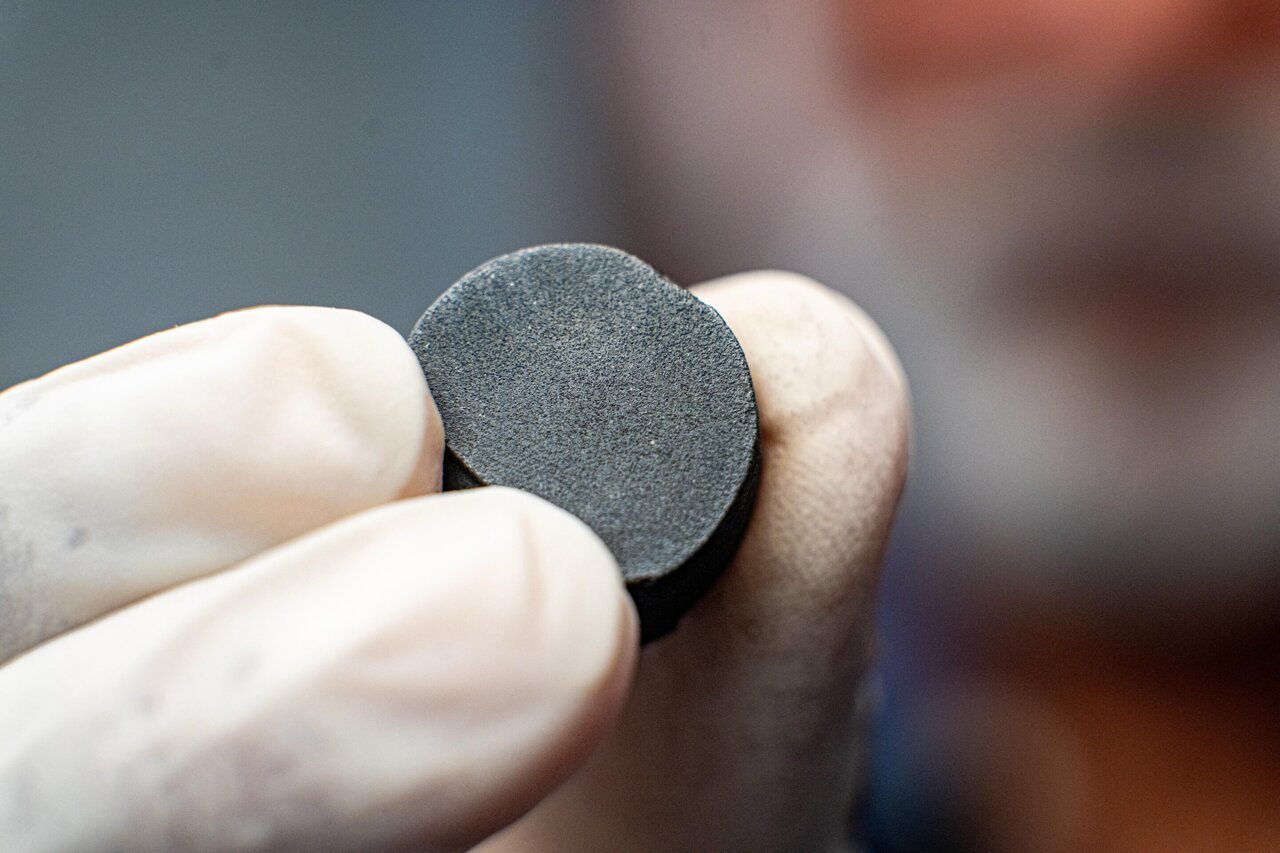
The popular adage that “diamonds are forever” has long served as a cultural shorthand for ultimate durability and resistance to destruction, given that diamond is naturally the hardest known substance on Earth. However, a groundbreaking new scientific study conducted by a collaborative research team from the Texas A&M University College of Engineering and Rice University, with support from the Air Force Office of Scientific Research, has shattered this long-held perception. Published in the prestigious journal Materials Today, the research reveals that when ultra-hard diamond composites are subjected to violent mechanical shock—specifically being struck by projectiles traveling at hypersonic speeds—portions of the diamond rapidly transform into graphite within microseconds. This counterintuitive atomic-scale metamorphosis demonstrates that even the rigid, tetrahedral crystal structure of diamond can undergo a dramatic phase transition under extreme conditions, turning a hyper-hard material into a softer form of carbon that serves an unexpected survival function.
To put this extreme hypothesis to the ultimate test, the research team—led by doctoral candidate Aniket Mote and professor of mechanical engineering Dr. Thomas Lacy at Texas A&M, alongside academic partners—forged specialized diamond composite materials. They then placed these samples directly into the line of fire using advanced high-velocity launchers, blasting them with aluminum projectiles traveling at velocities exceeding eight times the speed of sound (Mach 8.45). While classical mechanics and conventional material science would typically predict catastrophic brittle fracture, massive fragmentation, or complete pulverization upon encountering such immense kinetic energy, the researchers discovered a far more intricate physical phenomenon unfolding at the microscopic level.
Upon impact, the immense shock pressures and kinetic forces did not simply shatter the carbon lattice; instead, they catalyzed a swift structural rearrangement. Within microseconds of the collision, localized zones of the diamond structure underwent a phase transition, transforming directly into graphite interfaces. Although graphite is commonly known as the soft, layered material used in pencil leads—representing the polar opposite of diamond’s mechanical hardness—its sudden emergence during the impact event proved vital to the material’s survival. The newly formed graphite layers acted as an instant shock absorber, efficiently absorbing and redistributing a massive portion of the destructive mechanical energy that would have otherwise propagated completely through and obliterated the target.
To fully decode the mechanisms behind this surprising behavior, the scientists utilized detailed microstructural characterization combined with advanced atomistic molecular-dynamics simulations. By modeling how individual carbon atoms shift and rearrange during the violent impact event, the team mapped out the precise trajectory of the phase change. The analysis confirmed that the diamond-to-graphite transformation is not a sign of structural failure, but rather a dynamic, self-protective mechanism. The physical phase transition itself functions as a thermodynamic energy sink, consuming a massive amount of energy from the collision process, which effectively cushions the surrounding material against total catastrophic destruction.
For decades, materials scientists have extensively studied the reverse process—how graphite can be compressed under extreme static or shock pressures to synthesize diamond or hexagonal diamond structures. However, documenting this specific reverse pathway under hyper-velocity impact provides critical new insights into the reversibility and phase stability of carbon allotropes in extreme environments. This discovery proves that carbon bonds possess a surprising degree of dynamic adaptability when pushed past their conventional mechanical limits, undergoing rapid structural shifts rather than simply failing through standard fracture mechanics.
The broader implications of this study extend far beyond theoretical physics, providing a valuable blueprint for next-generation materials engineering. Modern aerospace, defense, and space exploration technologies frequently expose critical components to intense mechanical stress, high-velocity debris impacts, and hypersonic flight profiles where traditional metals and conventional ceramics face severe performance thresholds. By understanding how diamond composites harness phase transitions to dissipate extreme kinetic energy, engineers can design advanced protective shielding, impact-resistant armor, and specialized structural components that utilize controlled phase changes to mitigate damage. Rather than relying entirely on unyielding rigidity, future engineering paradigms may focus on materials that dynamically alter their internal atomic structure to survive catastrophic forces.
Ultimately, this pioneering research by the Texas A&M and Rice University teams underscores how even deeply rooted scientific principles are subject to refinement when tested at the absolute boundaries of physics. By revealing that diamonds can transition into graphite under hypersonic duress, the study opens an exciting new frontier in materials science. As researchers continue to refine atomistic simulations and explore new composite structures, harnessing built-in structural adaptability will transform how we protect vital infrastructure and advanced vehicles operating in the most hostile environments imaginable.