
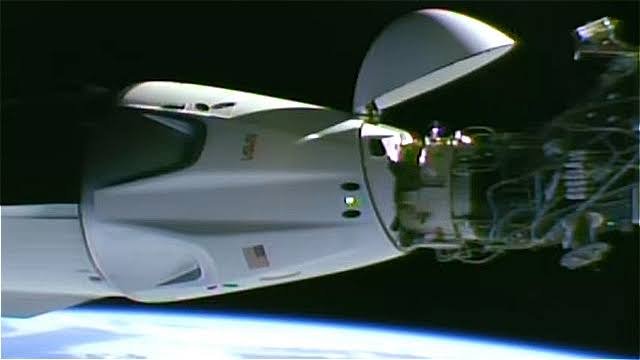
The four-person international crew commanding the mission includes NASA commander Jessica Watkins, NASA pilot Luke Delaney, Canadian Space Agency astronaut Joshua Kutryk, and Roscosmos cosmonaut Sergey Teteryatnikov. Commander Jessica Watkins, a veteran geologist who previously completed an extended stay aboard the orbital outpost in 2022, leads a team composed largely of spaceflight rookies. Both Delaney and Kutryk bring extensive backgrounds as former military test pilots, while Teteryatnikov previously served in the Russian submarine force before joining the cosmonaut corps. Upon reaching orbit, the four spacefarers became the 295th through 298th individuals to board the International Space Station.
The remarkably rapid rendezvous was made possible by precision orbital mechanics and optimized trajectory profiles executed during launch. Rather than spending a traditional 24 to 36 hours executing multiple phasing burns to slowly align orbits with the space station, SpaceX engineers calculated a high-energy trajectory direct insertion. By launching at the exact instant the orbital plane of the space station aligned with the Florida launch site, the Falcon 9 upper stage was able to insert the Crew Dragon Grace almost directly into the intercept trajectory. Minor automated thruster burns using the spacecraft’s Draco engines refined the approach while in low Earth orbit, seamlessly navigating toward the station’s forward docking interface without requiring lengthy holding orbits or overnight rest periods for the crew.
The expedited trip offers significant practical advantages for future human space Exploration endeavors. Traditional multi-day transits subject astronauts to extended periods inside the restricted quarters of the transport capsule prior to reaching the larger habitat of the space station. Demonstrating an ultra-fast rendezvous capability minimizes crew fatigue, reduces reliance on life support consumables during flight, and opens up operational flexibility for urgent medical or cargo missions. While Russian Soyuz vehicles have previously demonstrated express four-hour and six-hour rendezvous profiles, reaching this capability on American commercial platforms represents a major technological leap for SpaceX’s commercial crew program.
Following the autonomous docking maneuver, the crew initiated standard pressurization and leak checks between the spacecraft hatch and the Harmony module. At approximately 9:19 p.m. EDT, the hatches opened, allowing the Expedition 75 crew aboard the station to welcome the new arrivals with open arms. The entrance of the four Crew-13 members temporarily expands the total population of the space station to 11 astronauts and cosmonauts. This brief handover period allows the incoming crew to receive operational briefings from the outgoing Crew-12 astronauts, who are scheduled to wrap up their own multi-month scientific expedition and return to Earth in the coming days.
Over the course of their planned six-month mission, the Crew-13 team will conduct more than 200 scientific experiments and technology demonstrations. Key research initiatives include investigations into microgravity-induced cellular aging, advanced 3D bioprinting of human tissue constructs, automated material science studies, and testing next-generation environmental control hardware required for deep-space Artemis missions to the Moon. Beyond scientific operations, the crew will maintain routine space station upkeep, participate in scheduled spacewalks for solar array maintenance, and oversee incoming robotic cargo resupply vehicles.
The mission carries unique personal milestones, particularly for Canadian Space Agency astronaut Joshua Kutryk, whose journey to space coincided with a major family occasion. Kutryk’s wife is expecting their third child around late November 2026, roughly two months into his station stay. This makes Kutryk only the fourth astronaut in history to welcome a child while off the planet. Reflecting on the emotional weight of departing Earth, Kutryk quoted Arctic explorer Fridtjof Nansen prior to launch, acknowledging the challenges and privileges inherent to human exploration as he embarked on his maiden voyage.
The launch of Crew-13 also highlights the resilience of commercial launch operations. The flight was originally slated for mid-September 2026 but experienced a temporary delay when engineers identified a minor propulsion valve issue during pre-flight vehicle checkouts. SpaceX technicians promptly replaced the faulty component and re-verified system integrity to ensure maximum crew safety, leading directly to the flawless execution seen during October 1st’s record launch.
With the Crew Dragon Grace now securely attached to the station, NASA and SpaceX officials expressed high praise for the joint control teams in Houston and Hawthorne, California. The success of this ultra-fast docking profile establishes a new benchmark for U.S. spaceflight capabilities, demonstrating that commercial crew transport is not only reliable and reusable, but increasingly efficient. As the Crew-13 astronauts settle into their weightless home for the winter, their record-setting flight stands as a testament to the continuous evolution of orbital logistics and human space exploration.