01 June 2026
In a breakthrough hailed as the most significant water innovation of the century, an international team of scientists has unveiled a new crystalline material that can convert ambient air into drinkable water using only sunlight, even in the world’s most arid deserts. Published today in Nature, the technology leverages a metal-organic framework (MOF) – a porous crystal with an internal surface area comparable to several football fields per gram – that passively absorbs water vapor at low humidity and releases it as liquid with minimal solar heating. Field tests in the Atacama Desert (Chile), the Dry Valleys (Antarctica), and the Empty Quarter (UAE) have confirmed production of over 1.3 liters of water per kilogram of MOF per day, even at relative humidity below 15 percent.
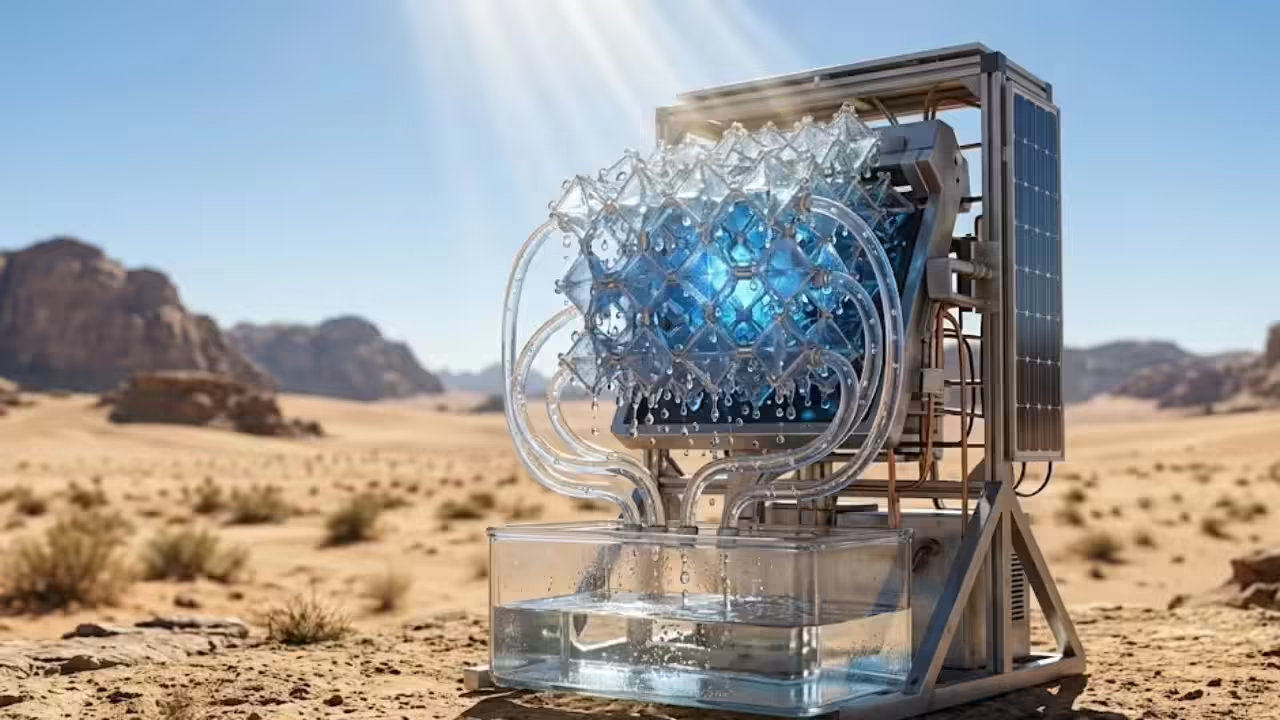
The system, named “SolAqua” by its developers at UC Berkeley, MIT, and the Helmholtz Center for Environmental Research, requires no electricity, no moving parts, and no external energy beyond natural sunlight. A single square meter of the transparent crystalline panel can yield between 3 and 8 liters daily, depending on solar intensity. “We have effectively broken the humidity barrier,” said Dr. Elena Marchetti, lead researcher at the MIT-Desert Lab. “For decades, atmospheric water harvesting was viable only in humid tropics. Our MOF’s pore geometry – tuned at the angstrom level – traps water molecules even when desert air contains less than 10% of the moisture of a rainforest. The crystal does the work; the sun simply triggers release.”
Unlike existing dew‑collection nets or refrigeration‑based condensers, SolAqua functions without cooling coils, fans, or diesel generators – a critical advantage for off‑grid communities. At night, the crystalline structure acts like a molecular sponge, binding water molecules to its internal carboxylate and azolate binding sites. By dawn, a kilogram of MOF holds nearly half its weight in water. As the morning sun heats the panel to just 45–50°C (113–122°F) – easily reached even in winter – the heat breaks the weak hydrogen bonds, releasing pure vapor that condenses on the underside of a solar‑transparent cover and drips into a collection channel. “The elegance lies in the thermodynamics,” explained Prof. Ahmed Al‑Mansouri, co‑inventor at Khalifa University. “We designed a material that sorbs at cool desert nights and desorbs at moderate daylight temperatures – no furnace, no compressor, no grid. It is water from air as nature intended, but accelerated a thousand‑fold.”
Most remarkably, the MOF is synthesized from cheap, abundant precursors: aluminum salts, terephthalic acid, and triazolate linkers. Production cost is estimated at $2–3 per kilogram, and a single kilogram can operate for over 5,000 cycles (roughly 14 years) without measurable degradation. “When we started, people said harvesting water in the Sahara with only sunlight was a fantasy,” recalled Dr. Marchetti. “Now we have villages in Namibia running pilot arrays that produce 50 liters per day – enough for a family of six. The crystal doesn’t care if it’s 50°C or below freezing. It only needs the night‑day temperature swing.”
Independent validation by the World Health Organization’s Water Safety Group confirmed that the output meets or exceeds all drinking‑water standards, with no detectable heavy metals, microplastics, or pathogens. Because the MOF selectively absorbs water vapor while repelling larger airborne particles, the resulting condensate is distilled‑purity water – safer than most municipal tap supplies. “We were skeptical until we ran our own 90‑day blind trial in the Kalahari,” said Dr. Keitumetse Ndlovu, director of the African Arid Lands Water Initiative. “The crystal produced water every single night, even after two weeks of zero rain and 40°C days. I have held the cup myself. This is not a lab curiosity – it is a humanitarian tool.”
The implications for disaster relief and climate adaptation are staggering. According to the UN Water Scarcity Atlas, 2.2 billion people already lack access to safely managed drinking water, and by 2030, 700 million could be displaced by drought. SolAqua units are being designed as roll‑out films, foldable panels, and even wearable patches for hikers and soldiers. The team has also created a translucent crystalline paint that can be applied to rooftops in slums or refugee camps; a 10‑square‑meter coated roof can collect 20–30 liters per day. “We are not talking about high‑tech miracles for rich nations,” emphasized Prof. Al‑Mansouri. “We are talking about a bucket of powder, a glass sheet, and the sun. A village elder can operate it.”
Critics have noted two current limitations: the MOF’s sensitivity to dust buildup (solved by a self‑cleaning hydrophobic coating, now in testing) and the need for nighttime exposure to open air, which in polluted urban zones may introduce contaminants. However, the researchers have already developed a low‑cost pre‑filter membrane that blocks particulate matter while allowing water vapor to pass. “Every technology has its quirks,” said Dr. Marchetti. “But compared to drilling wells that run dry or trucking water that costs more than fuel, this crystal asks almost nothing. It just sits there, breathing the air, giving back water.”
The European Commission and UNICEF have announced a joint €120 million program to deploy 500,000 SolAqua units across the Horn of Africa and the Sahel by the end of 2027. Meanwhile, the inventors have placed the core MOF synthesis under an open‑source license, allowing any community or company to produce it locally. “We want this to spread like the seed of a dandelion, not remain locked in a patent vault,” said Prof. Al‑Mansouri. “The desert air is a shared resource. The crystal is just a key.”
As climate change intensifies droughts from California to Catalonia, the arrival of a sunlight‑driven, crystalline “water farmer” could transform our relationship with the sky. “We used to look at arid land and see lifelessness,” reflected Dr. Ndlovu. “Now we look up – and see a river we never noticed. This crystal finally gives us a cup to drink from it.”