
March 21, 2026
As the conflict ignited by the joint U.S.-Israeli operation “Epic Fury” enters its fourth week, Iran has executed a meticulously planned military doctrine centered on the Strait of Hormuz, transforming the narrow waterway from the world’s most vital energy artery into its primary strategic weapon against a conventionally superior foe. The strategy, activated following the death of Supreme Leader Ayatollah Ali Khamenei on the conflict’s first day, hinges on a fundamental asymmetry: shipping traffic through the strait, which normally carries approximately 20 percent of the world’s oil and liquefied natural gas, has plummeted by a staggering 97 percent since the war began on February 28, according to United Nations data . This near-total closure has sent shockwaves through global energy markets, representing the core of Tehran’s gambit to leverage economic pain as its most powerful deterrent. While U.S. and Israeli airstrikes have successfully destroyed a significant portion of Iran’s conventional naval assets—the Pentagon reports 20 Iranian Navy and IRGC ships damaged or destroyed, with hundreds of smaller attack craft neutralized at their moorings—these losses have not broken Tehran’s chokehold . Instead, they have triggered a shift to a more distributed and resilient form of warfare that relies on cheap, plentiful munitions and a deeply entrenched coastal defense network, prompting a prominent analyst to note, “Iran is outgunned — there is no way it can defeat them in a direct confrontation,” adding that by taking the global economy hostage, Tehran anticipates its adversary will ultimately “blink first” .
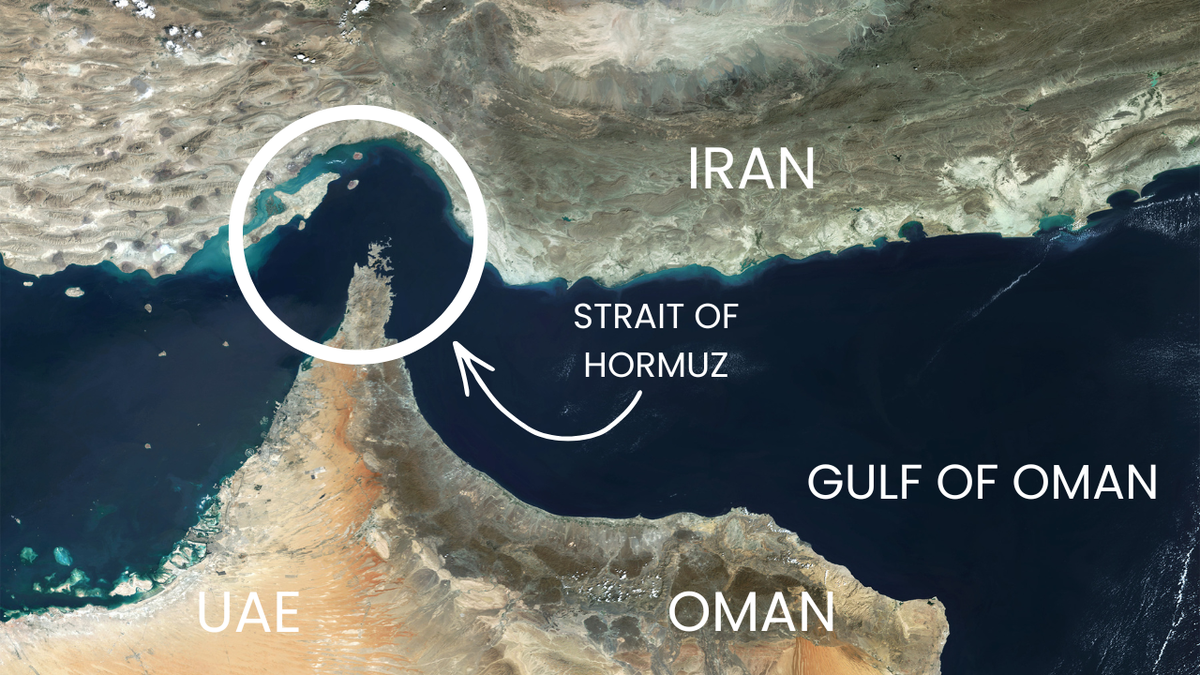
The bedrock of Iran’s current military dominance in the strait lies in its extensive preparations for an asymmetric conflict, a doctrine built on the principle of imposing unsustainable costs rather than achieving outright military victory. The core of this strategy involves a layered defense that combines thousands of sea mines, land-based anti-ship cruise missiles, one-way attack drones, and swarms of small, fast attack boats. Analysts estimate Iran possessed an arsenal of approximately 5,000 sea mines before the war, including sophisticated influence mines that are difficult to detect and clear, as well as a network of tunnels and caves along the coast designed to protect these assets from airstrikes . Iranian missile sites along the coastline have proven particularly resilient, recently requiring the U.S. to deploy 5,000-pound GBU-72 “bunker buster” deep penetrator munitions to target hardened anti-ship cruise missile positions that posed a direct threat to international shipping . This campaign against Iranian infrastructure has been extensive, with U.S. Central Command reporting over 7,000 targets struck, yet the strategic objective remains elusive . Middle East analyst Anatolii Maksymov explained the dynamic, stating, “The United States may be winning on the battlefield, but strategically Iran is winning. Tehran’s asymmetric strategy strikes several precisely defined pressure points that the United States entered the war with only a crudely drawn plan to address” .
The immediate military reality in the Strait of Hormuz is one of paralysis and extreme risk, where Iran dictates the terms of passage from a position of tactical disadvantage but strategic leverage. Even with much of its conventional navy damaged, the Islamic Revolutionary Guard Corps (IRGC) Navy has asserted de facto control, with its commander declaring that any ship must obtain permission from Iran to transit . The U.S. Navy has so far refused to provide escorted convoys for tankers, acknowledging that thin-hulled warships would be highly vulnerable to mines, drones, and missiles in a contested environment . The logistical and tactical challenges of a full-scale reopening are immense; clearing a potential minefield in the strait under active fire is an operation the U.S. Navy has not prioritized and would be exceptionally dangerous. Caitlin Talmadge, a political science professor at MIT, highlighted this vulnerability, writing, “Clearing mines is always slow and difficult; doing it during a full-blown war, while facing threats from land-based antiship cruise missiles, drones, and other Iranian naval assets, would be exceedingly dangerous” . The current situation has forced individual nations to seek separate accommodations; India, Turkey, France, and Italy have opened direct diplomatic channels with Tehran to secure safe passage for their vessels, a move that reflects a fracturing of the international coalition supporting the U.S. and a recognition of Iran’s immediate control over the waterway .
Beyond the physical blockade, Iran has expanded its asymmetric campaign to encompass a multi-domain battle, targeting the economic and digital infrastructure of its adversaries to amplify the pressure. The disruption to shipping has already inflicted severe economic damage on Gulf oil producers, with estimated losses reaching $15 billion in energy revenues, and economists project that if the strait remains closed for two months, the GDP of Qatar and Kuwait could shrink by 14 percent . Simultaneously, Iranian-linked hacking groups have executed a sophisticated cyber campaign, exploiting vulnerabilities in internet-connected infrastructure across the region. Attackers have compromised surveillance cameras in at least five Gulf countries to provide real-time targeting intelligence for missile strikes and have targeted desalination plants and AI data centers, blurring the lines between military and civilian infrastructure . Sergey Shykevich, a threat intelligence group manager at Check Point, described the scale of this operation, noting, “Starting Feb. 28 we saw a huge spike in targeting of major IP camera brands in Israel, five Gulf countries and Cyprus. When we mapped the activity, the countries targeted in the cyber operations matched the countries being hit by missiles in those same days” . This coordinated approach—using drones, missiles, mines, and cyber-attacks in concert—is designed to showcase Iran’s ability to project power and inflict pain far beyond its borders, exploiting what experts call the “mosaic” doctrine to ensure its command structure can survive and continue operations even after significant leadership losses .
Looking ahead, the military situation in the Strait of Hormuz appears locked in a stalemate that heavily favors Iran’s strategic objectives. The U.S. is reinforcing its presence, with the 31st Marine Expeditionary Unit, comprising 2,200 Marines and three amphibious assault ships, deploying to the region, signaling a potential preparation for more direct action to reopen the waterway . However, the prospect of a ground invasion to secure the Iranian coast remains a deeply unattractive option, described by experts as a potential quagmire requiring hundreds of thousands of troops. As Michael Eisenstadt of the Washington Institute observed, this is “asymmetric warfare par excellence, in which Iran achieves outsized, even global effects through a small number of attacks that impose painful costs” . With the new Iranian supreme leader, Mojtaba Khamenei, vowing to keep the strait closed as a “pressure tool” and the U.S. seeking an exit strategy, Tehran’s bet on its ability to endure longer than a far stronger enemy is being put to the test . The waterway remains a battleground where Iran, though outgunned, has successfully demonstrated that it holds the key to the global economy, leveraging geography and asymmetric strategy to dominate the strait militarily from a position of what it perceives as strategic strength.