
8 June 2026,
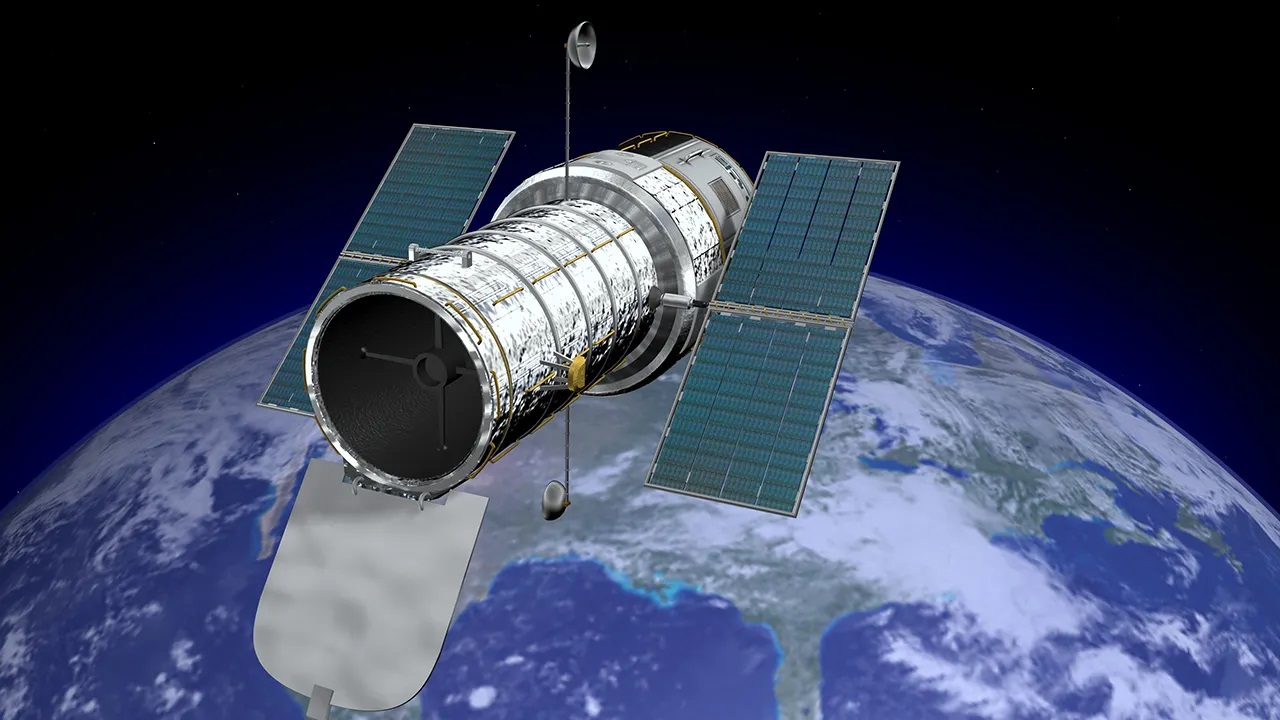
The iconic Hubble Space Telescope has entered a critical phase in its operational life, facing not only the physical threat of orbital decay but also a significant budget crisis that could curtail its scientific mission years before it burns up in the atmosphere. However, a new technological path may be opening. NASA has officially signaled that it is interested in performing a reboost of the Hubble Space Telescope—an operation to raise its altitude and delay its reentry—but only if the high costs of operating the observatory can be reduced simultaneously .
This stance was articulated by Shawn Domagal-Goldman, director of NASA’s astrophysics division, during a recent advisory committee meeting. The agency’s position comes as it prepares for a high-risk, $30 million mission later this month involving the Katalyst Space-built “Link” spacecraft, which will attempt to rendezvous with and reboost the Neil Gehrels Swift Observatory . “These reboost things are now not just available to us as an agency, but the costs are lower than I think I anticipated,” Domagal-Goldman explained, noting that this lower cost makes the return on investment for Hubble far more enticing . Yet he immediately pivoted to the central problem: “It was built in a different era, and it’s more costly to maintain and to get the best science out of it… We have to first figure out how we’re going to bring down the operations costs” .
The urgency for a physical reboost is underscored by the telescope’s steadily decaying orbit. In January 2026, scientists presented new models at the American Astronomical Society meeting, providing a clearer timeline for Hubble’s demise. The data revealed that the median reentry date for Hubble, if no action is taken, is 2033 . More alarmingly, the analysis indicates a roughly 10% chance that the telescope could reenter Earth’s atmosphere as early as 2029 .
This accelerated timeline is driven by higher-than-anticipated solar activity, which heats Earth’s atmosphere and causes it to expand, increasing drag on the telescope. “The solar flux levels are currently longer in duration and more elevated than previously anticipated, resulting in an earlier reentry forecast for the Hubble Space Telescope if no reboost mission is conducted,” stated the Hubble reentry tracker analysis . Currently operating at an altitude of approximately 326 miles (525 kilometers), down from its original 360 miles (579 kilometers), the telescope is caught in a death spiral. Once it descends to around 248 miles (400 kilometers), experts estimate it would have less than a year of life left .
While the orbital threat is imminent, the financial threat to Hubble’s productivity is already here. NASA spent $98.8 million on Hubble in fiscal year 2025, and budget projections show a dramatic reduction to just $64.7 million annually by fiscal years 2029 and 2030 . This represents a reduction of more than 40% from current operating costs . According to internal planning documents from the Space Telescope Science Institute (STScI), this funding cliff would result in a “severely reduced operational model” . The impact of these cuts would be catastrophic to research.
“No new grant awards in FY29-30,” the documents state, which would choke off the funding that supports the research of hundreds of astronomers worldwide who rely on Hubble data . Furthermore, the budget plan would require stopping science operations for several of Hubble’s key instrument modes, including the ACS/WFC, WFC3/IR, and STIS/CCD, effectively blinding the telescope to large portions of the ultraviolet and optical spectrum . “The under-guide budget would severely reduce Hubble’s scientific potential, impact, and productivity, as well as public impact and support,” the STScI analysis warns, noting that these cuts would “result in the end of Hubble as we know it” .
The juxtaposition of these two crises—a decaying orbit and shrinking budget—has created a unique policy dilemma. Technologically, a reboost is feasible. The Swift mission serves as a commercial proof-of-concept, and NASA has already studied a plan with SpaceX to use a Dragon capsule to raise Hubble’s orbit . However, raising the telescope’s altitude only extends its lifespan if there is money left to actually operate its instruments and pay the scientists who use them. Officials have suggested that if the operating costs can be streamlined, a reboosted Hubble could serve as a “nice bridge” to the Habitable Worlds Observatory (HWO) , NASA’s next flagship mission, which is not expected to launch until the 2040s .
Without Hubble to fill the gap, astronomers fear a crippling void in ultraviolet observations that no other current or planned telescope can fill. “Hubble’s unique UV capabilities will not be matched until HWO,” the STScI budget documentation emphasizes . As NASA moves forward with the critical Swift reboost test this month, the astronomy community watches closely. The success of that mission may prove the technical ability to save Hubble, but without a parallel financial rescue from Congress and NASA leadership to restore its science budget, the most famous telescope in history could still be forced into a premature retirement, not by a fiery crash, but by a slow starvation of the very funding needed to keep its eyes on the universe.