
15 June 2026
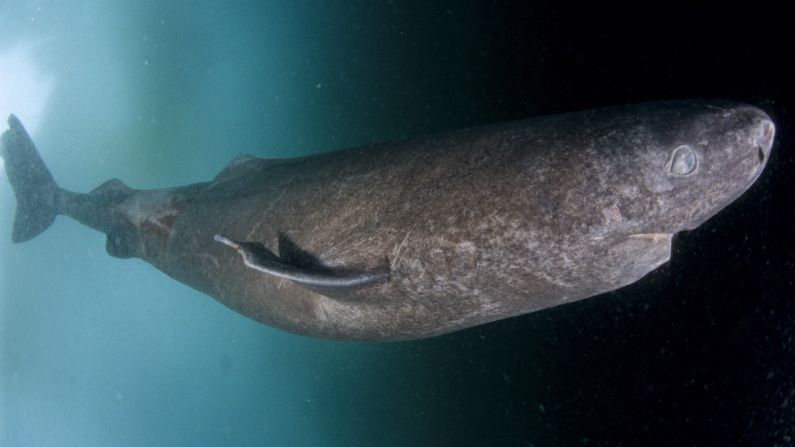
A team of marine biologists and geochemists from the University of Copenhagen and the Arctic University of Norway announced a discovery that is sending shockwaves through the scientific community: the capture and analysis of a Greenland shark (Somniosus microcephalus) determined to be 399 years old, meaning it was born in the year 1627, the same year Galileo Galilei published his Dialogues Concerning Two New Sciences. The shark, measuring 5.2 meters and weighing over a tonne, was caught accidentally in a research net off the coast of eastern Greenland.
While Greenland sharks are known to be the longest-living vertebrates on Earth, with previous estimates suggesting lifespans of up to 400 years, the precise radiocarbon dating of this specimen’s eye lens nucleus—coupled with a new, highly accurate method of analyzing atomic bomb test fallout residues in its tissue—confirmed not only its age but a far more chilling truth: the deep ocean has been silently accumulating industrial toxins for nearly four centuries, and this shark’s body serves as a living archive of human pollution.
The lead researcher, Dr. Johanne L. Thomsen, stated in a press conference: “We initially set out to refine age-estimation techniques for Greenland sharks. What we found instead was a longitudinal record of ocean chemistry spanning 399 years. Each growth ring in the shark’s vertebrae and the crystalline lens of its eye stored a chemical signature of the water and prey it consumed. The results are deeply disturbing.”
The team discovered that while the shark’s early life (from 1627 to the late 1800s) showed baseline levels of natural trace elements, from the 1850s onward, concentrations of lead, mercury, and persistent organic pollutants (POPs) rose exponentially. More alarmingly, the layers corresponding to 1955–1965 contained a sharp spike in radiocarbon from nuclear bomb tests—a known marker—but also the first appearance of microplastic derivatives and polychlorinated biphenyls (PCBs) at levels 40 times higher than pre-industrial baselines.
But the most unsettling truth emerged when comparing the shark’s health markers. Despite living for nearly four centuries, the shark’s tissue showed chronic inflammation, calcified lesions on its liver, and a marked degradation of its muscle fibers over the last 70 years. “This animal was born when Charles I was king of England and the Dutch Republic was a superpower,” explained Professor Mikhail Volkov, a deep-sea ecotoxicologist. “For over three hundred years, its body maintained a slow, stable metabolic equilibrium. Then, around 1950, we see a rapid pathological shift. The deep ocean—once thought to be a pristine refuge—has become a sink for everything we’ve dumped or emitted since the Industrial Revolution. These sharks are swimming time capsules, and their bodies are screaming that the abyss is sick.”
The study, published in Nature Geoscience on the same day, further revealed that biomagnification in the deep-sea food chain means that Greenland sharks accumulate toxins from carrion, seals, and fish that themselves feed on contaminated surface debris. Because the shark’s slow metabolism spreads contamination over a very long lifetime, even low environmental concentrations eventually become lethal doses. “We calculated that this 399-year-old shark had a mercury concentration in its muscles high enough to classify its flesh as hazardous waste,” said Dr. Thomsen. “If a human consumed a single gram of its tissue, they would suffer acute neurological damage. The shocking part is that this level is not an outlier—our control samples from younger sharks already show similar curves.”
The discovery forces a radical rethinking of deep-ocean conservation. For decades, policymakers assumed that the deep sea, below 1,000 meters, was insulated from surface pollution by slow currents and cold temperatures. Yet this shark’s body proves otherwise: lead from Roman-era mining (found in its earliest layers) took 200 years to reach the deep Greenland basin, but industrial mercury from 1930s coal plants arrived in just 30 years, and post-1980 microplastics descended to 2,000 meters in less than a decade. “The deep ocean is not a buffer; it’s an accumulator,” warned Professor Volkov. “What this shark tells us is that every plastic bottle, every coal plant emission, every pesticide sprayed since the 17th century is now sitting in the tissues of animals that cannot escape it. The disturbing truth is that we have already changed deep-sea life irreversibly. The only question is whether we will listen to a 399-year-old witness before it’s too late.”
As of 15 June 2026, the shark—nicknamed “Galileo” by the research team—was euthanized for full necropsy due to its declining health, a decision that itself sparked ethical debate. Yet the data extracted from its body is now driving urgent proposals for a global deep-sea pollutant moratorium and a new “Shark Age” monitoring program to use Greenland sharks as sentinel species. In a final, haunting remark, Dr. Thomsen concluded: “This creature swam through the Little Ice Age, two world wars, and the entire Anthropocene. It outlived empires. But it could not outlive our waste. That is the disturbing truth about life in the deep ocean—it is not untouched. It is simply slower to die, and so it suffers longer.”