June 21. 2026
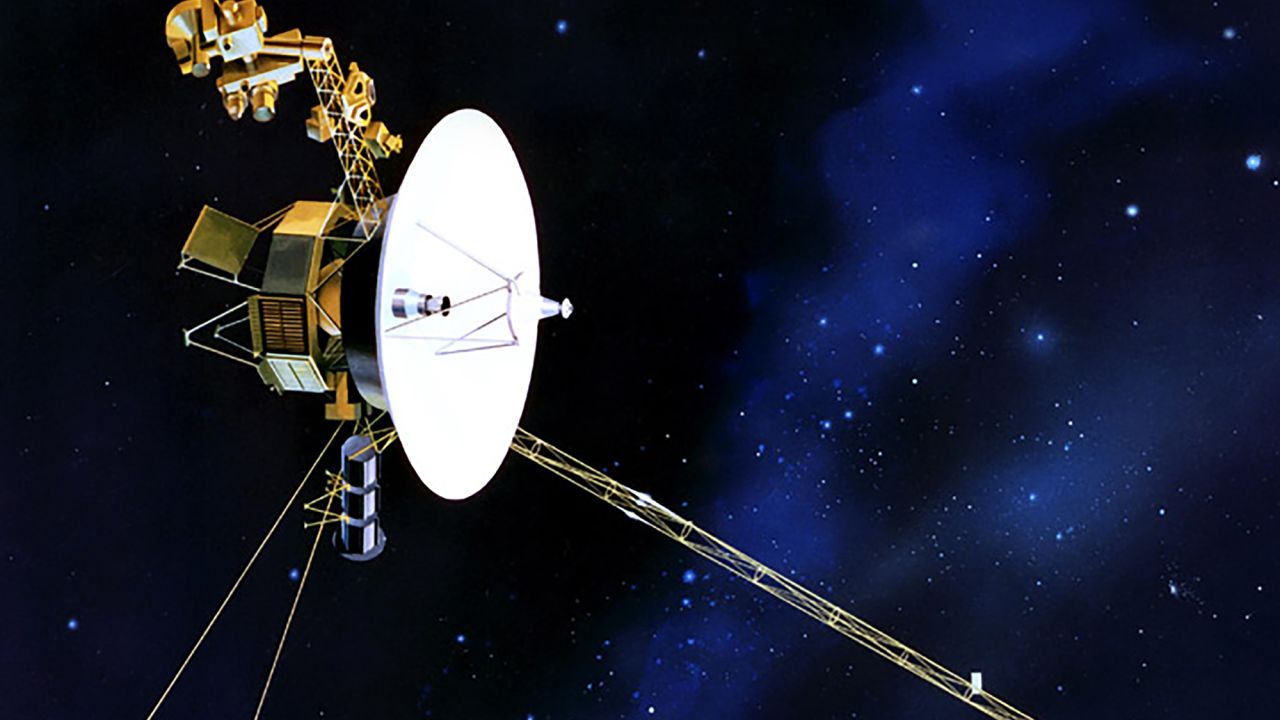
A faint signal from the edge of our solar system continues to reach Earth, a ghostly whisper from a machine built in an era of bell-bottoms and disco. This November, NASA’s Voyager 1 spacecraft is expected to reach a historic milestone, becoming the first human-made object to be a full “light-day” away from Earth. This staggering distance of approximately 26 billion kilometers means that a command radioed from our planet, traveling at the speed of light, now takes a full 24 hours to reach the probe, and another 24 hours for a response to be returned. Launched in 1977 alongside its twin, Voyager 2, on a mission originally slated to last just five years, the spacecraft has not only survived but thrived, transforming our understanding of the solar system and continuing to send back irreplaceable data from interstellar space.
The sheer longevity of the Voyager mission is a testament to extraordinary engineering and a series of fortunate cosmic events. The mission’s genesis can be traced to an aerospace engineer who identified a rare planetary alignment that would allow a single spacecraft to use the gravity of Jupiter, Saturn, Uranus, and Neptune to slingshot from one to the next. This “Grand Tour” became a reality thanks to the foresight of the original team, who built the spacecraft with a level of redundancy and durability far exceeding its official five-year mandate. The computers on Voyager 1 have roughly the same amount of memory as a modern car key fob, and yet they continue to execute complex commands from Earth.
Fran Bagenal, a planetary scientist who began working on the mission as a student in the late 1970s, reflected on this incredible feat: “Voyager 1’s computer was put together in the 1970s, and there are very few people around who still use those computing languages. The communication rate is 40 bits per second. Not megabits. Not kilobits. Forty bits per second. Moreover, the round-trip communication time is 45 hours. It’s amazing that they’re still communicating with it at all”.
What Voyager 1 achieved in its primary mission was nothing short of revolutionary, rewriting textbooks with each planetary flyby. As it journeyed through the outer solar system, it discovered active volcanoes erupting on Jupiter’s moon Io, the first evidence of ongoing geological activity on another celestial body. It sent back the first high-resolution images of intricate ring systems around Jupiter, Uranus, and Neptune, and captured lightning in the atmosphere of Jupiter. These observations painted a picture of a dynamic and violent solar system, a stark contrast to the static, barren worlds many scientists had previously imagined. While exploring Saturn, Voyager 1 also provided a detailed look at its moon Titan, revealing its nitrogen-rich atmosphere and dynamic clouds—a world shrouded in mystery that would later become the target of the dedicated Cassini-Huygens mission. However, one of its most profound contributions came not from a grand discovery, but from a quiet, introspective moment. In 1990, at the request of astronomer Carl Sagan, Voyager 1 turned its camera back toward Earth and captured a grainy image of our planet, a tiny “pale blue dot” suspended in a sunbeam. “Look again at that dot. That’s here. That’s home. That’s us,” Sagan wrote, a sentiment that continues to resonate, evoking a sense of awe and responsibility for our fragile world.
Since crossing the heliopause in 2012 and entering the vast, uncharted territory of interstellar space, Voyager 1’s mission has transformed into an even more existential endeavor. It is now the sentinel of humanity, sending back data that no other instrument can provide. Yet, maintaining this lonely outpost is an ongoing battle against the immense cold and the relentless decay of its power source. The spacecraft’s plutonium-powered generators are losing about four watts of power each year, forcing NASA’s engineers to make agonizing decisions to conserve energy. In February 2026, a sudden power drop triggered an automatic protection system, leading to the shut down of a key instrument.
To keep the spacecraft alive, mission engineers at the Jet Propulsion Laboratory (JPL) have had to turn off non-essential heaters and scientific instruments, navigating a complex “survival” battle where power is the most precious resource. One of the greatest threats is the cold; turning off a heater risks letting critical fuel lines freeze and rupture. “We’re trying to extend the spacecraft’s lifespan as long as possible to gather the final bits of information from interstellar space,” said Linda Spilker, the Voyager project scientist, who has been with the mission since its inception. “Every byte of data received at this moment holds invaluable historical value because no device has ever gone this far”.
To extend this unprecedented mission even further, NASA is planning a risky “Big Bang” activity for the Voyagers in 2026, which will involve reconfiguring how the spacecraft manage their thermal systems to save nearly 10 watts of power. This delicate, high-stakes operation could delay the need to shut down a science instrument by at least another year. These challenges are not deterring the team, which includes retirees in their 80s who still advise on specific subsystems, alongside a new generation of engineers who weren’t even born when the probes launched.
The goal is to keep both Voyager 1 and 2 operational for their 50th “birthdays” in 2027. Suzanne Dodd, the project manager, expressed both optimism and realism about the coming years: “We don’t know how long the mission will continue, but we can be sure that the spacecraft will provide even more scientific surprises as they travel farther away from the Earth. If we got really lucky, maybe doing some operating below some thresholds, we might be able to go out to the 2030s”. Even when its power finally fades and its instruments fall silent, Voyager 1 will continue its journey, a silent ambassador for humanity, carrying the golden record of Earth’s sounds, images, and greetings into the cosmic ocean, a testament to a time when we dared to reach for the stars and succeeded beyond all measure.