
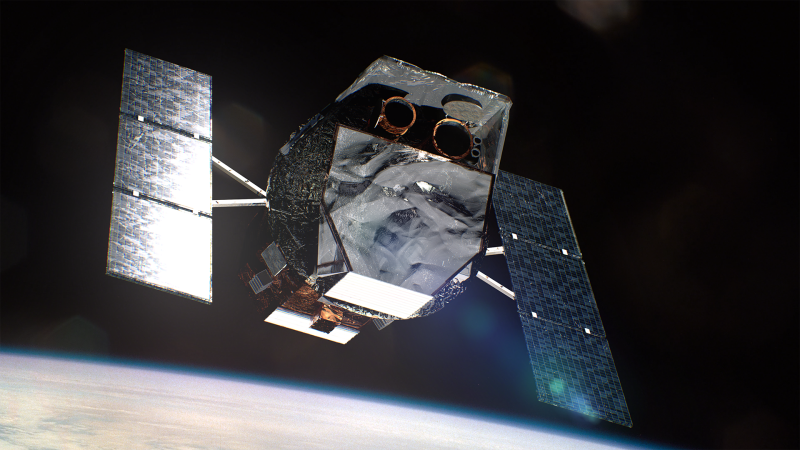
June 20, 2026, marks the culmination of an unprecedented, high-stakes race against time. Just nine months ago, the idea was dismissed by many as impossible: a daring mission to robotically capture and boost a falling space telescope. Yet, against all odds, NASA is on the verge of launching a first-of-its-kind rescue operation to save its prized Neil Gehrels Swift Observatory . “No one thought it was going to be possible,” admitted Shawn Domagal-Goldman, NASA’s Astrophysics Division director, reflecting on the sheer audacity of the plan . The 22-year-old Swift telescope, a vital sentinel for detecting the universe’s most powerful explosions, is plummeting back to Earth faster than anyone anticipated. Without intervention, it faces a fiery, uncontrolled reentry into the atmosphere before the year’s end .
The crisis began in 2024 when mission managers noticed the telescope’s orbit was decaying at an alarming rate . Launched in 2004 into a stable orbit 600 kilometers (about 370 miles) high, Swift had already exceeded its planned two-year mission by two decades . However, an unexpected and intense peak in the Sun’s 11-year magnetic activity cycle heated and expanded Earth’s upper atmosphere, creating significantly more drag on the spacecraft . This relentless drag pulled Swift down to a precarious altitude of just 370 kilometers (about 230 miles) . With no onboard propulsion system to counteract this decay, NASA’s original estimates that Swift could operate into the early 2030s were shattered. The new timeline was measured in months, not years . By February 2026, NASA was forced to suspend Swift’s science operations, placing it in a low-drag orientation to conserve its rapidly dwindling altitude . For astronomers who relied on its unique capabilities, the loss was immediate and painful, with dozens of crucial observations already being missed .
Faced with the prospect of losing a half-billion-dollar asset, NASA took the extraordinary step of abandoning its typical risk-averse, multi-year development cycles. In September 2025, the agency awarded a $30 million contract to Katalyst Space Technologies, a U.S. startup, with a seemingly impossible mandate: build a robotic rescue craft in under a year . Katalyst, known for its work in in-orbit repair and refueling, responded with a blistering pace. In just seven months, the company delivered the completed LINK spacecraft—a 400-kilogram, refrigerator-sized robot equipped with three robotic arms and advanced sensors designed for a task never before attempted . This breakneck speed was born of pure necessity; Katalyst’s principal investigator, Kieran Wilson, noted the singular requirement from NASA was to “launch before it’s too late” . With the spacecraft integrated onto its rocket, the mission’s very existence is a testament to human ingenuity and urgency .
The rescue plan itself is a masterclass in high-risk space engineering. The LINK spacecraft is scheduled to launch on June 27, 2026, aboard a Northrop Grumman Pegasus XL rocket, which will be air-launched from an aircraft over Kwajalein Atoll in the Pacific Ocean . This unusual launch profile was chosen to place LINK directly into Swift’s specific orbital plane, a feat that would be too costly from traditional launch sites . After launch, LINK will take a week or two to catch up to its target . The core challenge is that Swift was never designed to be serviced; it has no docking ports or grappling fixtures . To overcome this, LINK will use its advanced sensors to autonomously inspect Swift, mapping its condition in real-time—a critical step since no pre-launch images of the telescope’s “backside” exist for guidance . It will then attempt a non-cooperative docking, using its three robotic arms to clamp onto the small metal flanges on Swift’s main body, which were originally used only for ground handling before its launch over two decades ago .
If the capture is successful, LINK will begin a slow and meticulous process to push the telescope back to safety. Over more than six weeks, it will use its three Hall-effect ion thrusters to gradually raise Swift’s orbit back to its original 600-kilometer altitude . A successful mission would not only save Swift, adding years to its operational life, but it would also demonstrate a revolutionary new capability for extending the lives of other spacecraft . This could have profound implications for other aging observatories like the Hubble Space Telescope, whose orbit is also decaying . For NASA, it’s a monumental gamble on the future of commercial space services. As Domagal-Goldman stated, the agency’s ability to bureaucratically move this fast was as surprising as the engineering feat itself . The eyes of the scientific and space communities are now fixed on the Pacific, waiting to see if this daring, unprecedented gamble will pay off and rewrite the rules of spacecraft longevity .