June 27, 2026
India’s defense capabilities reached a significant milestone as the indigenous Airborne Early Warning and Control (AEW&C) system, Netra, was awarded Final Operational Clearance (FOC) by the Defence Research and Development Organisation (DRDO) . This final certification, which clears the system for full operational deployment, was formally handed over to the Indian Air Force (IAF) during a ceremony in Bengaluru on June 25 .
The event was presided over by the Deputy Chief of the Air Staff, Air Marshal Awadhesh Kumar Bharti, and attended by former IAF chief Air Chief Marshal RKS Bhadauria (Retd), former DRDO Chairman Dr. S. Christopher, and senior DRDO scientists including Dr. K. Rajalakshmi Menon, Director General of the Aeronautics Cluster, and Dr. B.K. Das, Director General of the Electronics Cluster . The clearance is the culmination of a long developmental journey that began decades ago and marks a pivotal moment for India’s goal of achieving self-reliance in critical aerospace and defense technologies .
The journey to this achievement can be traced back to 1983, when the Indian Air Force’s pursuit of an indigenous AEW&C system received partial approval under “Project Guardian” . A small team of scientists and IAF officers initiated studies on the HS-748 Avro aircraft, but the modern Netra program officially took shape in the early 2000s . The program gained significant momentum with government approval in 2004, and the Centre for Airborne Systems (CABS) in Bengaluru was designated the nodal laboratory for its development .
Three Embraer EMB-145 jets were procured from Brazil in 2008 to serve as the airborne platform for the sophisticated radar system being developed . After extensive development and testing, the first system was handed over to the IAF in 2017, receiving Initial Operational Clearance (IOC) that same year . The FOC, granted nearly a decade later, is the final stamp of approval that confirms the system’s full operational capability and combat readiness after years of rigorous user trials, system validation, and upgrades .
The Netra system’s value was not just theoretical but was proven in real-world operations. Air Marshal Awadhesh Kumar Bharti, in his address at the ceremony, highlighted the system’s proven operational reliability during the 2019 Balakot air strikes and, more recently, during Operation Sindoor, which ultimately paved the way for its final certification . This operational utilization demonstrated the system’s effectiveness as a force multiplier in modern, network-centric warfare . Functioning as an airborne command-and-control center, Netra is designed to monitor air activity over long distances, detect enemy aircraft and missiles in real-time, and provide tactical guidance to fighter aircraft, thereby significantly enhancing radar coverage and battlefield situational awareness . It is essentially a “Flying Eye” for the IAF, providing a comprehensive view of the airspace that is unattainable from ground-based radars . K. Rajalakshmi Menon, the DRDO scientist and director of CABS, captured the sentiment of the achievement, calling it “India’s pride, the Indian Air Force’s precious jewel, and every Indian’s dream” .
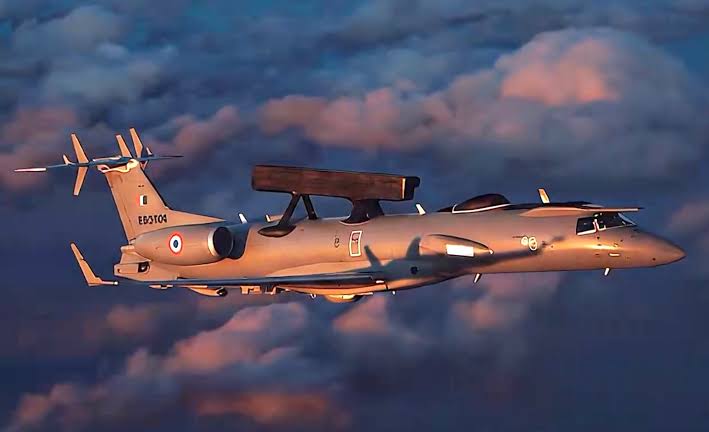
The Netra system is a technological marvel, built around an Embraer EMB-145 aircraft and equipped with an indigenous Active Electronically Scanned Array (AESA) radar housed in a dorsal radome . This powerful radar provides roughly 240-degree coverage with a detection range of up to 375 kilometers . The system’s effectiveness is augmented by electronic and communication intelligence systems, satellite communications, a self-protection suite, and beyond-line-of-sight datalinks, enabling it to detect hostile aircraft, cruise missiles, and other threats, and to fuse data from multiple sensors into a single, real-time air picture for commanders and fighter pilots .
While the Netra is an AEW&C platform and not a full-fledged, large AWACS like the Israeli Phalcon systems, its successful development and deployment are a testament to India’s growing technical prowess . The FOC is seen as a major boost to India’s defense self-reliance, and the government has already cleared the development of 12 advanced variants, including Netra Mk-1A and Mk-2 systems, to further strengthen the IAF’s aerial surveillance capabilities, which are still well short of the required 18 platforms for a two-front war scenario . The successful induction of the Netra system, as Defence Minister Rajnath Singh noted, marks a technological milestone and significantly strengthens India’s airborne surveillance and command-and-control capabilities .