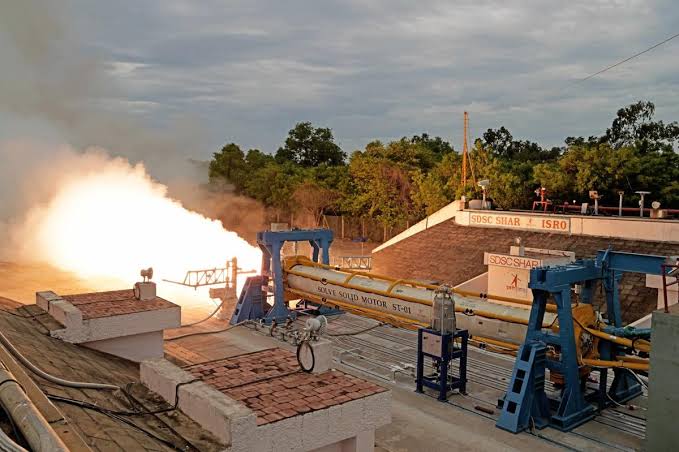
In a significant step toward realizing India’s first human spaceflight mission, Gaganyaan, the Indian Space Research Organisation (ISRO) successfully conducted the first ground test of a new solid motor on July 3, 2026. This crucial test, conducted at the Static Test Facility at the Satish Dhawan Space Centre (SDSC) in Sriharikota, validated the motor that will power a newly developed experimental launch vehicle known as SOLVE . SOLVE stands for Sub-Orbital Launch Vehicle for Experiments and is being designed as a dedicated, flexible test platform to rigorously evaluate the complex parachute-based deceleration system of the Gaganyaan crew module. The space agency confirmed that during the trial, all key performance parameters of the motor were met as expected, marking a major milestone in qualifying the systems that will ensure the safe return of Indian astronauts from space .
The SOLVE vehicle is a sub-orbital test rocket specifically developed to carry out Integrated Parachute Tests, which are vital for the Gaganyaan mission’s success. During these test flights, the SOLVE rocket will carry the Gaganyaan crew module to a simulated altitude of between 10 and 17 kilometers before separating it in flight . After separation, a carefully orchestrated sequence of ten parachutes will deploy to progressively decelerate the module, ensuring a controlled, low-velocity splashdown in the sea . This entire process is designed to closely replicate the critical descent and recovery phase of an actual crewed mission, allowing ISRO engineers to validate the deceleration system’s performance under diverse flight conditions without the cost and complexity of a full orbital launch. The primary objective of these tests is to certify the recovery system as foolproof, as any malfunction during the descent phase could pose a significant risk to the lives of astronauts .
To meet the specific requirements of the Gaganyaan mission, the SOLVE rocket’s solid stage is derived from the proven, reliable strap-on motor used in ISRO’s workhorse Polar Satellite Launch Vehicle (PSLV) but has been modified with several key advancements . These modifications include the development of a slow burn-rate propellant to achieve the desired sub-orbital flight profile, the integration of a straight nozzle, and the incorporation of a secondary injection thrust vector control system to ensure precise steering and stability during the test flight . By creating this new test platform, ISRO gains the flexibility to conduct numerous test missions, simulating a wide range of scenarios that an actual crew module might encounter during its return to Earth.
This approach is a crucial part of the agency’s strategy to methodically and safely test critical technologies, building on other successful qualification tests like the Integrated Air Drop Tests (IADT) that were conducted in the previous year . The Gaganyaan mission is a landmark project for India, aiming to demonstrate indigenous human spaceflight capability by launching a crew of up to three members into a 400 km orbit for a three-day mission and returning them safely to Indian sea waters, a feat that would make India the fourth nation to achieve such a milestone .