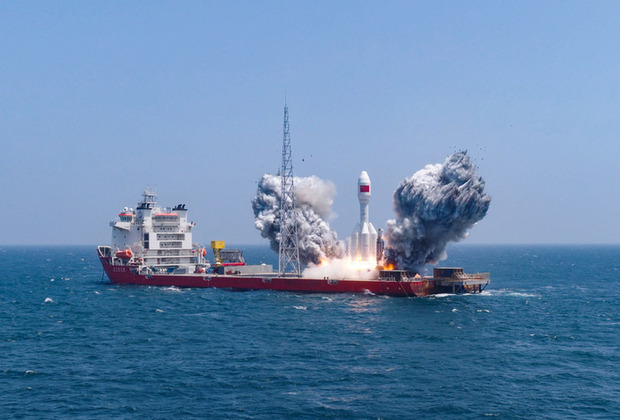
On July 22, 2026, China achieved a significant milestone in its commercial space endeavors with the successful launch of the Gravity-1 rocket from the East China Sea, marking the country’s first far-sea launch by a private company . The mission, conducted under the direction of the Taiyuan Satellite Launch Center, saw the 30-meter-tall rocket lift off at 10:54 a.m. Beijing Time from a launch vessel off the coast of Shanghai, ultimately placing nine satellites and one experimental device into their designated orbits . This event, which was the third flight of the Gravity-1 vehicle, is a major step forward for China’s private aerospace sector and its pursuit of flexible, efficient, and safe space launch capabilities .
The Gravity-1 rocket, developed by the private Chinese company OrienSpace, is a technological powerhouse . It is a three-stage solid-propellant rocket augmented by four side boosters, making it the world’s largest and most powerful solid-propellant launch vehicle currently in operation, surpassing the European Space Agency’s Vega-C in lift-off weight and thrust . With a liftoff weight of 405 metric tons and a thrust of 600 tons, it can deliver up to 6.5 tonnes of payload to low-Earth orbit (LEO) or 4.2 tonnes to a 500-kilometer sun-synchronous orbit . This capability, combined with its large payload fairing, makes it particularly suited for multi-satellite deployment missions, a key requirement for building large-scale satellite constellations .
The mission’s significance extends beyond its payload capacity, as it demonstrates China’s growing ability to conduct complex operations from the sea. Moving the launch platform approximately 170 kilometers off the coast into the open sea presented unique challenges compared to previous launches that took place just kilometers from land . The development team had to contend with rough sea conditions, including waves and strong winds, which could affect the stability of the 405-tonne rocket . To mitigate these risks, engineers prepared a multi-layered protection system, which included coordinating with weather satellites to forecast conditions, equipping the vessel with real-time weather monitoring gear, and establishing sheltered ports along the route for emergency shelter. This successful demonstration of the rocket’s extended standby capability and adaptability to complex offshore conditions is critical for reliable far-sea launches in the future .
The advantages of sea-based launches are numerous and were a key driver for this mission . Primary among them is safety, as the rocket’s trajectory and debris fall zone remain over the ocean, minimizing risk to populated areas and overland assets. This is complemented by efficiency; unlike land-based launches that must alter their trajectory to avoid cities and airspace, a sea launch can follow a direct path to the optimal orbit, conserving energy and maximizing payload capacity. Furthermore, sea launches offer unparalleled orbital flexibility. The launch point can be selected almost freely based on the specific requirements of the spacecraft, allowing for the deployment of satellites into a wider variety of orbits . This mission was a vital step in perfecting China’s coordinated sea-launch network and establishing a diversified, flexible launch infrastructure that is not constrained by fixed geographic locations .
The payloads onboard the Gravity-1 rocket were as diverse as they were technologically advanced, destined to support a range of applications from Earth observation to cutting-edge artificial intelligence. The nine satellites included the Dongpo-13, Dongpo-14, and Dongpo-17 to Dongpo-20, which form part of the Dongpo series . This constellation consists of two optical satellites and four synthetic aperture radar (SAR) satellites designed to work together. Once operational, they will join four previously deployed Dongpo satellites, significantly enhancing data collection efficiency and expanding observation range for vital applications such as land mapping, disaster response, agriculture, forestry, and water resource management, particularly in southwestern China .
Another notable payload was the Xiguang-201 satellite, which represents a leap forward in integrating artificial intelligence with space technology . Developed as the first AI computing satellite of its kind, it incorporates hyperspectral remote sensing with on-board intelligent data processing. This allows the satellite to independently collect, process, and make decisions directly in space, a significant departure from traditional methods that require transmitting all raw data to ground stations for analysis. This capability promises to dramatically shorten response times for Earth observation services in fields like mineral exploration, environmental monitoring, and urban planning . The Tianyi-49 satellite, also on board, will complement these efforts with its own quantitative remote sensing and AI-powered services .
Finally, the Lilac-3 satellite was included to conduct in-orbit technology tests for an ultra-thin satellite platform that integrates structural and thermal control functions, along with next-generation attitude control technologies . By successfully deploying this varied payload, the mission not only expanded China’s orbital infrastructure but also provided a crucial testbed for future satellite technologies. The launch also set a new national record for the combined payload weight delivered into orbit by a Chinese private rocket, highlighting the growing maturity and capability of the country’s commercial space sector . With Gravity-1 transitioning from testing to regular commercial operations and the development of a larger liquid-propellant rocket, Gravity-2, already underway, this mission firmly establishes sea-based launches as a cornerstone of China’s ambitious space program .