
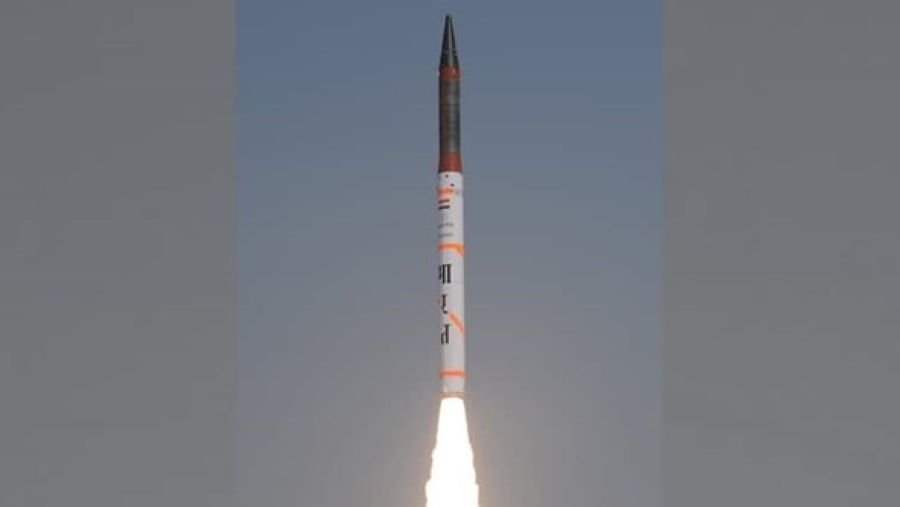
In a major validation of India’s strategic deterrence and defense readiness, the Strategic Forces Command (SFC) successfully conducted a routine user flight-trial of the nuclear-capable Agni-4 medium-range ballistic missile (MRBM) off the coast of Odisha at Chandipur. Developed natively by the Defence Research and Development Organisation (DRDO), the two-stage solid-fueled missile has solidified its position as a cornerstone of India’s land-based strategic force. By bridging the critical operational gap between medium-range ballistic missiles (MRBMs) and intercontinental ballistic missiles (ICBMs), the system provides New Delhi with a highly credible, versatile nuclear deterrent specifically tailored to address regional security dynamics, particularly along the northern frontier with China.
The strategic significance of the 4,000-kilometer operational range lies in its geographical coverage. While shorter-range systems like the Agni-1 (1,000 km) and Agni-2 (2,000 km) are primarily calibrated toward deterrence along the western border, the Agni-4 extends deep into mainland China, bringing major industrial, economic, and military centers—including key hubs along China’s eastern seaboard—within striking range when deployed from northeastern locations in India. Positioned precisely between the 2,000-km Agni-Prime / Agni-2 class and the 5,000+ km Agni-5 ICBM, the Agni-4 fills a vital tier in India’s layered nuclear force structure, ensuring that New Delhi maintains flexible, flexible, and proportional response options under its established No-First-Use (NFU) nuclear doctrine.
Beyond its extended reach, the Agni-4 represents a massive technological leap over earlier variants in the Agni series. Measuring approximately 20 meters in length and weighing around 17 tonnes, the missile incorporates lighter composite rocket motors, significantly optimizing its payload-to-weight ratio. It is capable of carrying a 1-tonne payload comprising either conventional explosives or strategic nuclear warheads. Its advanced guidance architecture features an indigenously developed Ring Laser Gyro-based Inertial Navigation System (RLG-INS) coupled with a Micro Inertial Navigation System (MINGS) and high-speed digital flight controllers. This redundancy ensures an exceptionally high degree of accuracy with a Circular Error Probable (CEP) of less than 100 meters, even at maximum operational range.
Survivability and operational flexibility are further amplified by the missile’s road-mobile launch platform. Deployed via 8×8 Transporter Erector Launchers (TEL) and rail-mobile systems, the Agni-4 can be rapidly dispersed, camouflaged, and relocated across vast terrains. Unlike fixed-silo launch systems that remain vulnerable to satellite detection and preemptive target mapping, mobile launchers make it nearly impossible for adversaries to track or neutralize the platform prior to launch. Combined with its advanced thermal re-entry shield, which enables onboard avionics to survive re-entry temperatures exceeding 3,000 °C to 4,000 °C, the missile offers unmatched reliability during all phases of flight.
Furthermore, DRDO engineers have incorporated specialized design features to significantly reduce radar cross-section (RCS) and optical signatures, enhancing the missile’s ability to penetrate sophisticated Anti-Ballistic Missile (ABM) defence systems. The success of recent user trials conducted directly by military personnel—rather than development engineers—underscores the operational maturity, routine readiness, and maintenance standard of India’s strategic assets. As missile race dynamics intensify across Asia, the demonstrated reliability of the Agni-4 reasserts the robust, survivable, and second-strike capability of India’s land-based strategic force, bolstering regional stability through unshakeable deterrence.