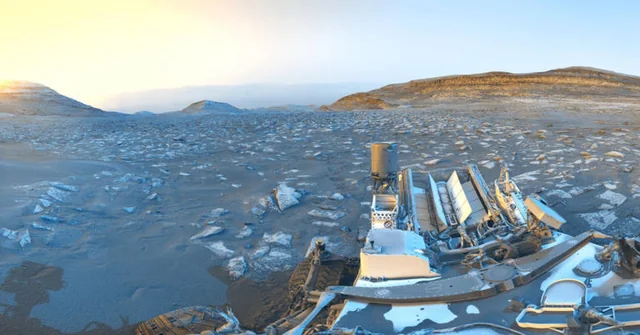
NASA has released a series of panoramic images from the Curiosity rover that reveal, for the first time in a “postcard” format, the complete daily cycle of light and shadow on Mars from morning to dusk. These images are not single snapshots but rather composites stitched together from black-and-white photographs taken at the same location at different times of day, then artistically colorized to highlight the dramatic differences in lighting and terrain detail across a Martian day.
The core concept behind this “A Day on Mars” panorama series is capturing two distinctly different lighting periods on Mars: morning and afternoon. For example, one famous “postcard” released earlier was taken on April 8, 2023, recording scenes at 9:20 a.m. and 3:40 p.m. local time respectively. In a subsequent release, to celebrate the Curiosity rover’s 5,000th Martian day (sol) on the planet, the team produced a new version with images taken at 9:56 a.m. on August 30, 2026, and 5:39 p.m. on September 2, 2026. Because dust levels in the Martian atmosphere are at their lowest during the winter season, shadows captured during this time are sharper and deeper than in summer, adding a theatrical, stage-lit quality and strong three-dimensionality to the images.
The colors in these panoramas are a deliberate “artistic interpretation” used to convey temporal information. All raw images were captured by Curiosity’s black-and-white navigation cameras, with each single panorama requiring about 7.5 minutes to shoot and consisting of 5 individual photographs, which are then stitched together after being transmitted back to Earth. In the final composite images, the sections representing morning are tinted blue, while those representing afternoon or evening are colored yellow or with warm tones. NASA engineers explained that this approach helps different details stand out more clearly in the landscape, much like how morning and afternoon views look distinctly different in a national park on Earth.
The images contain a wealth of geographical and mission-related information about Mars. Visible in the frame are components of the Curiosity rover itself, including its three antennas, its nuclear power source (a radioisotope thermoelectric generator), and the Radiation Assessment Detector used to protect future astronauts from radiation. The rover’s tracks trailing behind it point toward a winding region known as the “Marker Band Valley,” where Curiosity discovered unexpected evidence of an ancient lake. Further in the distance, Mount Sharp (Aeolis Mons) can be seen, the peak that Curiosity is currently climbing, standing about 5 kilometers tall within Gale Crater. Because the Martian atmosphere is so clear, the images can even capture mountain silhouettes approximately 87 kilometers away, beyond the rim of Gale Crater.
The latest panorama release also marks an important milestone for the Curiosity mission. The September 2026 images were produced specifically to commemorate the rover’s 5,000th Martian day on the planet, at which point it was parked on a sandy ridge called “Chocolatal.” Since landing in Gale Crater in 2012, Curiosity has been operating continuously for more than 13 years, far exceeding its original design lifespan. It is currently exploring the lower slopes of Mount Sharp, studying the sulfate-rich rock layers in the region to piece together Mars’s history of transition from a wet, habitable environment to the cold, arid planet it is today. By analyzing the chemical composition, textures, and mineral veins of rocks, Curiosity continues to provide scientists with crucial clues about ancient water activity and the potential habitability of Mars.