In a bold stride toward redefining deep-space exploration, NASA has officially announced its plan to launch a first-of-its-kind nuclear-powered spacecraft to Mars in late 2028. This ambitious mission, named Space Reactor-1 (SR-1) Freedom, will serve as the interplanetary transport for a secondary but equally groundbreaking project called SkyFall, which will deploy three small, autonomous helicopters to the Martian surface to scout for future human landing sites and search for subsurface water ice.
The entire endeavor is a cornerstone of NASA’s new exploration strategy, aiming to prove that nuclear electric propulsion (NEP) is a viable and essential technology for the next era of space travel, enabling humanity to operate farther, longer, and more effectively beyond low Earth orbit. By leveraging existing hardware and focusing on a practical, pathfinding approach, NASA Administrator Jared Isaacman has described this as a “70 percent solution” designed to break a decades-long cycle of unfulfilled concepts and finally establish an operational space nuclear reactor.
Central to this mission is the SR-1 Freedom spacecraft, which represents a paradigm shift in how we propel probes through the solar system. Unlike traditional chemical rockets or solar-powered craft, SR-1 Freedom will be propelled by a nuclear fission reactor generating 20 kilowatts of electrical power using High-Assay Low-Enriched Uranium (HALEU). This reactor, developed in partnership with the Department of Energy, will be situated at one end of a long truss to shield other spacecraft electronics from its radiation. At the opposite end, the spacecraft will incorporate the Power and Propulsion Element (PPE) – a component originally designed for the now-cancelled lunar Gateway – which will be adapted to use the reactor’s power for highly efficient electric thrusters.
This closed Brayton cycle system converts heat into electricity to ionize a propellant like xenon, providing a slow but steady thrust that can eventually accelerate a spacecraft to greater speeds than chemical rockets, potentially reducing future travel times to Mars and beyond. The estimated cost for the SR-1 Freedom is approximately $2.1 billion, and NASA has emphasized that the design will be shared openly with industry, ensuring no single entity holds proprietary rights and that the technology can benefit future commercial and governmental missions.
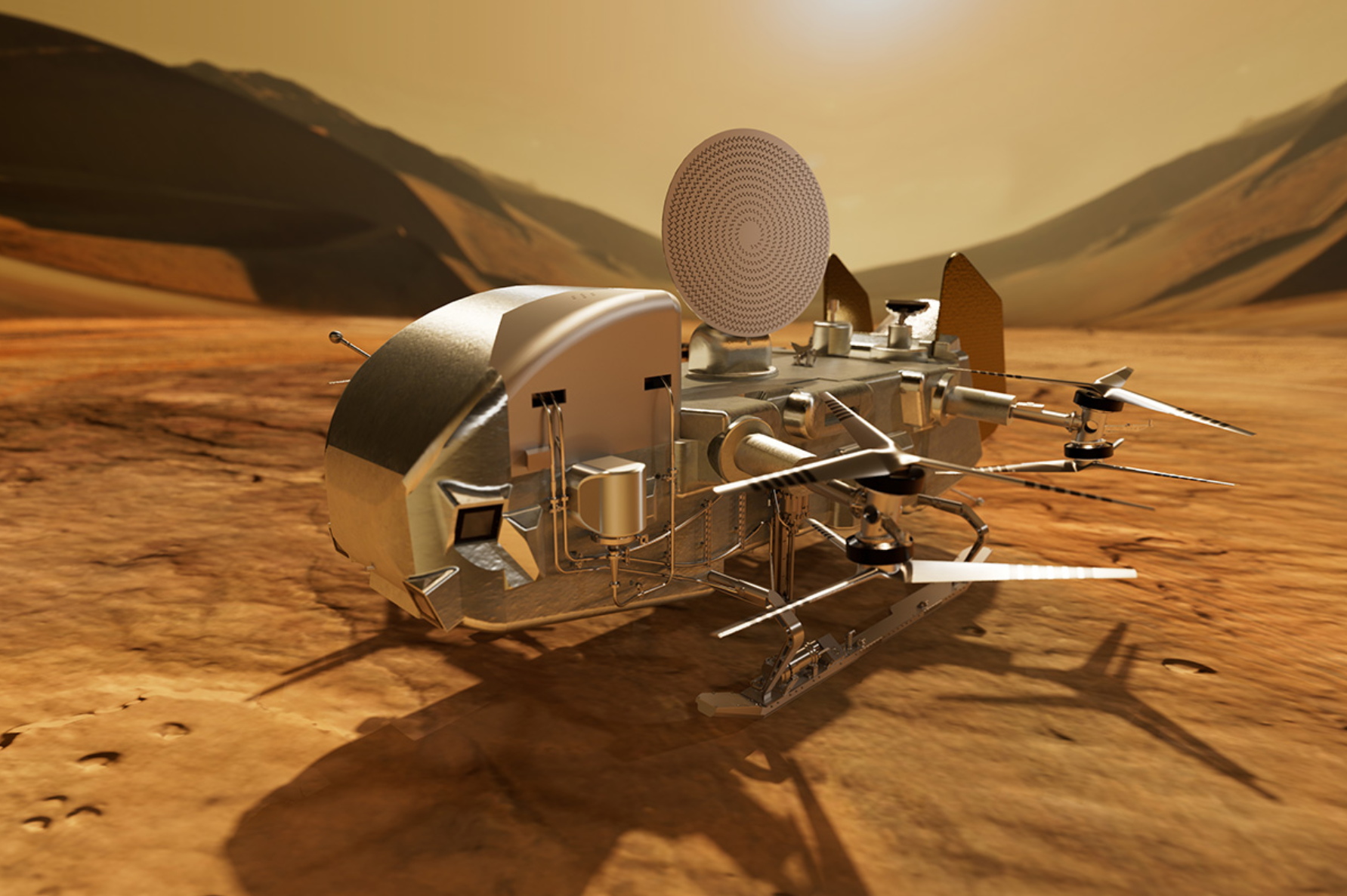
After a year-long cruise, SR-1 Freedom is scheduled to arrive at Mars and execute the innovative SkyFall maneuver to deploy its payload. This novel technique will see the spacecraft release the three helicopters directly into the thin Martian atmosphere, where they will separate, deploy their rotors, and descend to a powered landing autonomously, eliminating the need for a costly and complex lander stage or rover to act as a base station. The helicopters are being built by AeroVironment in partnership with NASA’s Jet Propulsion Laboratory (JPL), drawing directly on the legacy of the groundbreaking Ingenuity helicopter, which completed 72 historic flights on Mars.
While Ingenuity was a technology demonstrator, the SkyFall helicopters are full-fledged science missions, equipped with a suite of instruments designed to perform crucial reconnaissance. AeroVironment is leading the production of key components, including the rotor systems, airframes, and avionics integration, while JPL is developing the power systems, electronics, and flight software. Each helicopter will be equipped with a JPL-designed ground-penetrating radar to map the shallow subsurface, as well as cameras and other instruments to collect data on the Martian atmosphere and environmental processes.
The primary mission objective for these aerial scouts is to conduct a high-value scientific survey to support NASA’s long-term vision for human exploration. The helicopters will use their instruments to scout potential future human landing sites, providing critical data on terrain slopes, hazards, and topographical features necessary for the safe landing of larger, human-scale landers. More importantly, they will focus on identifying and characterizing subsurface water ice deposits, a resource of paramount importance for future astronauts, as it can be used for drinking water, oxygen production, and even as a component for rocket fuel.
The SkyFall mission is a clear example of how NASA is pivoting from simple scientific discovery to active site preparation for its crewed Mars goals, helping to build the “transcontinental railroad of the Solar System,” as described by program executive Steve Sinacore. While this approach has generated some discussion within the planetary science community, with some scientists concerned that it might divert resources from other established scientific priorities, the mission’s focus on reconnaissance for human exploration signals a major strategic shift in the agency’s Mars program. The ultimate fate of SR-1 Freedom after deploying the helicopters is still under consideration, with options including entering orbit around Mars or continuing on a journey deeper into the solar system to further test the nuclear propulsion system.