
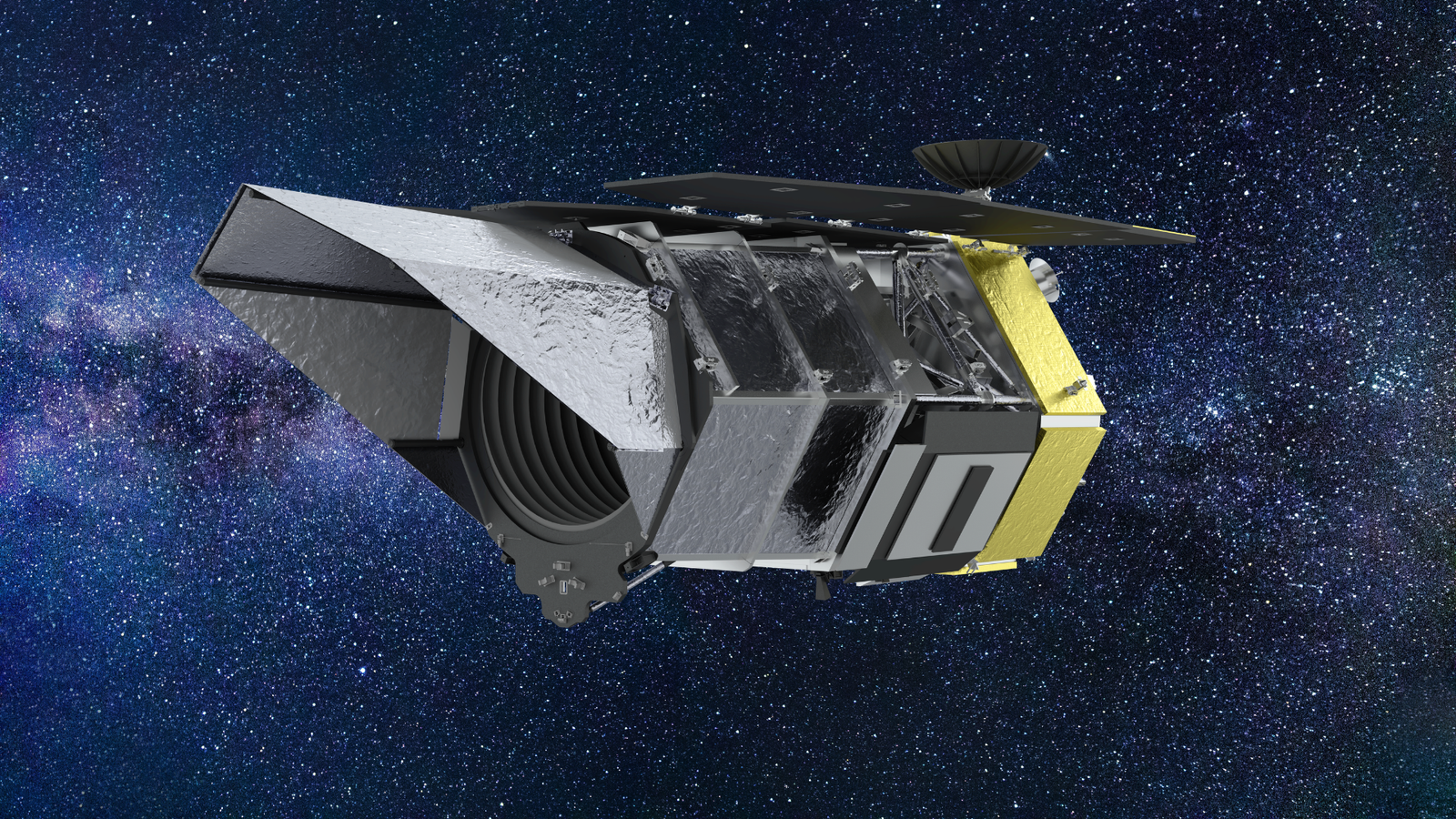
In late September 2026, NASA officially selected the PRobe far-Infrared Mission for Astrophysics (PRIMA) as the inaugural mission for its brand-new Probe Explorers astrophysics program. This milestone selection establishes a fresh class of space missions designed to bridge the gap between lower-cost small explorer missions and multi-billion-dollar flagship observatories. PRIMA has now progressed into Phase B preliminary design and technology development, with the mission’s total cost capped at $1.2 billion (excluding launch and operating overheads). Targeted for a launch in 2033 and a baseline 5-year primary operational mission, PRIMA will provide an unprecedented window into the heavily obscured, dust-shrouded history of the cosmos.
At the heart of the observatory is a 1.8-meter (5.9-foot) primary telescope specifically optimized for far-infrared wavelengths spanning roughly 24 to 261 microns. While observatories like the James Webb Space Telescope (JWST) peer deeply into the near- and mid-infrared spectrum, PRIMA is designed to capture longer far-infrared waves that easily pass through dense clouds of cosmic dust. To detect these subtle infrared signals without interference from the spacecraft’s own heat, the entire optical assembly and payload will be cryogenically cooled down to 4.5 Kelvin (-451.6°F). This extraordinary level of cooling allows its instruments to operate with a level of sensitivity orders of magnitude higher than previous far-infrared observatories, such as ESA’s Herschel Space Observatory.
The primary scientific goals of PRIMA center on understanding the lifecycle of dust, gas, stars, and planets, as well as the co-evolution of supermassive black holes with their host galaxies across cosmic time. Infrared radiation carries nearly half of all cosmic light ever emitted, yet much of it remains unmapped at high resolution. By observing the far-infrared cosmos, PRIMA will trace how heavy elements and interstellar dust built up in early galaxies. Furthermore, by measuring cold molecular gas reservoirs, the mission will uncover the precise mechanisms that trigger or halt star formation in the universe. Scientists also intend to use PRIMA to study planet-forming disks surrounding nearby young stars, tracing the abundance of water ice and complex organic compounds to shed light on how planet-forming environments—including early Earth—received their water and life-enabling ingredients.
PRIMA’s scientific suite relies on state-of-the-art instruments developed through broad national and international collaborations. NASA’s Jet Propulsion Laboratory (JPL) will lead overall mission management in partnership with the Goddard Space Flight Center and Marshall Space Flight Center. Advanced spectroscopic capabilities will allow astronomers to record line spectra across vast swaths of the distant universe simultaneously, providing direct measurements of elemental abundances and gravitational movements. The mission also features strong global collaboration, integrating major contributions from international space institutions including the UK Space Agency, France’s CNES, Italy’s ASI, Germany’s DLR, the Canadian Space Agency (CSA), Korea’s KASI and KASA, and Japan’s JAXA.
By operating in the 2030s alongside current and upcoming flagships like JWST and the Nancy Grace Roman Space Telescope, PRIMA will complete a crucial missing piece of humanity’s multi-wavelength view of the universe. Its broad survey power and unmatched far-infrared sensitivity ensure that astronomers can systematically strip away the thick cosmic dust masking the most crucial phases of cosmic history.