
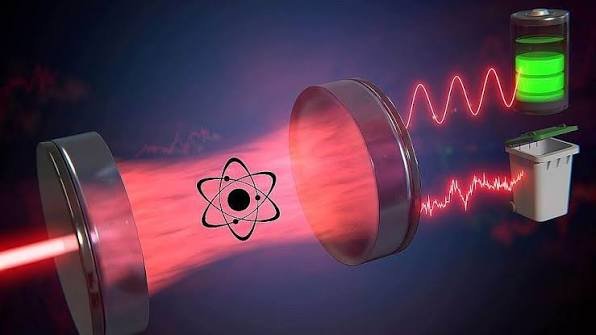
Recent breakthroughs in the field of physics have led to a remarkable paradigm shift in how scientists understand energy conversion at the absolute smallest scales. Researchers investigating the nuances of quantum thermodynamics have discovered that a one-atom quantum engine can effectively turn what was traditionally classified as “waste” light into useful energy. This discovery challenges centuries-old assumptions inherited from the macroscopic age of steam engines, forcing physicists to rethink the fundamental boundaries between heat, work, and dissipation. As modern technology rapidly miniaturizes, understanding energy flows in microscopic machines has transitioned from a theoretical curiosity into an essential requirement for building the next generation of efficient quantum devices. At the heart of this revolution is a radical re-evaluation of what happens when energy leaks out of an ultra-small system, proving that what engineers once wrote off as completely lost can actually be harnessed to perform productive tasks elsewhere.
To appreciate the significance of this discovery, it is necessary to examine the astonishingly minimal physical setup designed by physicists. The system under investigation centers around a single atom positioned precisely inside an optical cavity bounded by partially reflecting mirrors. Into this microscopic chamber, a continuous laser beam pumps energy in the form of light. Within the cavity, individual photons interact directly with the trapped atom, being continuously absorbed and re-emitted in a continuous cycle. Because light constantly enters the system and simultaneously leaks out through the semi-transparent mirrors at a steady rate, this setup forms what physicists define as a driven-dissipative open quantum system. In ordinary terms, it functions continuously as a miniature heat engine, drawing energy from an external source and perpetually exchanging it with its surrounding environment. However, because its core components operate entirely under the laws of quantum mechanics, classical macroscopic rules fail to accurately track where every individual unit of energy goes, setting the stage for a deeper investigation into quantum energetics.
For generations, classical thermodynamics has operated under a strict and intuitive rule: whenever energy escapes or leaks from a working machine, it is automatically labeled as waste heat. In macroscopic engines, such as internal combustion engines or steam turbines, escaping thermal energy is disordered, random, and fundamentally unrecoverable for any further mechanical utility. When researchers first began studying quantum-scale engines, they naturally applied this same conventional assumption, treating any photons that managed to slip past the optical cavity mirrors as lost dissipation. However, the unique laws governing the subatomic world make this traditional classification deeply flawed. Quantum mechanics introduces a level of subtlety and coherence that completely alters how energy can be stored and transferred. The recent research demonstrates that the label “heat” is frequently misapplied to quantum systems, because the energy leaving the machine is not necessarily as disordered or useless as macroscopic physics dictates.
The key realization behind this discovery is that escaping light can retain usable properties, including a coherent component capable of performing work. When photons leak out of the optical cavity, they do not simply vanish into random thermal noise; instead, a portion of that exiting radiation preserves structural information and phase coherence. If this coherent light is directed toward another adjacent quantum device, its energy can be successfully transferred to drive subsequent processes. This means that a significant fraction of what standard thermodynamic accounting would automatically dismiss as waste heat is actually hidden work waiting to be utilized. By recognizing that the output light holds a functional resource rather than pure dissipation, scientists can completely recalculate the efficiency metrics of nanoscale thermal machines, unlocking performance levels that conventional physics previously deemed impossible.
Developing a robust mathematical model to capture this phenomenon required overcoming significant theoretical hurdles, particularly regarding the transition between microscopic and macroscopic descriptions. Physicists needed a framework that functions accurately when the entire system is treated strictly through quantum mechanics, while also behaving sensibly in the semi-classical limit. In this hybrid description, the trapped atom continues to obey discrete quantum energy levels, whereas the electromagnetic field can be treated more like a classical wave. Achieving this consistency was vital because classical physics must emerge naturally from quantum mechanics under the right physical conditions. By carefully defining how the system behaves across these different regimes, researchers successfully established a reliable mathematical method to differentiate between disordered heat and usable work without creating internal contradictions. This theoretical bridge ensures that the laws of thermodynamics remain universally valid while accurately accounting for the quirky realities of quantum fluctuations.
The implications of this discovery extend far beyond basic theoretical physics, offering profound practical benefits for the maturation of quantum technologies. As processors, sensors, and communication networks shrink down to the atomic and molecular scales, managing thermal management and energy dissipation becomes one of the greatest engineering bottlenecks. Uncontrolled energy leaks can introduce noise, degrade quantum coherence, and cause device failures. By learning how to capture and repurpose escaping light rather than treating it as an unavoidable nuisance, engineers can design next-generation quantum engines and thermal machines with unprecedented energy efficiency. Furthermore, this capability opens up exciting possibilities for recycling energy within complex quantum networks, where the output of one nanoscale component serves as the input power source for another. Ultimately, this milestone study proves that at the quantum level, nothing is truly wasted if one has the theoretical tools and ingenuity to see the hidden utility within the light.