
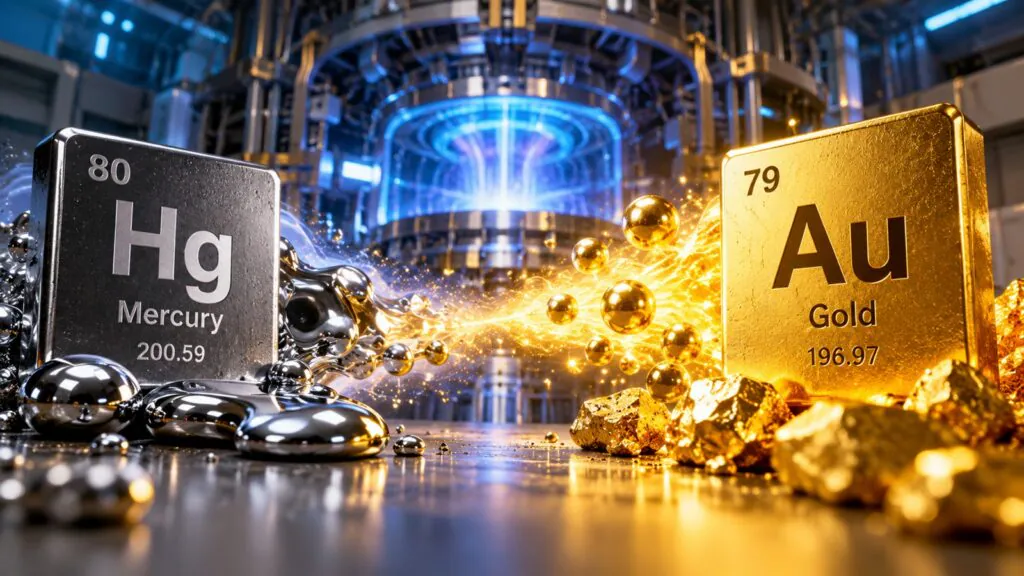
In October 2026, a San Francisco-based deep-tech startup named Marathon Fusion generated global headlines by announcing that it had successfully achieved modern-day alchemy. The company revealed that it converted liquid mercury into real, stable gold atoms using advanced nuclear physics techniques. While the dream of transmuting base metals into gold dates back thousands of years to ancient alchemists, modern science has long recognized that changing one element into another requires altering the fundamental structure of an atom’s nucleus. Marathon Fusion claims to have overcome previous technological barriers, demonstrating a high-rate nuclear transmutation process that yielded a production rate 10 times higher than the previous record established by researchers at CERN in 2025.
To understand how the technology works, it helps to look at the underlying atomic structures of mercury and gold. Gold consists of a single proton-stable isotope, gold-197, which contains 79 protons in its nucleus. Mercury sits directly adjacent to gold on the periodic table with an atomic number of 80 protons. Rather than attempting to “smash” heavy particles together in massive particle accelerators—a method historically used by organizations like CERN that yielded only microscopic, unstable fractions of gold—Marathon Fusion utilized a neutron-driven transmutation mechanism originating from nuclear fusion reactions.
In Marathon Fusion’s process, target liquid mercury enriched with the isotope mercury-198 is subjected to intense neutron bombardment generated by a high-density plasma fusion reactor. When a mercury-198 nucleus absorbs a neutron, it acts as a neutron multiplier and briefly transforms into mercury-197, an unstable, radioactive isotope. Because mercury-197 is unstable, it undergoes a natural decay process known as electron capture. During electron capture, an inner atomic electron is absorbed by a proton in the nucleus, converting that proton into a neutron and emitting a neutrino along with characteristic gamma-ray radiation. By losing one proton, the atomic number decreases from 80 to 79, transforming the mercury atom directly into stable gold-197. The company provided gamma-ray spectroscopy measurements to prove the presence and decay of mercury-197 into pure gold-197 following reactor irradiation.
While transforming mercury into gold sounds like a science-fiction gimmick, Marathon Fusion’s broader goal is actually rooted in the commercial economics of nuclear fusion energy. One of the primary engineering hurdles facing future commercial fusion power plants is maintaining tritium self-sufficiency and funding the immense capital costs of running plasma reactors. Marathon Fusion engineered its neutron-multiplying mercury blanket to sit around the fusion core. This design allows the plant to simultaneously generate electricity, breed fusion fuel cycle isotopes, and yield tons of valuable precious metals as an automatic secondary byproduct. According to company projections, producing gold as a co-product could more than double the annual revenue of a gigawatt-scale fusion power plant without sacrificing energy output or reactor performance.
Despite the enthusiasm surrounding the announcement, scientists and industry experts urge caution regarding near-term market impacts. Marathon Fusion has not publicly disclosed the exact total weight of the gold produced in its recent proof-of-concept demonstration, and the findings have not yet gone through comprehensive independent peer review. Furthermore, scaling nuclear alchemy into a commercially profitable enterprise presents steep engineering challenges. Handling liquid mercury inside intense radiation zones requires extreme safety protocols, heavy radiation shielding, and costly isotopic separation processes to ensure that no residual radioactive isotopes remain mixed with the synthesized gold. Consequently, while laboratory-grown gold represents a landmark step forward in modern nuclear engineering, it will remain an experimental industrial milestone rather than a commercial source of jewelry or bullion in the immediate future.