
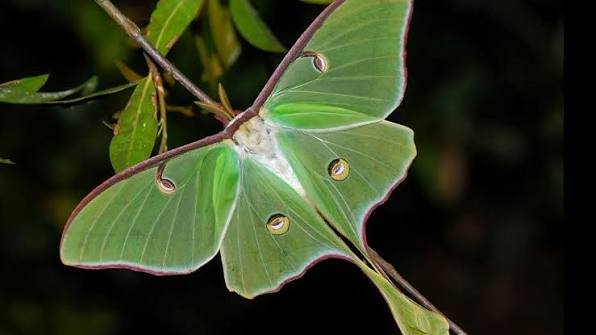
The Indian luna moth (Actias selene), a spectacular pale-green giant of the night, is disappearing from the eastern forests of India, and this decline is occurring with little public awareness or scientific oversight. These magnificent insects, with their 90 to 120 mm wingspan and long, trailing tails that can confuse the echolocation of bats, are not just beautiful, but their dwindling numbers signal a profound degradation of their forest habitats. The moth exists in a state of ‘conservation silence,’ lacking any dedicated population monitoring programme, a baseline count, or systematic field surveys to measure its decline. This lack of data is a critical problem, as by the time its absence becomes obvious, the ecological data needed to understand why it vanished will likely have never been collected.
The crisis for the Indian luna moth is driven by a confluence of human-induced pressures. The primary threat is the widespread loss and fragmentation of its forest habitat in northeastern India, with states like Nagaland, Meghalaya, Assam, and Sikkim being key areas. Unabated deforestation for agriculture, infrastructure development, and jhum cultivation is shrinking the continuous canopy these moths require. Light pollution from expanding towns and road networks represents a second, often overlooked, threat. As nocturnal insects, luna moths rely on natural light gradients to navigate and find mates, and artificial light severely disrupts this crucial process. Compounding these issues is illegal collection; the moth’s striking appearance makes it a target for the international specimen trade. Although protected under Schedule II of India’s Wildlife Protection Act of 1972, enforcement is inconsistent, and illegal trade persists via online channels.
Adding to these pressures is the species’ own biological vulnerability, which leaves it with little resilience against environmental change. The adult Indian luna moth does not eat, possessing vestigial mouthparts that are fused shut. Its sole purpose is to reproduce within a fleeting adult lifespan of just four to seven days, relying entirely on the energy reserves accumulated during its caterpillar stage. This makes its survival highly precarious. A bad year for caterpillars, due to host plant loss or pesticide use, directly translates into a diminished adult population the following season, with no long-lived adults to act as a buffer. The species’ reliance on specific host plants, including Rhododendron, Ziziphus, and Terminalia, turns this dietary specialisation from a strength in stable forests into a major liability in a fragmented landscape.
This neglect is part of a broader global pattern where invertebrate conservation receives a fraction of the funding and public attention dedicated to charismatic megafauna like tigers and elephants. In India, despite its protected status and its role as a wild silk moth with potential for commercial sericulture, Actias selene has no dedicated population study. A functioning Indian luna moth population serves as a vital indicator species; its presence signals a healthy forest with an intact canopy, abundant host trees, and low light pollution. Its disappearance is not just a loss of a single species but a clear warning that the intricate web of life in the eastern forests is fraying, and the alarm is going unheard.