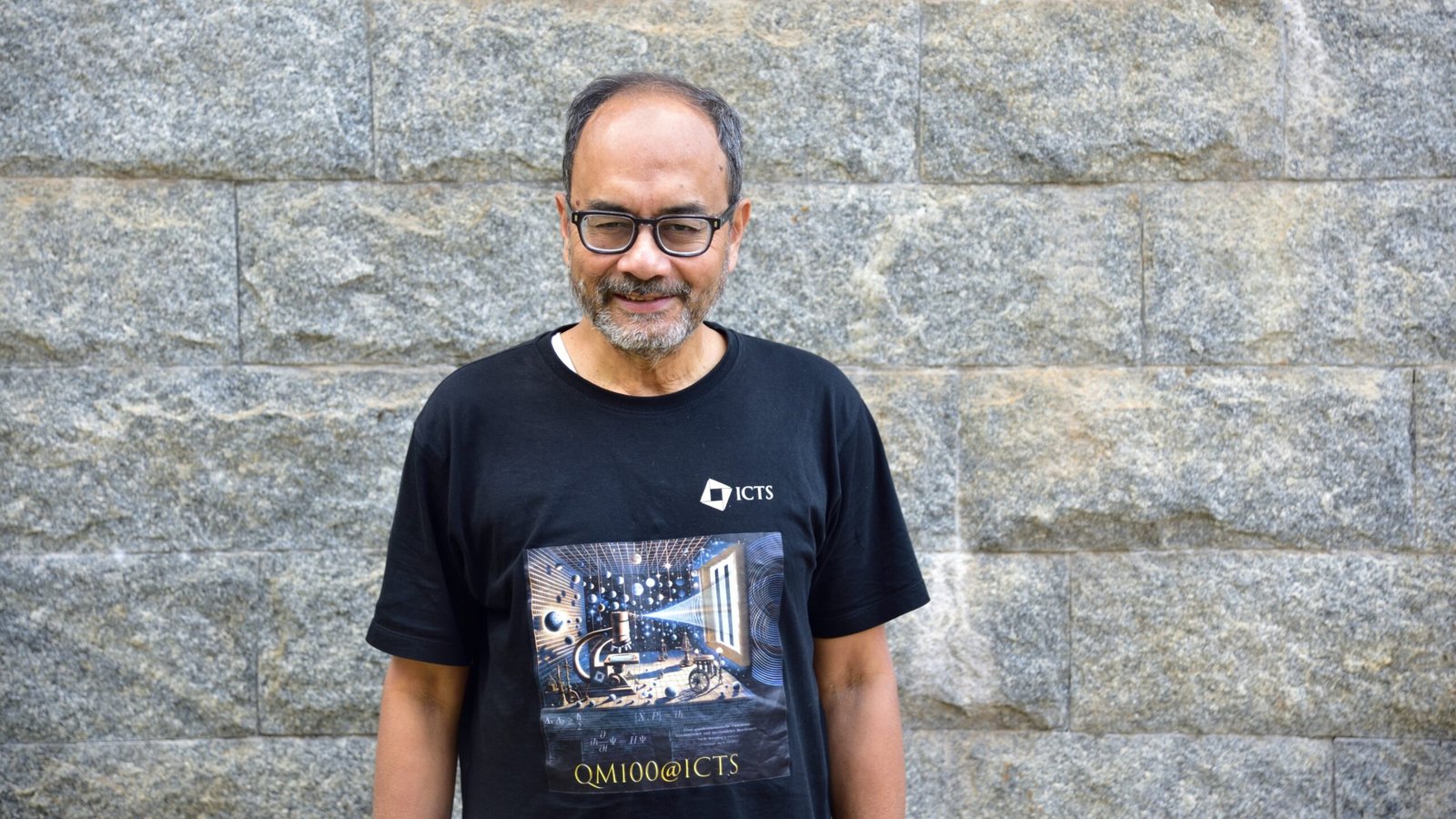
The landscape of Indian science reached a monumental milestone when renowned theoretical physicist Professor Ashoke Sen was awarded the prestigious Oskar Klein Medal for 2026. Jointly conferred by Stockholm University and the Nobel Committee for Physics of the Royal Swedish Academy of Sciences, this high-profile international award makes Professor Sen the first Indian physicist to ever receive the esteemed honor. Established in 1988, the Oskar Klein Medal is presented annually to scientists who have made distinguished contributions to theoretical physics, placing Professor Sen in an elite cohort of past laureates that includes legendary Nobel laureates such as Stephen Hawking, Peter Higgs, Chen-Ning Yang, Steven Weinberg, and Hans Bethe. This achievement highlights a prolific career spanning over four decades, during which Professor Sen has dedicated himself to untangling some of the deepest and most complex questions concerning the fundamental laws of nature, string theory, and the universe.
The international recognition primarily honors Professor Sen’s pioneering contributions to string theory, a revolutionary framework that attempts to replace point-like subatomic particles with tiny, vibrating one-dimensional strings to unify quantum mechanics and general relativity. Among his many profound theoretical breakthroughs, his work on S-duality stands out as a monumental pillar. S-duality describes a remarkable mathematical relationship where a physical theory under strong coupling conditions behaves identically and can be equivalently mapped to another description under weak coupling conditions. This profound duality allows physicists to solve complex, otherwise intractable calculations by shifting perspectives, effectively bridging gaps between seemingly unrelated string theories and providing crucial insights into the underlying mathematical symmetry of nature.
In addition to his breakthroughs in duality, Professor Sen has made monumental advancements in the physics of black holes, particularly regarding black hole entropy and microstate counting. Black holes represent some of the most extreme and challenging gravitational environments in the universe, and understanding their thermodynamic properties is essential for a complete theory of quantum gravity. Professor Sen made groundbreaking strides by developing the entropy function formalism for extremal black holes and applying the attractor mechanism, which successfully enabled the precision counting of black hole microstates in string theory. By demonstrating how microscopic states account for macroscopic black hole entropy, his research bridged a critical gap between quantum mechanics and gravity, deepening humanity’s understanding of the quantum nature of spacetime and black hole physics.
Furthermore, Professor Sen’s extensive work on string field theory has added immense value to the theoretical physics community. String field theory provides a comprehensive framework to describe the dynamics and interactions of strings using advanced concepts adapted from conventional quantum field theory. His formulations and deep analytical investigations have refined the mathematical structures of string theories, clarifying how different formulations connect with one another and expanding the toolkit available to theoretical physicists. As part of receiving the 2026 medal, Professor Sen delivered the prestigious Oskar Klein Memorial Lecture, titled “Gravity from Strings and Strings from Gravity,” at Stockholm University’s AlbaNova Centre, sharing his profound insights with global peers and students.
Professor Sen’s academic journey reflects a life devoted to rigorous scientific inquiry. Born in Kolkata in 1956, he completed his undergraduate studies at Presidency College, Kolkata, where he drew inspiration from legendary physicists like Amal Kumar Raychaudhuri, before earning his master’s degree from IIT Kanpur in 1976 and pursuing his doctoral studies at Stony Brook University in the United States. Over the years, his exceptional contributions have earned him numerous accolades, including the Padma Shri in 2001, the Padma Bhushan in 2013, the inaugural Breakthrough Prize in Fundamental Physics in 2012, and the Dirac Medal in 2014. He is also a esteemed Fellow of the Royal Society and serves as the Infosys-Madhava Chair Professor at the International Centre for Theoretical Sciences (ICTS) in Bengaluru.
The conferral of the Oskar Klein Medal on Professor Sen is a historic moment of immense pride for India’s scientific community, as highlighted by congratulatory notes from the Office of the Principal Scientific Adviser to the Government of India. While foundational research in string theory may not yield immediate commercial applications, it expands the outer boundaries of human knowledge, shapes modern mathematical methods, and elevates India’s standing on the global scientific stage. By breaking barriers and earning one of physics’ most elite international honors, Professor Ashoke Sen continues to inspire generations of researchers while cementing his legacy as one of the defining theoretical physicists of our era.