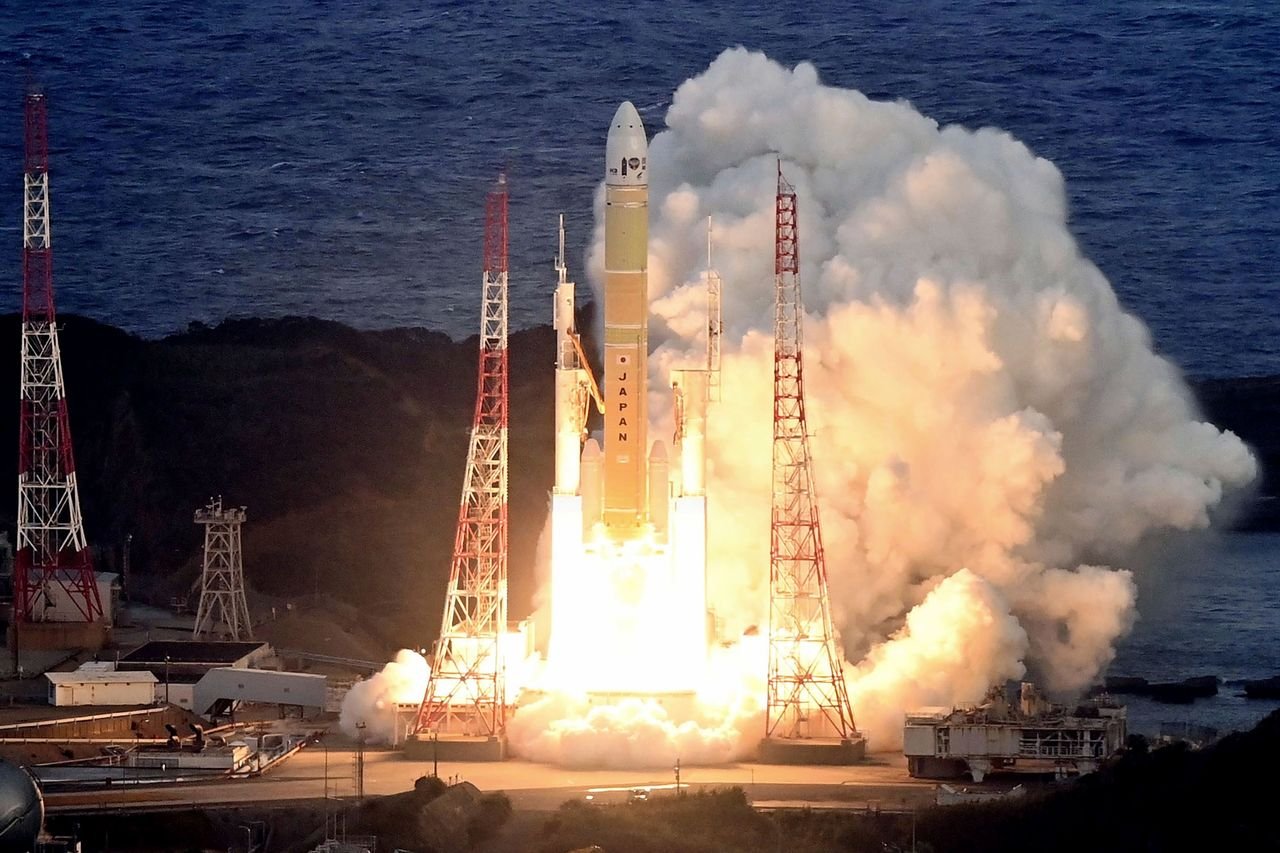
Japan’s Martian Moons eXploration (MMX) mission, spearheaded by the Japan Aerospace Exploration Agency (JAXA) in collaboration with international partners including France’s CNES and Germany’s DLR, successfully lifted off from the Tanegashima Space Center aboard an H3 launch vehicle. The ambitious deep-space enterprise is engineered to solve one of planetary science’s most enduring mysteries: the origin of Mars’ two natural satellites, Phobos and Deimos. For decades, scientists have fiercely debated whether these potato-shaped moons are captured asteroids originating from the outer asteroid belt or native accretion disks formed from debris blasted into orbit by a massive impact on the Martian surface. By embarking on a historic five-year round trip to the Martian system, the MMX mission aims to settle this debate definitively while pioneering advanced technologies for future interplanetary travel.
The core objective of the MMX mission is to execute a world-first sample-return operation from the Martian sphere. After a roughly one-year interplanetary cruise, the spacecraft is scheduled to enter orbit around Mars in August 2027 before transitioning into a stable quasi-satellite orbit (QSO) around Phobos. From this vantage point, the probe will conduct extensive remote-sensing observations, mapping the global topography, internal structure, gravity field, and mineral composition of the larger moon. A standout feature of the exploration phase is the deployment of the French-German Idefix rover, a lightweight, 25-kilogram robotic vehicle designed to navigate the moon’s extremely low-gravity environment. Operating on the surface, Idefix will analyze local soil textures and physical characteristics, serving as an advanced scout to help ground teams select a safe, optimal landing zone for the main spacecraft.
Following the rover’s reconnaissance, the main MMX spacecraft will perform two landing operations to collect regolith. Using a specialized pneumatic sampling system, the probe intends to harvest at least 10 grams of loose dust, soil, and rock fragments from a depth of up to two centimeters beneath the surface of Phobos. Because Phobos is heavily exposed to space impacts, scientists believe its regolith may also harbor traces of ancient Martian meteorites—ejected rocks from early Mars when the planet still possessed liquid water and potentially habitable environments. Analyzing these pristine samples in terrestrial laboratories will yield invaluable context regarding the geological evolution, atmospheric loss, and volatile transport history of the entire Martian system.
Beyond its primary focus on Phobos, the spacecraft will execute a series of close flybys of Deimos, Mars’ smaller outer moon, to broaden the scope of comparative planetary data. In 2030, the spacecraft will ignite its main engines to depart the Martian sphere, setting a course back toward Earth. The mission will culminate in 2031 when the Sample Return Capsule separates and plunges into Earth’s atmosphere, parachuting down for a targeted recovery in the Australian desert. Ultimately, MMX represents a massive technological leap for humanity, validating critical techniques for deep-space round-trip navigation, precision landing on low-gravity bodies, and complex extraterrestrial sampling that will pave the way for future human and robotic exploration of Mars.