
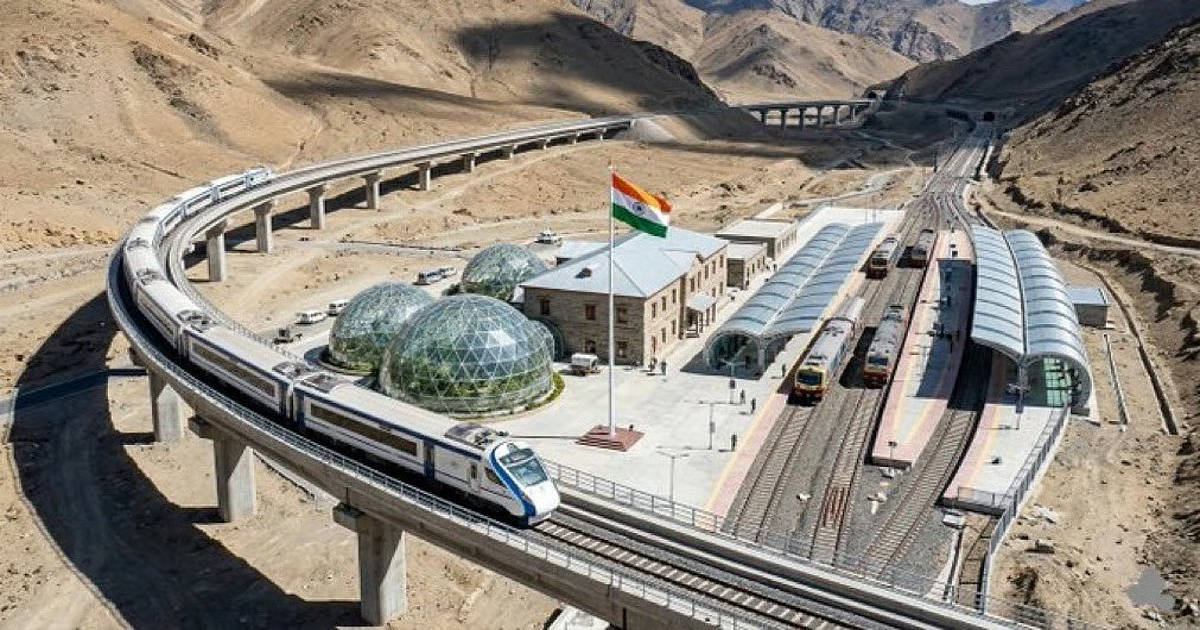
In an unprecedented leap forward for high-altitude infrastructure, India is planning an ambitious ₹1.31 lakh crore railway project that will connect Bilaspur in Himachal Pradesh to Leh in Ladakh. Spanning a massive 489 kilometers, this engineering marvel is designed to feature a station at an astounding altitude of 17,244 feet (approx. 5,256 meters) above sea level beneath the rugged Tanglang La mountain pass. Once completed, this milestone will comfortably surpass China’s Tanggula railway station—currently holding the record at 16,627 feet—to establish India as home to the world’s highest railway station.
The sheer scale of the Bilaspur-Manali-Leh railway corridor highlights the immense complexity of carving modern rail networks through the fragile and towering Himalayan terrain. According to the Detailed Project Report (DPR) prepared by the Ministry of Railways, approximately 270 kilometers of the 489-kilometer route will pass through tunnels. This means that more than half of the entire railway track will run completely underground, safely navigating treacherous topography, extreme weather events, steep mountain gradients, and delicate geological formations. Additionally, the route is planned to feature an innovative underground railway station at Keylong in the Lahaul-Spiti district, further demonstrating pioneering subterranean engineering.
Beyond its civil engineering triumphs, the project carries monumental strategic importance for India’s national defense. The Ministry of Defence has designated the line as a vital strategic corridor to transform logistical capabilities along the northern frontier. Presently, civilian travel and military supply lines to Leh heavily rely on road networks and air transport, both of which face severe disruptions during heavy winter snowfalls and harsh weather blocks. A heavy-capacity broad-gauge railway system will guarantee all-weather, uninterrupted connectivity, facilitating rapid deployment of troops, heavy weaponry, essential provisions, and heavy machinery to sensitive border zones.
The economic and social footprint of the project is expected to match its geographic scale, profoundly transforming regional trade, commerce, and tourism across Himachal Pradesh and Ladakh. By connecting towns such as Sundernagar, Mandi, Manali, Sissu, Darcha, Keylong, Sarchu, Pang, and Upshi, the railway will seamlessly integrate remote Himalayan communities into the national mainstream. Local apple growers, artisans, and tourism operators will gain cheap, year-round access to nationwide markets, replacing expensive and weather-vulnerable road transport with a high-volume freight network.
While the survey work and final Detailed Project Report (DPR) have been successfully completed by the Railway Ministry, the mega-project is currently awaiting final construction approvals and funding allocations. Overcoming severe land acquisition hurdles, fragile environmental ecosystems, and extreme financial requirements will demand meticulous planning. If greenlit and brought to fruition, the Bilaspur-Manali-Leh railway line will not only shatter global altitude records but also stand as a definitive testament to modern engineering prowess, permanently rewriting the map of global mountain rail transport.