
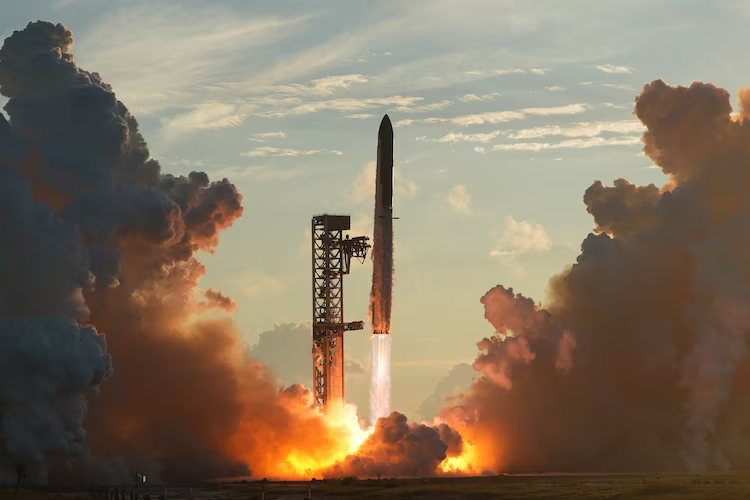
SpaceX’s upcoming Starship Flight 15 test launch marks one of the most ambitious and technically demanding milestones in modern spaceflight history. Elon Musk’s massive aerospace enterprise is preparing to launch the world’s largest and most powerful orbital rocket system from its Starbase facility in Boca Chica, Texas. The mission is targeted for November 14 (Indian Standard Time early morning window), pending final regulatory clearance. What makes this flight particularly captivating for global observers is that the giant upper-stage Starship will spend more than 22 hours orbiting Earth, completing approximately 14 full orbits. During these orbits, the spacecraft’s ground track will take it directly over parts of India multiple times, presenting a rare, spectacular spectacle for skywatchers and space enthusiasts across the Indian subcontinent.
The primary technical goal that turns Flight 15 into Starship’s toughest launch to date is SpaceX’s attempt at an unprecedented double-stage recovery. Never before in spaceflight history has a launch provider attempted to recover both the primary booster and the orbital upper stage using mechanical infrastructure on a single mission. Just minutes after liftoff, the Super Heavy v3 Booster 22 will separate from the upper stage via hot-staging, perform a boostback burn, and steer itself back toward the launch site. There, it will attempt a landing return where giant mechanical arms—famously nicknamed the “chopsticks”—on the launch tower will catch the descending booster out of mid-air. SpaceX previously demonstrated booster catches, but performing this under full operational Block 3 parameters pushes the limits of structural engineering and precision control guidance.
While the booster recovery occurs within minutes of launch, the upper-stage Ship 42 will push far deeper into operational territory than any previous Starship iteration. Upon reaching low Earth orbit, the vehicle will deploy 26 next-generation Starlink V3 internet satellites, testing payload delivery systems critical for expanding SpaceX’s global satellite constellation. Throughout its 22-hour duration in orbit, mission control will conduct key in-space system checks, including operational thruster burns and hardware validation for future in-space propellant transfer demonstrations. The continuous orbital tracking across multiple daylight and night passes over Asia means Indian tracking stations and ground observers will have unprecedented visibility of the spacecraft as it glides overhead at high altitude.
The climax of the mission presents the absolute hardest challenge: catching the orbital upper-stage Starship at the launch site. After surviving the intense thermal friction of atmospheric re-entry, the spacecraft will execute a precise belly-flop glide, flip upright using its Raptor engines, and maneuver back to the Orbital Launch Pad in Texas to attempt its own mechanical tower catch. Flight controllers will enforce strict safety commitment criteria throughout the descent. If any system anomaly or unfavorable weather condition is detected prior to de-orbit, Starship will bypass the catch attempt and execute a controlled contingency splashdown in a designated safe zone in the Indian Ocean.
Achieving rapid and complete vehicle reusability remains the core vision behind Elon Musk’s Starship program. Successfully catching both the Super Heavy booster and the Starship upper stage will drastically cut operational costs, accelerate launch turnaround times, and bring humanity one step closer to regular payload, lunar, and Mars transport missions.