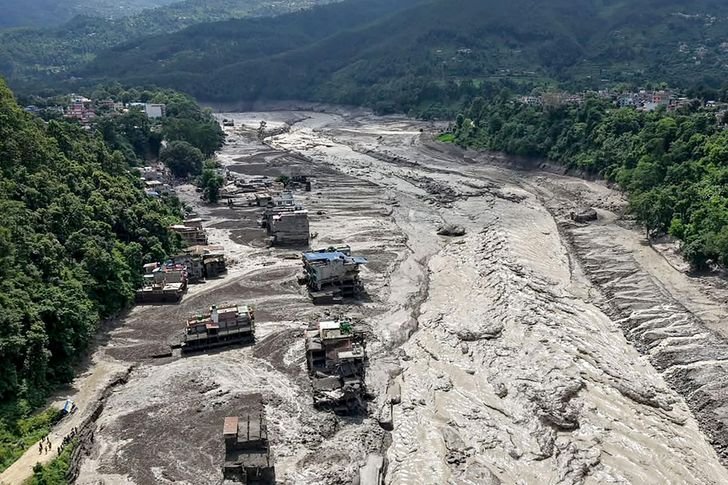
Yesterday, August 26, 2026, a catastrophic flash flood struck Nepal’s northern border region, causing unprecedented devastation that has been described as an “inland tsunami”. The disaster, which occurred around 9:00 AM local time when a sudden, massive surge of water entered the Bhote Koshi River from the Tibetan side, has resulted in a mounting humanitarian crisis across multiple districts . Initial reports suggesting an earthquake trigger were later refuted by the US Geological Survey (USGS), which confirmed that the seismic energy detected was actually generated by a massive landslide or ice-rock avalanche . Leading experts from the International Centre for Integrated Mountain Development (ICIMOD) have since corroborated that the event was most likely triggered by an ice-rock avalanche from a glacier on the Nepal side, which blocked the river and then released a sudden, devastating surge downstream .
The human toll of this singular event is staggering and tragically still evolving. As of the evening of August 26, the confirmed death toll had climbed to at least 72 across seven districts, with one body recovered in Rasuwa, 11 in Nuwakot, 18 in Dhading, 28 in Chitwan, nine in Gorkha, four in Tanahu and one in Nawalparasi East . However, hundreds remain missing, creating an agonizing state of uncertainty for countless families. The missing include a significant number of security personnel, with 32 police and Armed Police Force members unaccounted for after their posts in Timure, Syaphrubesi, Rasuwagadhi, and Melung were overwhelmed . The disaster also struck the nation’s workforce, with at least 60 people associated with the 20MW Langtang Khola Hydropower Project, including engineers, drivers, kitchen staff, and 35 workers who were inside a tunnel, reported as out of contact . The project had tragically been scheduled to begin testing in just two days . Furthermore, 15 employees of the Rasuwa Customs Office and around 26 employees from nine commercial banks are also missing .
The flash flood has also created a crisis for Nepal’s vital tourism sector. The Nepal Tourism Board officially recorded 384 tourists as unaccounted for, including 291 foreign nationals and 93 Nepali tourists . The missing foreign nationals represent a wide array of countries, with 105 Indian nationals among the unaccounted, as well as 12 British, 17 Malaysian, 8 South Korean, 4 South African citizens, and one person each from Australia and the Netherlands . The powerful floodwaters swept away at least 19 bridges, damaged approximately 40 kilometers (25 miles) of road, and caused over £70 million (more than 15 billion Nepali rupees) in damage to roads and bridges alone . An 18-kilometer stretch of road between Syaphrubesi and Rasuwagadhi was completely washed away . In addition, at least 12 hydropower plants were damaged, disconnecting 431.1 MW from the national grid—representing more than 12% of Nepal’s installed capacity . The renowned Friendship Bridge at Rasuwagadhi, which had been recently rebuilt, was also destroyed . This destruction has significantly impacted cross-border trade, as the flood also cut off road links, communications, and power supplies to the Gyirong Port in Tibet .
In response to the escalating crisis, Prime Minister Balendra Shah convened an emergency cabinet meeting and mobilized the Nepal Army, Armed Police Force, and Nepal Police, deploying a large-scale search and rescue operation involving at least 15 helicopters . However, rescue efforts have been severely hampered by high water levels, ongoing bad weather, and difficult terrain . The government has decided to provide free treatment to all those injured in the floods and has made Nepal Telecom’s phone and data services free to aid rescue and coordination efforts in the affected districts . As authorities warn that the risk remains high because the point where the river was blocked has not yet fully cleared, the crisis is far from over, and downstream residents have been urged to stay away from riverbanks . The international community has also mobilized, with the Indian government issuing flood alerts for border states and sending 10 tons of aid, while China has deployed over 574 rescuers to the affected region on its side of the border .