
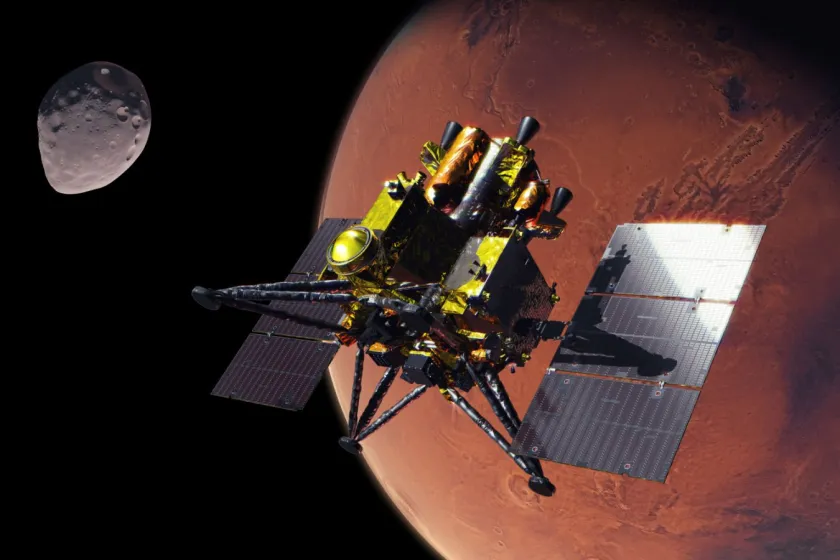
The historic Martian Moons eXploration (MMX) mission represents a monumental leap forward in interplanetary science and deep-space engineering. Launched by the Japan Aerospace Exploration Agency (JAXA) aboard an H3 launch vehicle from the Tanegashima Space Center, the spacecraft has embarked on a staggering 500-million-kilometre voyage across the solar system. Its ultimate destination is the Martian system, where its primary objective is to study and scout landing sites on Phobos, the largest and innermost of Mars’s two potato-shaped moons. Operating in the gravitational sphere of Mars introduces extreme complexity, as the planet’s massive gravity well demands exceptionally precise trajectory corrections and deep-space navigation compared to missions visiting isolated asteroids.
The fundamental scientific mystery driving this ambitious journey centers on the origin of the Martian moons. For decades, astronomers have debated whether Phobos and its smaller companion Deimos are captured asteroids originating from the main asteroid belt or whether they are native debris accreted from a massive ancient impact on the surface of Mars. To finally resolve this cosmic debate, the MMX spacecraft is engineered to enter a stable quasi-satellite orbit around Mars and Phobos. Once in position, the probe will spend years conducting meticulous observations of the moon’s topography, internal structure, composition, and gravity field using an advanced suite of scientific instruments, including telescopic cameras, spectrometers, and radiometers.
A critical phase of the mission involves surface reconnaissance to identify and secure safe landing locations. To accomplish this delicate scouting task, the spacecraft carries an innovative French and German rover named Idefix. Designed to withstand the treacherous, low-gravity environment of the 22-kilometre-wide moon, Idefix will separate from the main spacecraft and drop to the surface from a height of nearly 100 meters. Equipped with specialized mobility systems, the rover will crawl across the rocky regolith at a snail’s pace, mapping local terrain features, testing surface stability, and scouting the exact geological coordinates where the primary spacecraft will later touch down.
Following the reconnaissance phase, the main MMX spacecraft will perform one or two soft-landing operations on the surface of Phobos. Utilizing a specialized pneumatic sampling system developed with international collaboration, the probe will scoop up at least 10 grams of pristine regolith and dust from the moon’s upper crust. This physical acquisition is a monumental milestone, as it marks the first-ever sample return from the Martian sphere. Because Phobos is heavily exposed to space weathering and potential impact ejecta from Mars itself, these regolith samples may also contain ancient traces of Martian material flung into orbit billions of years ago, offering indirect clues about early environmental conditions on the Red Planet.
Beyond its immediate scientific dividends, the mission serves as an essential stepping stone for future human exploration. Space agencies view Phobos as a potential natural space station—an orbital outpost that could act as a staging base for crewed missions to Mars and deep space. By validating long-duration interplanetary travel, advanced deep-space communication technologies, and precise landing protocols in low-gravity celestial bodies, MMX is laying the technical foundation for crewed interplanetary logistics.
The mission timeline spans an intensive five-year duration from launch to sample delivery. After arriving at the Martian sphere and completing its orbital and surface operations between 2027 and 2030, the spacecraft will depart Phobos—conducting close flybys of the second moon, Deimos, along the way—and dispatch a dedicated sample return capsule back toward Earth. Traveling across the inner solar system for another year, the heat-protected re-entry capsule is scheduled to parachute down into the Woomera Prohibited Area in South Australia in 2031. Transporting these precious extraterrestrial grains to Earth laboratories will provide researchers worldwide with unprecedented data to reconstruct the history of the solar system and evaluate how habitable environments emerge across terrestrial planets.