
In a monumental leap for experimental physics, scientists aboard China’s Tiangong space station have successfully shattered previous temperature records by chilling a cloud of rubidium atoms to an astonishing 9.7 trillionths of a degree above absolute zero (9.7 picokelvin). Published in the prestigious journal Science, this remarkable milestone represents the coldest man-made matter ever created in the history of human scientific exploration. Absolute zero—the theoretical thermal boundary where thermodynamic systems possess their minimum possible energy and molecular motion theoretically ceases—is set at −273.15 °C (−459.67 °F). While atoms do not entirely stop moving at this extreme limit due to quantum mechanical zero-point energy, removing virtually all thermal kinetic energy allows researchers to peer into the fundamental building blocks of nature with unprecedented clarity, unlocking mysteries that govern the subatomic realm.
Reaching such mind-bogglingly low temperatures requires pushing advanced laser and vacuum technology to its ultimate limits. Temperature is fundamentally a macroscopic measure of the average kinetic energy possessed by the particles within a system—essentially capturing how rapidly atoms jiggle, collide, and bounce around. As experimental physicists strip thermal energy away from a cloud of atoms, the particles decelerate dramatically, causing their quantum mechanical wave-like properties to dominate over their classical particle-like behavior. However, performing these delicate experiments on Earth introduces an unavoidable and severe antagonist: gravity. The relentless pull of Earth’s gravitational field causes atomic clouds to sag and drop out of optical traps almost instantly. To counteract this, laboratories must employ intensely strong magnetic and laser fields, which inadvertently introduce confining forces that distort the atoms, restrict their expansion, and fundamentally limit how low temperatures can drop. While ground-based drop towers, sounding rockets, and specialized parabolic aircraft flights can simulate brief windows of weightlessness, they restrict researchers to a mere couple of seconds of free fall, abruptly cutting short the cooling process just as it reaches its most critical phase.
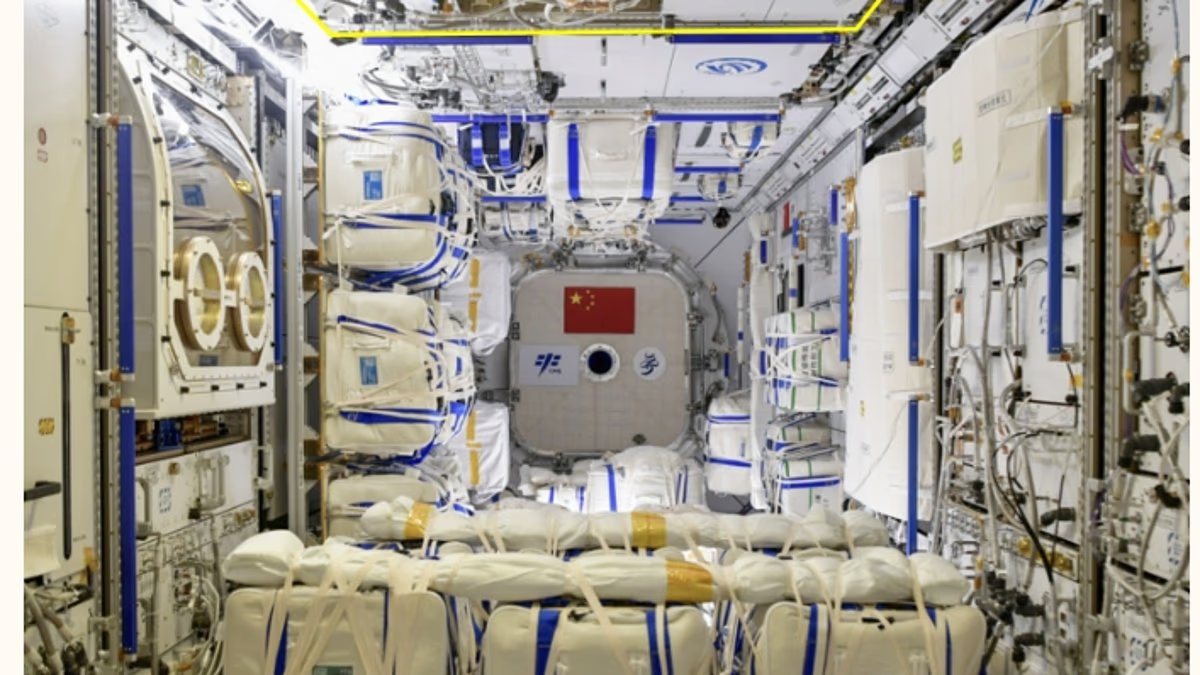
To bypass the tyrannical constraints of terrestrial gravity, scientists turned to the microgravity environment of low Earth orbit, utilizing the permanently crewed Tiangong space station as an orbital laboratory. The groundbreaking experiment was designed and executed by a collaborative research consortium featuring leading institutions such as Peking University, the Shanghai Institute of Optics and Fine Mechanics, and various institutes under the Chinese Academy of Sciences. Inside the space station’s dedicated scientific module, the team initiated their cooling sequence by isolating approximately 20,000 rubidium atoms inside a tightly controlled, high-vacuum optical trap. Utilizing sophisticated laser-cooling techniques—often metaphorically described as using laser beams to apply optical brakes to moving atoms—the researchers systematically drained the kinetic energy out of the gas cloud, forcing the particles closer and closer to a complete standstill.
As the thermal energy plummeted, the rubidium atoms underwent a profound and exotic phase transition, coalescing into a Bose-Einstein Condensate (BEC). Often dubbed the “fifth state of matter,” a Bose-Einstein Condensate occurs when a dense cloud of bosons is cooled so close to absolute zero that individual atoms lose their separate identities and merge into a single macroscopic quantum entity, overlapping their wave functions to act in synchronized harmony. Once this delicate condensate was securely formed inside the orbital apparatus, the research team engineered a clever manipulation of their containment fields. They transferred the condensate into a much wider, gentler trap and carefully dimmed the trapping laser lights. This deliberate reduction in confinement allowed the ultra-cold cloud to gently expand without heating up, effectively slowing the particles down even further as the cloud drifted across the vacuum chamber.
Because the Tiangong space station orbits the Earth in a state of continuous, uninterrupted free fall, the rubidium atoms floated completely weightlessly, remaining undisturbed for an extended observation window of roughly seven seconds after release. Back on Earth, such a prolonged free-expansion phase would be entirely impossible as gravity would pull the atoms downward out of the observation zone instantly. By meticulously tracking the precise rate at which the cloud of atoms diffused and spread outward into the vacuum, the physicists calculated its equivalent temperature with extraordinary precision, yielding the record-breaking value of 9.7 picokelvin. This figure describes the minute thermal energy associated with the cloud’s outward expansion, marking a monumental milestone that places the atoms less than ten trillionths of a degree away from the absolute thermal floor of the universe.
This unprecedented achievement decisively eclipses previous milestones in low-temperature physics, pushing human engineering into uncharted territory. The prior terrestrial record was set in 2021 by a German research team utilizing a tall drop tower in Bremen, which achieved an equivalent temperature of 38 picokelvin during a brief, plunging descent. In space, NASA’s Cold Atom Laboratory (CAL) aboard the International Space Station previously held the orbital record, having achieved 52 picokelvin in 2022. By driving the temperature down to 9.7 picokelvin, the Tiangong experiment compressed the previous low-temperature record to less than a quarter of its former value, vividly demonstrating that long-duration orbital platforms are vastly superior testing grounds for ultra-cold physics than any terrestrial facility can ever hope to achieve.
The implications of reaching the sub-picokelvin regime extend far beyond setting an impressive numeric record in academic journals. Mastering matter at these staggering levels of cold opens up transformative pathways for quantum simulation and high-precision measurement instrumentation. By utilizing these ultra-cold quantum gases, scientists can construct advanced atom interferometers—instruments capable of detecting minuscule shifts in gravity, mapping underground mineral deposits, tracking ocean currents, and testing fundamental physical laws such as Einstein’s theory of General Relativity with unprecedented sensitivity. Furthermore, these pristine condensates act as microscopic simulators, allowing researchers to model complex quantum materials and topological states that are otherwise impossible to study in traditional laboratory settings. As humanity pushes deeper into the twenty-first century, achievements like the Tiangong space station cooling experiment underscore how conquering the coldest extremes of the universe can illuminate the path toward revolutionary technological breakthroughs.