Quantum computing represents a fundamental shift in how information is processed, moving away from the classical physics that has governed computing for decades and harnessing the counterintuitive laws of quantum mechanics. While traditional computers store and manipulate data as bits—binary units that exist strictly as either 0 or 1—quantum computers use quantum bits, or qubits, which can exist in a combination of both states simultaneously. This shift is not merely an incremental speed boost for existing software; rather, it introduces a completely new computational paradigm capable of exploring vast problem spaces in ways that classical architectures find intractable.
At the heart of a qubit’s power is superposition, a quantum property that allows a qubit to represent a linear combination of the 0 and 1 states until it is measured. In a classical system with $n$ bits, the computer can hold only one of $2^n$ possible configurations at any given moment. By contrast, a system of $n$ qubits in superposition can represent a state spanning all $2^n$ combinations simultaneously, expanding computational state space exponentially as more qubits are added. However, measuring a qubit forces it to collapse into a single classical outcome—0 or 1—with probabilities determined by its quantum state, meaning quantum algorithms must carefully shape probabilities rather than simply reading out every answer at once.
Equally transformative is entanglement, a phenomenon in which two or more qubits become deeply correlated so that the quantum state of one cannot be described independently of the others, regardless of the physical distance separating them. Entanglement links qubits into a unified system where operations on one qubit instantaneously influence the joint state of the entangled group. Combined with quantum interference—the wave-like amplification of paths leading to correct answers and cancellation of paths leading to wrong ones—entanglement allows quantum processors to isolate solutions to specific structured problems far more efficiently than brute-force classical search.
Building a practical quantum computer requires isolating fragile quantum states from environmental noise, a challenge known as decoherence. Qubits are extraordinarily sensitive to tiny fluctuations in temperature, electromagnetic radiation, vibrations, and stray magnetic fields, any of which can cause them to lose their quantum properties and introduce errors. Because quantum information cannot simply be copied like classical bits—a rule known as the no-cloning theorem—quantum systems rely on sophisticated quantum error correction schemes that distribute logical information across multiple physical qubits to detect and correct errors without directly measuring and destroying the underlying quantum state.
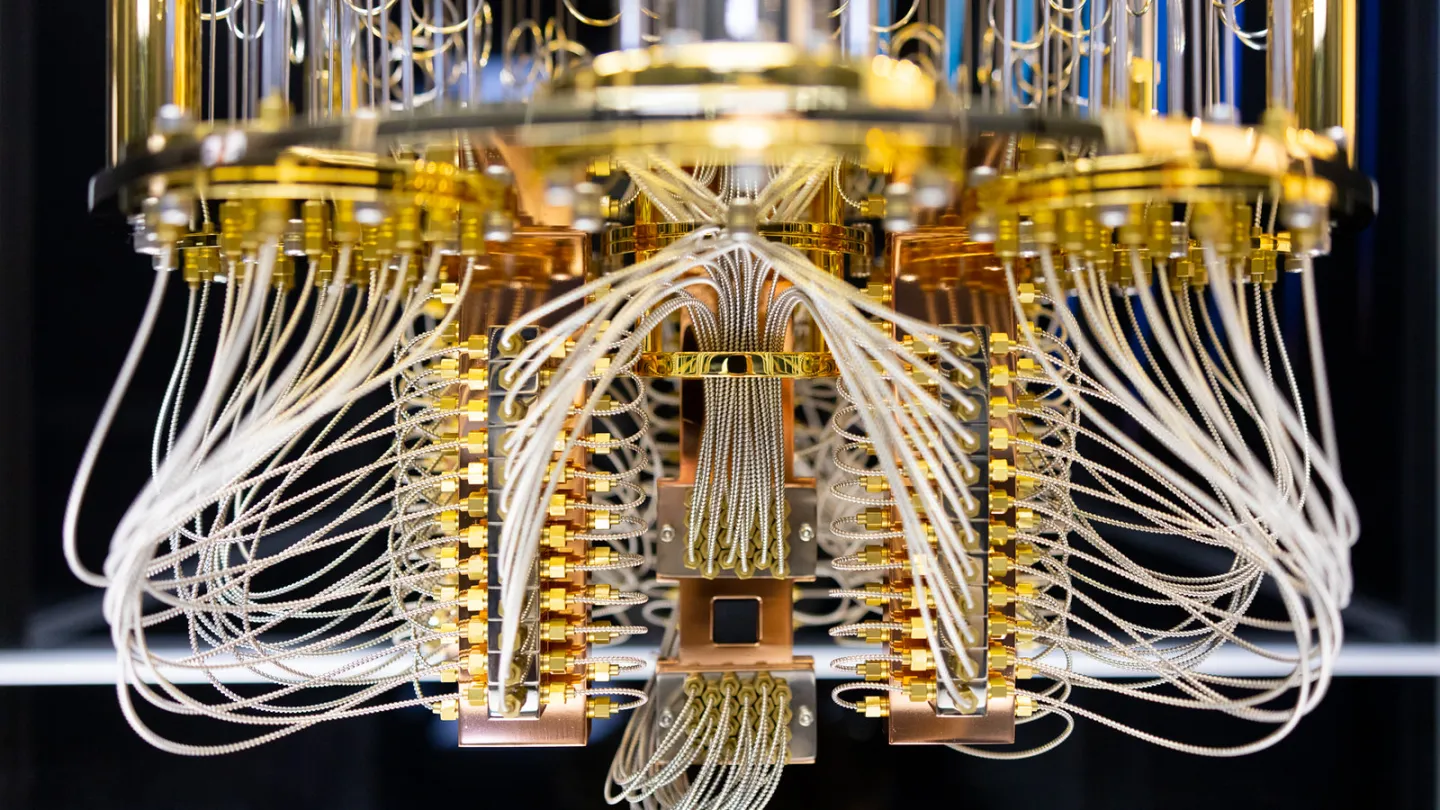
Several distinct hardware modalities are competing to scale quantum processors into reliable, fault-tolerant machines. Superconducting qubits use tiny circuit loops cooled to near absolute zero (millikelvin temperatures) to maintain zero electrical resistance and manipulate microwave pulses. Trapped-ion systems suspend individual charged atoms in electromagnetic fields and control their internal energy states with precision lasers, offering long coherence times and high gate fidelity. Other promising approaches include photonic quantum computing, which uses particles of light that naturally resist thermal noise; neutral-atom arrays arranged with optical tweezers; and topological qubits, which aim to protect information geometrically against local disturbances.
Quantum computing also differs sharply from classical computing in its programming model and algorithmic strengths. Rather than acting as a drop-in replacement for everyday laptops, phones, or standard data centers, a quantum processor acts as a specialized quantum co-processor or accelerator paired with classical hardware. Classical systems handle control logic, error decoding, input/output, and routine tasks, while the quantum unit tackles specific subroutines where quantum interference provides a decisive advantage. Notable milestones in quantum algorithms include Shor’s algorithm, which can factor large integers exponentially faster than known classical methods, and Grover’s algorithm, which offers a quadratic speedup for unstructured search tasks.
The potential real-world applications of quantum computing span science, industry, and medicine. In chemistry and materials science, simulating molecular interactions and electron behavior naturally scales with quantum mechanics, potentially accelerating the discovery of high-efficiency batteries, novel catalysts, superconductors, and targeted pharmaceuticals without years of costly trial-and-error experimentation. In optimization and logistics, quantum and hybrid quantum-classical methods aim to find better solutions for complex routing, supply chains, financial risk modeling, and grid management where variables interact in intricate ways. In artificial intelligence and machine learning, researchers are exploring whether quantum subroutines can enhance kernel methods, sampling, or optimization landscapes for specialized datasets.
At the same time, quantum computing poses major implications for cybersecurity and cryptography. Today’s widely used public-key encryption systems, such as RSA and elliptic-curve cryptography, rely on the practical difficulty of factoring large numbers or solving discrete logarithms on classical computers. A sufficiently large, fault-tolerant quantum computer running Shor’s algorithm could break these cryptographic standards, prompting global efforts to transition to post-quantum cryptography (PQC)—classical encryption algorithms designed to resist attacks from both quantum and classical machines—alongside quantum key distribution (QKD) for secure communication channels.
Despite rapid laboratory progress, significant engineering hurdles remain before universal, fault-tolerant quantum computers achieve broad commercial dominance. Scaling from tens or hundreds of noisy physical qubits to thousands or millions of physical qubits required to support robust logical qubits demands breakthroughs in cryogenics, control electronics, wiring density, interconnectivity, and error rates. Many near-term systems operate in the noisy intermediate-scale quantum (NISQ) regime, where error rates and qubit counts limit circuit depth, making careful benchmarking and honest assessment of practical quantum advantage essential.
Even with these challenges, quantum computing is already reshaping scientific research, industrial strategy, and education. Governments, universities, and technology enterprises around the world are investing heavily in quantum hardware, software stacks, cloud access, and workforce training so that organizations understand both where quantum advantage is realistic and how to prepare their infrastructure today. In the long run, the true impact of quantum computing will not come from replacing every classical computer, but from unlocking problems that nature itself encodes in quantum terms, giving humanity a powerful new lens to simulate matter, secure information, and push the boundaries of computation forward.