
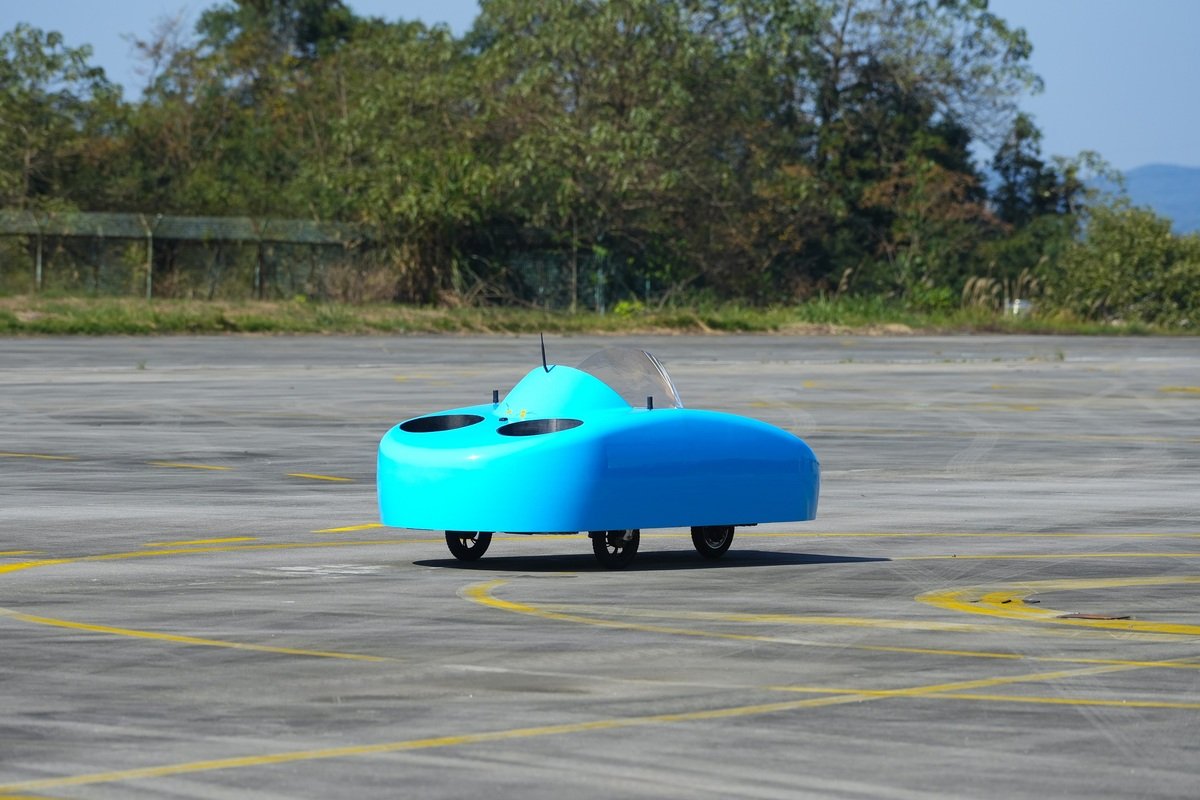
China has unveiled a groundbreaking advancement in personal air mobility with the successful maiden test flight of a domestically developed, wingless flying car in Changsha, Hunan Province. Unlike traditional aircraft or earlier flying car prototypes that rely on bulky folding wings, long airstrips, or exposed helicopter-style propellers, this sleek, compact vehicle lifted off vertically from a standard paved surface without requiring a single inch of runway. Footage of the historic demonstration, widely circulated on social media and shared by diplomatic officials including Chinese Ambassador to India Xu Feihong, showed the blue, futuristic single-seat prototype rising smoothly into the air, hovering steadily, executing controlled lateral maneuvers, and descending gently back to the ground. This milestone marks a significant leap forward in China’s rapidly expanding low-altitude economy, offering a tangible glimpse into how personal urban transport could bypass congested road networks in the near future.
At the heart of this engineering marvel is an innovative propulsion architecture that completely eliminates external rotors. Described by its developers as the world’s first piloted aircraft to feature a multi-stage vector ducted-fan propulsion system, the vehicle houses its lifting fans entirely within internal, enclosed ducts inside its aerodynamic body. By concealing the high-speed rotating blades rather than leaving them exposed on the exterior, engineers have directly addressed one of the biggest safety barriers to operating flying vehicles in densely populated cities. Exposed propellers pose severe hazards to nearby pedestrians, buildings, power lines, and trees during low-altitude takeoffs and landings. Enclosing the propulsion units not only minimizes the risk of physical contact and debris ingestion but also allows the craft to maintain a compact, boxy, car-like footprint that fits effortlessly into ordinary parking spaces and narrow urban streets.
In terms of physical specifications and flight performance, the prototype balances lightweight agility with practical utility. The aircraft features a maximum take-off weight of 280 kilograms while remaining capable of carrying a useful payload of up to 120 kilograms, making it well-suited for a single pilot and essential gear. Once airborne, the vehicle is engineered to reach a maximum flight speed of 150 kilometers per hour and cover a reported range of up to 300 kilometers on a single charge or fuel cycle. Furthermore, its designed maximum flight altitude of 3,000 meters provides ample operational ceiling to clear tall skyscrapers in megacities or navigate across elevated terrain. Crucially, the prototype is designed as a true bimodal vehicle; once it touches down after a flight, it can seamlessly transition to conventional road-driving mode, allowing the operator to drive directly to their final destination without needing specialized aviation terminals.
The debut of China’s wingless flying car has also sparked intense global comparisons, particularly with rival airborne vehicle concepts emerging in the United States. The test flight in Changsha took place just weeks after Elon Musk’s SpaceX and Tesla showcased a thrust-equipped Tesla Roadster prototype in Texas. However, the two vehicles rely on fundamentally different technologies to leave the ground. While the proposed Tesla Roadster utilizes cold-gas thrusters for short airborne hops alongside a separate suction fan system designed primarily to increase road grip, the Chinese prototype uses its enclosed ducted-fan system for sustained vertical takeoff, hovering, and long-distance horizontal flight. Social media users quickly dubbed the Chinese craft a real-life version of a sci-fi gadget, noting that its smooth, propeller-free silhouette looks straight out of a futuristic movie.
Beyond everyday commuting, the potential real-world applications for a runway-independent, dual-mode vehicle are vast. In sprawling metropolitan areas choked by gridlock, such vehicles could establish fast, point-to-point aerial transit corridors. Even more impactful is their utility in mountainous, rural, and remote regions where rugged terrain makes building roads, bridges, or airports prohibitively expensive. Because the craft can land on any flat patch of ground, it holds immense promise for emergency medical evacuations, disaster relief, and search-and-rescue missions, enabling first responders to reach isolated communities immediately after earthquakes, floods, or landslides when conventional infrastructure is destroyed.
Despite the excitement generated by the viral test footage, industry experts emphasize that the Changsha flight represents an early-stage prototype demonstration rather than a finished consumer product. While the vehicle successfully proved its stability during vertical lift, hover, and landing in a controlled environment, independent verification of its claimed 150 km/h top speed, 300-kilometer range, and 3,000-meter altitude ceiling is still pending. Additionally, the developers have not yet disclosed an estimated retail price or a timeline for mass production. Before ordinary drivers can pilot wingless flying cars through city skies, the vehicle must undergo rigorous endurance testing, battery and propulsion safety certifications, and complex regulatory approvals. Airspace management rules, pilot licensing frameworks, and urban noise standards will all need to evolve alongside the hardware. Nevertheless, by proving that a compact, wheel-equipped car can rise straight into the sky without wings or runways, China has taken a bold step toward turning one of transportation’s oldest dreams into an engineering reality.