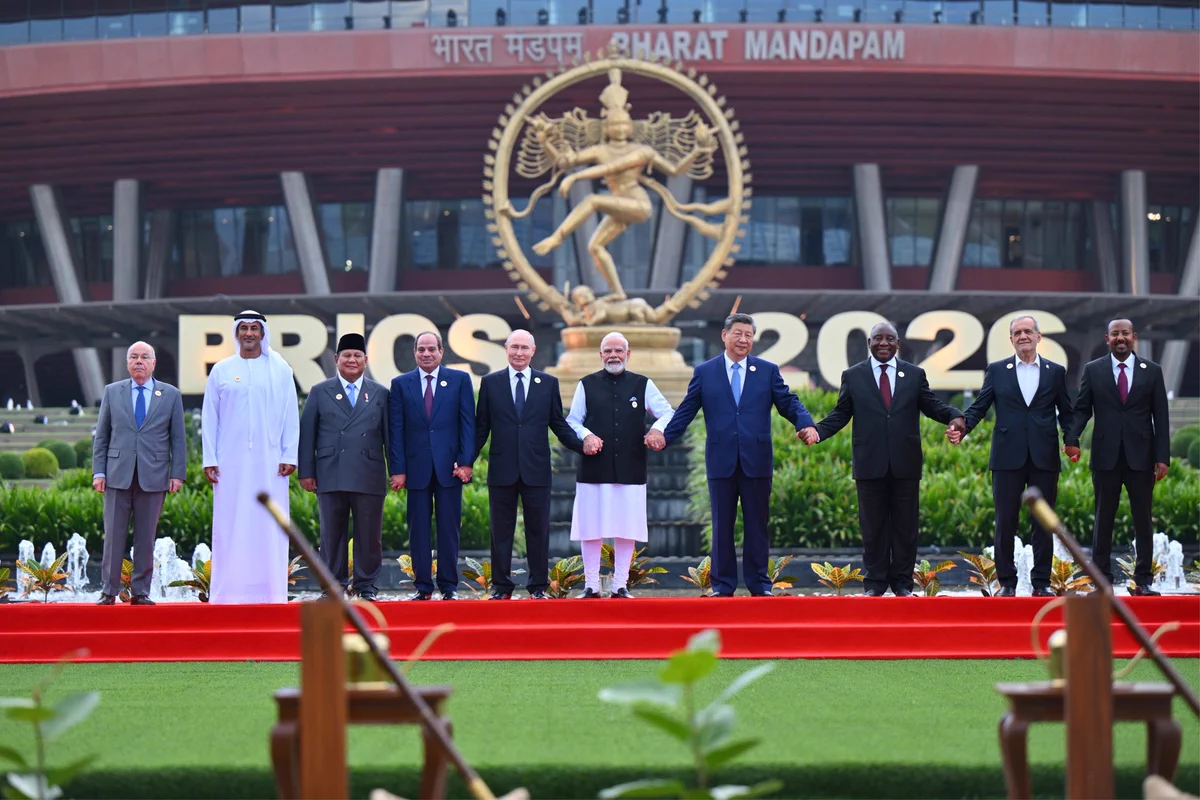
The 18th BRICS Summit held in New Delhi, hosted under India’s chairship, culminated in the unanimous adoption of the comprehensive New Delhi Declaration 2026. Guided by the theme “Building for Resilience, Innovation, Cooperation and Sustainability,” the summit demonstrated India’s capacity as a diplomatic bridge-builder, forging a consensus among diverse member states despite ongoing global geopolitical fragmentation and regional conflicts. The summit addressed global financial reform, cross-border trade, geopolitical conflicts, counter-terrorism, digital architecture, and energy security, yielding over 50 tangible outcomes and action plans designed to strengthen the voice of the Global South.
A primary highlight of the summit was the unified call for comprehensive reforms in global governance and multilateral institutions. BRICS leaders emphasized the urgent need to modernize the United Nations system, with permanent Security Council members China and Russia explicitly reiterating their backing for India and Brazil to play a larger role in the UN Security Council. Furthermore, the leaders demanded structural changes to the Bretton Woods institutions—the International Monetary Fund (IMF) and the World Bank—calling for an increase in quota shares, voting rights, and leadership representation for Emerging Markets and Developing Economies (EMDEs) to reflect contemporary economic realities.
On economic and financial cooperation, the New Delhi Declaration voiced serious concern over the global rise in unilateral trade-restrictive measures and indiscriminate tariffs. Denouncing policies inconsistent with World Trade Organization (WTO) rules, BRICS nations condemned protectionism, including carbon border adjustment mechanisms and economic sanctions that harm developing nations. To build economic resilience, member states agreed to advance local currency trade settlements and explore cross-border payment system interoperability. The New Development Bank (NDB) was encouraged to expand its local-currency financing and mobilize resources for critical infrastructure projects without relying heavily on third-party currencies.
Geopolitical issues and regional security formed another critical pillar of the discussions. In a significant diplomatic victory for India, the declaration adopted an unequivocal, zero-tolerance stance on terrorism, rejecting double standards and explicitly condemning the tragic Pahalgam terrorist attack in Jammu and Kashmir. The leaders called for decisive global action against cross-border terror movements, safe havens, and terror financing. Regarding the West Asia crisis, BRICS members urged maximum restraint and advocated for dialogue and diplomacy. The consensus text called for a sustained Gaza ceasefire, unhindered humanitarian access, and reaffirmed support for a two-state solution resulting in an independent Palestinian state along the 1967 borders.
The summit also established groundbreaking frameworks for technology, health, and clean energy. Recognizing the rise of emerging technology, BRICS formulated a unified stance on Artificial Intelligence (AI), pushing for safe, inclusive, and trustworthy AI resources tailored to the needs of the Global South. Key institutional initiatives were launched, including the India Centre for BRICS Industrial Competencies to help small businesses adopt Industry 4.0 digital technologies. In healthcare, members backed a BRICS Training Hub Network alongside a specialized mental health initiative led by Bengaluru’s NIMHANS. Finally, the summit reaffirmed energy security commitments, prioritizing a diversified energy mix that integrates renewable energy, nuclear power, biofuels, and low-emission hydrogen.