
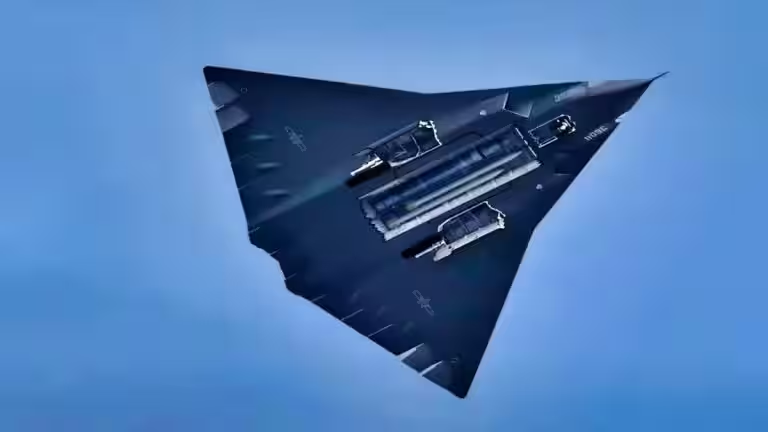
In late December 2024, a series of dramatic photographs and videos emerged on Chinese social media purportedly showing a tailless, stealthy aircraft in flight over Chengdu, Sichuan Province, igniting a global debate about whether China had secretly flight-tested its first sixth-generation fighter jet. The aircraft, which appeared to be a large, delta-winged design with no vertical tail surfaces, was captured in daylight flying at relatively low altitude, escorted by a twin-seat Chengdu J-20S stealth fighter—itself a newly introduced variant. The imagery spread rapidly across defense circles, with analysts noting that the timing coincided with the 13th anniversary of the J-20’s maiden flight (January 11, 2011) and followed shortly after the public debut of China’s other major aviation achievements, including the J-35A carrier-based stealth fighter at the 2024 Zhuhai Airshow. While Chinese state media did not officially confirm the aircraft as a “sixth-generation fighter,” the consensus among Western defense analysts is that this represents a technology demonstrator or prototype for a future air superiority platform, potentially designated J-36 or a similar moniker. The sighting has intensified the global race for next-generation air dominance, placing China alongside the United States, which is developing its own NGAD (Next Generation Air Dominance) program, and Europe, which is pursuing the GCAP and FCAS systems.
The most striking feature of the aircraft is its tailless, lambda-wing or diamond-delta configuration, which eliminates vertical stabilizers to achieve superior stealth across a broader frequency spectrum—particularly against low-frequency radar. This design choice significantly reduces radar cross-section but introduces immense challenges in flight control, requiring advanced fly-by-wire systems and thrust-vectoring engines to maintain stability. The aircraft appears to be powered by twin engines with serrated nozzles, suggesting a further evolution of China’s WS-15 or a newer adaptive cycle engine. Analysts from The War Zone and Aviation Week noted that the large internal volume and broad fuselage could accommodate directed-energy weapons, high-power microwave systems, or an extensive sensor suite for electronic warfare. The absence of a vertical tail also implies a heavy reliance on advanced flight control algorithms and possibly artificial intelligence-assisted piloting, hallmarks of sixth-generation design philosophy. Furthermore, the aircraft’s size—larger than the J-20—hints at extended range, greater payload capacity, and potentially the ability to control “loyal wingman” drones, a key requirement for future air combat.
The timing of the sighting is geopolitically significant. It occurred just weeks after the U.S. Air Force paused its NGAD manned fighter program to reassess costs and requirements, and amid heightened tensions over Taiwan and the South China Sea. Chinese military aviation has historically followed a pattern of rapid, incremental development: the J-20 flew in 2011 and entered service in 2017; the J-35A was unveiled in 2024. If the new aircraft is indeed a sixth-generation prototype, China may be aiming to field it by the mid-2030s, potentially matching or exceeding the timeline of the U.S. NGAD. The flight also demonstrated China’s growing confidence in revealing advanced prototypes, a departure from its traditionally secretive approach. However, skepticism remains: some analysts caution that the aircraft could be a technology demonstrator for specific subsystems—such as tailless flight control or advanced stealth shaping—rather than a full sixth-generation fighter. Others noted that the lack of official Chinese confirmation leaves open the possibility of a psychological warfare or disinformation campaign, though the high-quality imagery and multiple independent recordings make a hoax unlikely.
From a technical standpoint, a true sixth-generation fighter is expected to feature several key capabilities: broadband stealth (including against low-frequency and infrared sensors), adaptive cycle engines for optimal fuel efficiency and thrust, directed-energy weapons (lasers or high-power microwaves), advanced AI for autonomous operation and sensor fusion, networked swarming with unmanned systems, and optional manned-unmanned teaming. The spotted aircraft appears to check some of these boxes—particularly tailless stealth and large internal volume for future weapons—but no visual evidence confirms directed-energy weapons or AI-driven combat systems. Its propulsion remains a mystery: while serrated nozzles suggest stealthy exhaust, the engines could be an interim solution until China’s variable-cycle engine (likely the WS-19 or a successor) matures. The flight control system is equally critical: tailless designs like the B-2 bomber rely on split ailerons and drag rudders, but a fighter requires far greater agility. China’s progress in fly-by-wire and thrust-vectoring, demonstrated on the J-10B TVC and J-20, suggests it has overcome these hurdles, but the true test will be high-speed maneuvers and weapons separation.
International reactions have been swift and varied. U.S. defense officials acknowledged the sighting but declined to confirm whether it constituted a sixth-generation breakthrough, with Pentagon spokesperson saying they were “aware of the reports” and monitoring developments. The U.S. Air Force’s NGAD program, which aims to field a manned sixth-gen fighter by the 2030s, may now face increased pressure to accelerate, though budget constraints remain a hurdle. European analysts expressed concern that China’s rapid iteration could leapfrog the GCAP and FCAS timelines, which currently target the 2035–2040 window. Regional powers like Japan, India, and Australia are likely to reassess their air power modernization plans, potentially accelerating their own sixth-gen collaborations (e.g., Japan’s F-X with the UK and Italy). Taiwan’s defense ministry downplayed the sighting, calling it “part of China’s ongoing military modernization,” but the psychological impact on the island’s defense morale could be significant. Russia, meanwhile, has remained largely silent, though its own Su-57 is considered a fifth-generation fighter and its sixth-gen efforts (like the MiG-41 interceptor) are less advanced.
Looking ahead, several key questions remain. First, is this aircraft a one-off demonstrator or the first of multiple prototypes? China typically builds several prototypes for testing—the J-20 had at least eight before production. Second, what is its intended role? A large, tailless fighter could serve as a long-range air superiority platform, a penetration bomber, or even a command node for drone swarms. Third, when will it enter service?