
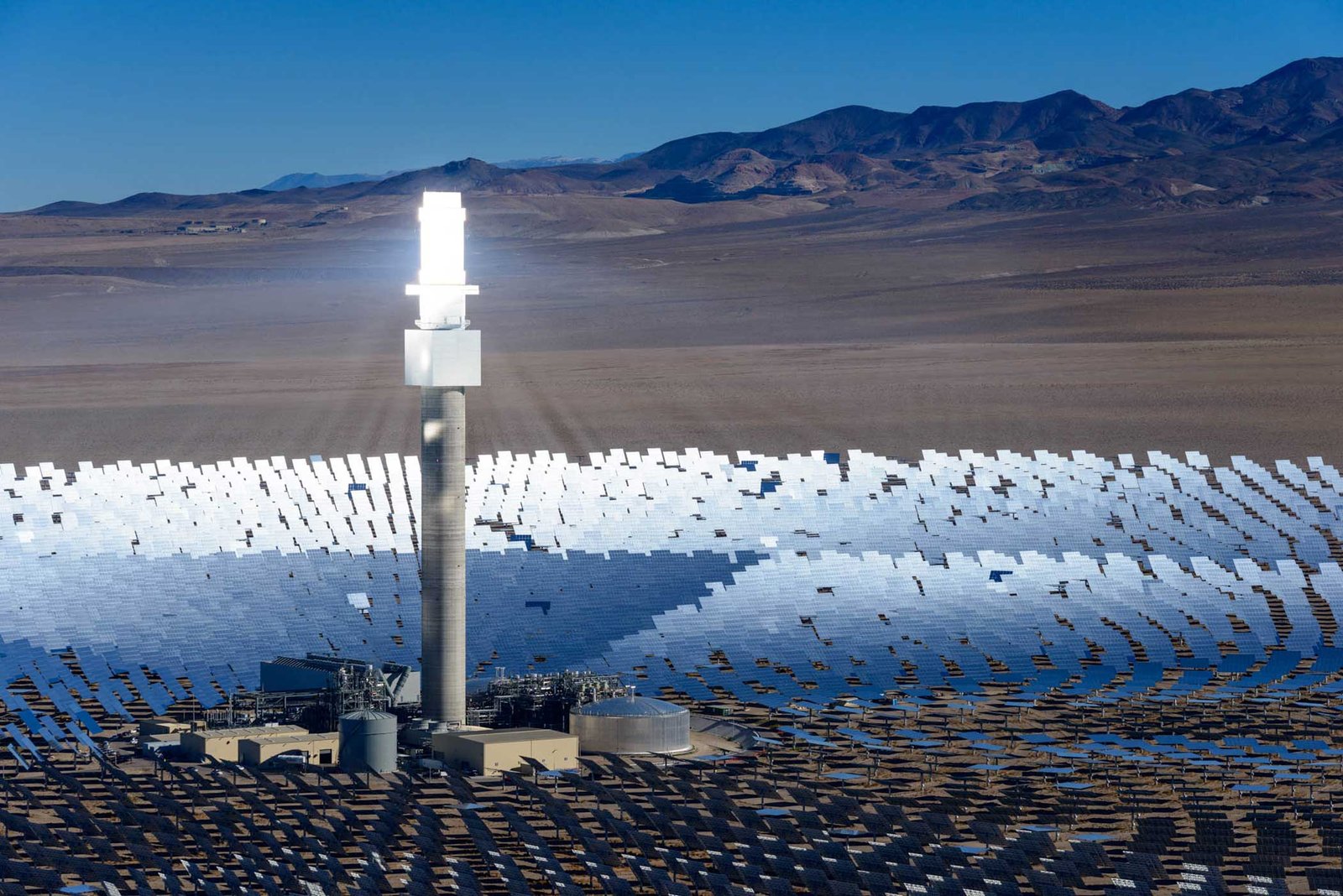
Deep in the vast, barren expanses of the world’s great deserts, a quiet energy revolution is unfolding. This is not a scene from a science fiction novel, but the reality of a new generation of power plants that are fundamentally changing how we harness the sun’s power. These facilities, often termed giant “solar power banks,” use a clever trick to overcome the sun’s most significant limitation: its absence at night . By employing advanced Concentrated Solar Power (CSP) technology combined with molten salt energy storage, these plants can continue generating clean electricity long after the sun has dipped below the horizon. In northwest China, for example, massive integrated projects are turning former wastelands into “green power treasure troves,” showcasing the technology on a truly grand scale .
The principle behind these facilities is both elegant and effective. Instead of converting sunlight directly into electricity like standard photovoltaic (PV) panels, CSP plants use thousands of mirrors to concentrate a vast area of sunlight onto a single, central receiver. In a linear Fresnel system, long, flat mirrors track the sun and reflect its rays onto elevated tubes . In a tower system, an expansive field of sun-tracking heliostats focuses intense solar radiation onto a receiver perched atop a central tower . This concentrated energy is used to heat a substance capable of storing immense thermal energy. The medium of choice is often molten salt, a mixture of salts that remains liquid at high temperatures and is an extremely efficient and cost-effective way to store heat .
The key to the “power bank” concept lies in the thermal energy storage system. During the day, the solar energy is used to heat the molten salt to temperatures exceeding 550 degrees Celsius before it is pumped into heavily insulated storage tanks . This stored heat represents captured sunlight, ready to be deployed on demand. When the sun sets and the PV panels stop generating power, the hot molten salt is circulated through a heat exchanger. Here, it boils water to create steam, which spins a conventional turbine to generate electricity . This process effectively allows the plant to supply power for hours after sundown, with the largest facilities capable of delivering power for up to ten hours through the night .
The scale of these facilities is staggering and represents a major leap forward in renewable energy infrastructure. One of the most notable examples is a hybrid project near Hami in China’s Xinjiang region, which has entered commercial trial operations. With a total capacity of 1 million kilowatts (1 GW), it combines a 900,000-kW photovoltaic (PV) power station with a 100,000-kW CSP plant. The solar field for the CSP section alone covers an enormous 800,000 square meters, using 260,000 tracking mirrors . This project, costing approximately $480 million, is a testament to the financial and technical commitment to this technology. When running at full capacity, it is expected to generate 2.07 terawatt-hours of electricity per year, enough to power about 830,000 homes, while cutting carbon dioxide emissions by an estimated 1.63 million metric tons annually . Similarly, the Jinta multi-energy complementary base in Gansu province, featuring a 100,000-kW tower-type molten salt plant with a mirror field spanning 770,000 square meters, is expected to supply 1.45 billion kilowatt-hours of clean electricity annually, saving 480,000 tonnes of standard coal .
This technology represents a powerful solution to one of the main criticisms of renewable energy: its intermittency. By providing stable, dispatchable power, CSP with storage can serve as a reliable baseload or peaking power source, offering essential grid stability that complements the fluctuating output of wind and solar PV . It also provides a clean alternative to gas or coal peaker plants, which are typically fired up to meet high evening demand. This capability is a critical component of a modern, carbon-free grid. The technology is also highly versatile. In China, for instance, the CSP plant is integrated with photovoltaic panels so that during the day, the PV panels feed electricity directly into the grid while the CSP plant simultaneously stores its thermal energy, optimizing the facility’s output and efficiency .
The advancement of this technology is not without its challenges, but significant progress is being made. The facilities must be engineered to withstand extreme desert conditions, including surface temperatures that can soar to 50°C during the day and plunge to -20°C at night, as well as frequent sandstorms . As a result, construction requires specialized techniques, from automated sand stabilization to innovative foundations for the massive molten salt storage tanks . Moreover, the industry has seen critical breakthroughs in key components. In China, companies have independently developed the heliostats and mirror field control systems, solving complex challenges like long-distance precision tracking and the intelligent management of vast arrays of thousands of mirrors . Innovations like low-position tank designs have also increased the usable molten salt from 85 percent to 90.3 percent, reducing costs and improving efficiency .
The impact of this desert energy revolution extends beyond just electricity generation. The construction of these mega-projects is revitalizing traditional industries like special glass and steel manufacturing, while also fostering new sectors in smart control systems . Furthermore, some projects are demonstrating a commitment to ecological restoration, with teams planting native species like poplars and desert willows, and economic crops such as apricot and peach trees, on the restored land . As the world continues to seek solutions for a decarbonized future, these sun-scorched deserts are being transformed from barren lands into the world’s newest and most powerful powerhouses. They stand as a shining example of human innovation, using the elements of nature to secure a cleaner, more sustainable energy future for all.