
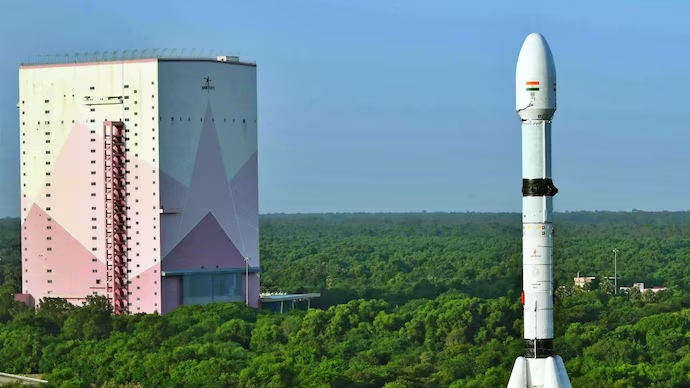
The Indian Space Research Organisation (ISRO) is poised to make a significant leap in its space-based capabilities with the scheduled launch of its latest Earth Observation Satellite, EOS-05, on September 4, 2026. This mission, designated GSLV-F17, will be conducted from the Satish Dhawan Space Centre in Sriharikota at 2:55 AM IST and marks the agency’s return to launch operations after a seven-month hiatus . The upcoming mission is particularly momentous as it will deploy India’s first-ever imaging satellite designed to operate from a geosynchronous orbit, a feat that will fundamentally change how the nation monitors its landmass and surrounding regions . The GSLV-F17, in its 19th flight, is a 51.7-meter-tall, three-stage heavy-lift vehicle with a lift-off mass of 420.5 tonnes. It will carry the 2,367 kg EOS-05 spacecraft, also known as GISAT-1A, into a Sub-Geosynchronous Transfer Orbit (Sub-GTO) with a perigee of 170 km and an apogee of 28,934 km. From this initial orbit, the satellite’s onboard propulsion system will then raise it to its final geostationary position, approximately 36,000 kilometers above the Earth .
The launch of EOS-05 is not just a routine mission; it is a critical step for ISRO, coming after a period of intense scrutiny following the failure of the PSLV-C62 mission in January 2026. This setback prompted a pause in launches, making the GSLV-F17 mission a vital opportunity for the organization to re-establish confidence in its launch vehicle program . Furthermore, EOS-05 serves as a crucial replacement for the ill-fated GISAT-1 (also known as EOS-03) mission, which ended in failure in August 2021 when the GSLV-F10 rocket’s cryogenic upper stage malfunctioned due to a valve issue . The success of this new mission is therefore paramount to fulfilling the original vision of establishing a geostationary Earth imaging system for India, a vision that was left unrealized five years ago .
What truly sets the EOS-05 apart from its predecessors and most other Indian Earth observation satellites is its operational orbit. While conventional remote-sensing satellites operate in Low Earth Orbit (LEO) and pass over a given area only at specific intervals, EOS-05 will reside in a geosynchronous orbit, a much higher altitude that allows it to maintain a fixed position relative to the Earth’s surface . This strategic placement endows the satellite with a unique capability: near-continuous imaging of a large area, specifically the Indian landmass. Unlike LEO satellites that provide snapshots at limited times, EOS-05 will be able to keep a persistent watch, offering repeated observations of the same broad region. This is made possible by its advanced imaging suite, which is designed to capture images in multi-spectral and hyper-spectral bands. With this technology, it can provide near real-time pictures under cloud-free conditions, with the capability to image a selected field every five minutes and the entire Indian subcontinent every 30 minutes at a spatial resolution of 42 meters .
This ability to offer high-frequency, wide-area surveillance has profound implications for a host of critical applications. The satellite’s data will be instrumental in disaster management, offering vital, rapid updates during fast-moving natural calamities such as cyclones, floods, and forest fires, potentially enabling swifter and more effective responses . In addition to disaster monitoring, EOS-05 will significantly enhance capabilities in agriculture, forestry, and environmental studies, providing crucial data for tracking crop health, vegetation patterns, and long-term environmental changes . Moreover, while designated primarily as an Earth Observation satellite, the persistent surveillance capability of EOS-05 also positions it as a vital asset for national security. The ability to continuously monitor borders, maritime zones, and critical infrastructure offers improved strategic awareness and surveillance, effectively making it a formidable “eye in the sky” for the nation .
In conclusion, the GSLV-F17/EOS-05 mission is more than just a satellite launch; it is a testament to ISRO’s resilience and its commitment to advancing India’s space technology. The mission carries the weight of a previous failure, the pressure of a launch hiatus, and the promise of a transformative capability. If successful, EOS-05 will provide India with a powerful new tool for observing its planet, enhancing its capacity for disaster response, resource management, and national security. By ushering in an era of geosynchronous imaging, ISRO is not just placing a satellite into orbit, but is fundamentally strengthening India’s ability to see, understand, and react to events unfolding on Earth in near real-time .