June 6, 2026
As the summer of 2026 begins, the race to industrialize the moon has taken a decisive leap away from science fiction. A growing coalition of private companies, led by Elon Musk’s SpaceX, alongside defense contractors and international space agencies, is actively planning the construction of giant electromagnetic catapults on the lunar surface. While proponents argue these “mass drivers” are the only viable path to building a true off-world economy, a chilling new security report warns that the same infrastructure could function as “an unassailable, undetectable first-strike platform” capable of changing the very nature of space warfare . The physical laws that make the moon ideal for cheap launches—no atmosphere and one-sixth the gravity of Earth—are the same laws that turn a commercial railgun into a planetary threat .
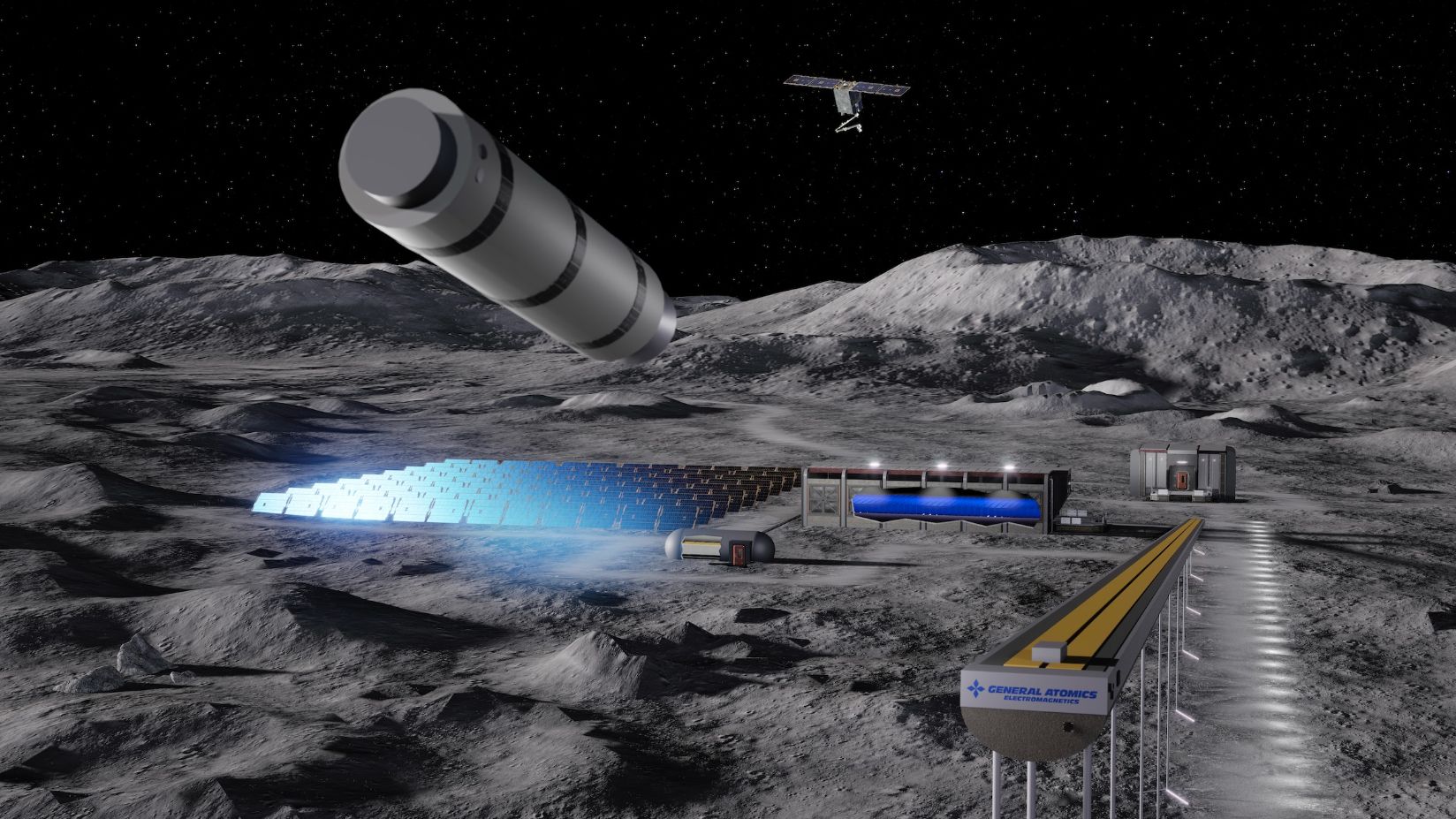
The concept, originally proposed by physicist Gerard O’Neill in the 1970s, is conceptually simple: a track utilizing sequential electromagnetic coils accelerates a payload to the moon’s escape velocity of 2.4 kilometers per second, hurling it into space without a single drop of chemical fuel . For companies like SpaceX, the economic incentive is irresistible. The company has outlined a vision of establishing factories on the moon to manufacture AI satellites using lunar materials, bypassing the astronomical cost of lifting every kilogram from Earth .
These “TeraFab” plans involve a massive coilgun powered by lunar solar arrays, capable of deploying hundreds of terawatts of computing infrastructure directly into deep space . “The economic advantages of mass drivers are inseparable from their security implications,” states a report released in late May by the American Foreign Policy Council (AFPC) and authored by cislunar security analyst Andre Sonntag . “As high throughput launch systems, they are inherently dual use. Mass drivers are, in fact, just large electrically driven cannons.”
The core of the anxiety revolves around the “dual-use” nature of the technology. A system designed to ship rare minerals or finished satellites to Earth orbit can, in milliseconds, be repurposed to launch kinetic projectiles or smart weapons. Unlike ICBMs launched from silos on Earth, which are easily spotted by infrared satellites, a lunar mass driver would operate in the silent, airless vacuum of space. Analysts warn that a device located on the far side of the moon could release a payload that drifts for hours or days before executing a small, untraceable burn to intercept a target, such as a GPS satellite or a space station . “This duality places mass drivers in a uniquely sensitive strategic position,” Sonntag writes in his findings, published via Space.com. “While mass drivers can bootstrap an off-world economy, they carry an equally potent and unsettling military capability: the ability to operate as an unassailable, undetectable first-strike platform.”
The geopolitical implications are further complicated by the legal framework governing the cosmos. The United Nations Outer Space Treaty explicitly prohibits the establishment of military bases or weapons of mass destruction on celestial bodies . However, a mass driver is technically an industrial launch system. It does not become a weapon until the moment the wrong payload is placed on the track.
“The question isn’t whether the physics works,” noted observers following the recent xAI shareholder meetings, where Musk doubled down on the vision. “The question is whether anyone is willing to fund, build, and maintain a railgun on the moon—and who watches the watchers.” Because a lunar catapult could launch dozens of times per day without the visual plume of a rocket, experts fear that a nation or corporation could conduct a saturation attack on orbital assets before terrestrial defenders even realized a conflict had begun .
As the United States, China, and private consortiums race to secure prime real estate near the lunar poles for these electromagnetic launchers, the AFPC report offers a stark directive rather than a warning. It argues that the window to regulate or dominate this technology is closing rapidly. “The United States faces a narrowing window to shape the strategic environment of the Lunar frontier,” the report concludes. “If the United States fails to invest in the practical development and ample fielding of Lunar mass drivers, competitors will be granted the ability to dictate their use and control space power.” For now, the “catapult” remains a marvel of logistics, but as June 2026 progresses, it is clear that the race to build the moon’s first mass driver is also a race to decide who controls the high ground of the future .