
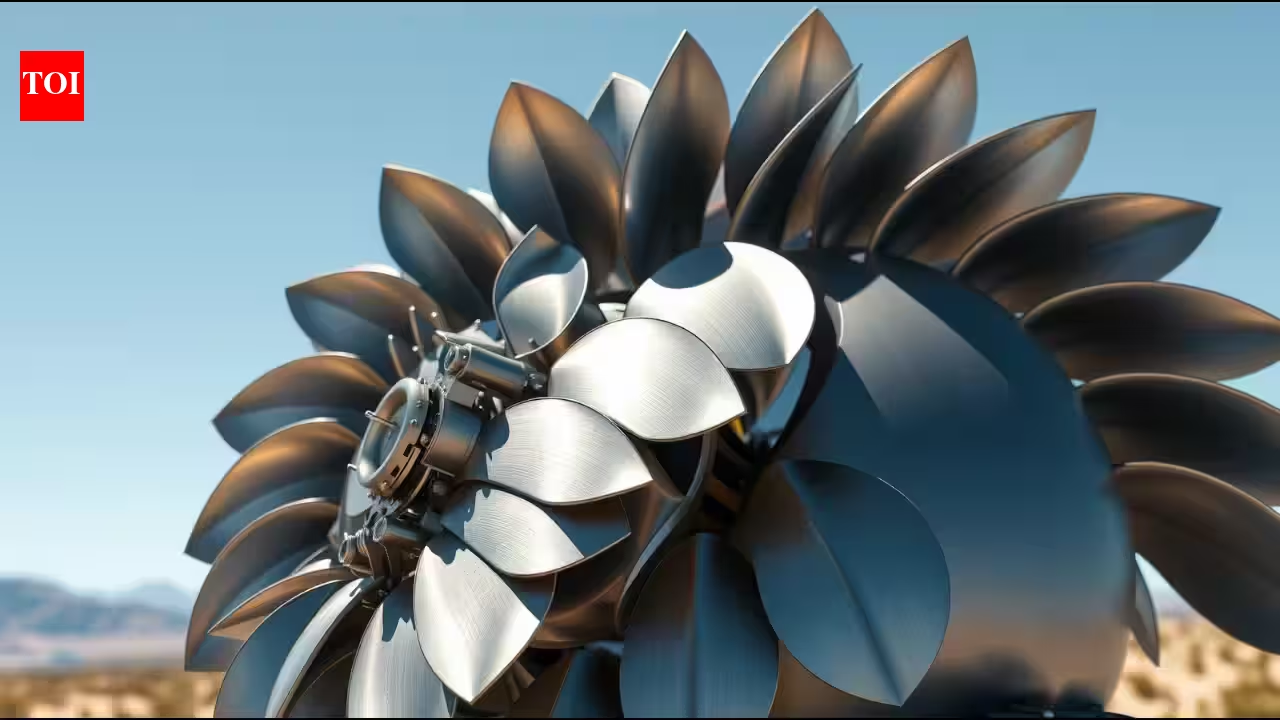
In a breakthrough for passive energy technologies, scientists in China have developed a biomimetic radiative cooling system inspired by the natural movement of sunflowers. The innovative technology, known as dynamic sky view factor steering (DSVFS), demonstrated a remarkable 135% increase in cooling flux at solar noon compared to standard fixed horizontal cooling panels. By actively adjusting the angle of a radiative cooling panel throughout the day, the system addresses one of the most stubborn challenges in sustainable thermal management: maintaining sub-ambient cooling under direct, intense sunlight.
Radiative cooling works by emitting heat in the form of infrared radiation directly into deep space through Earth’s atmospheric window. However, conventional daytime systems face significant inefficiency because flat panels remain exposed to intense direct solar radiation, absorbing unwanted heat faster than they can shed it. Unlike traditional solar panels that turn directly toward the sun to capture energy, the sunflower-inspired DSVFS system does the exact opposite—it continuously reorients the cooling surface away from direct solar rays while preserving maximum exposure to the cold sky. Controlled by a solar sensor and a dual-axis gimbal mechanism, the panel dynamically moves out of the sun’s path during peak daylight hours. When conditions become overcast or when night falls, the automated system flattens back into a horizontal position as solar radiation becomes isotropic.
Experimental tests revealed dramatic performance advantages across different surface materials. Using a specialized selective radiative-cooling paint with 4.6% solar absorptivity, the steered panel generated 71 watts per square meter (W/m²) of cooling power at solar noon, compared to just 30 W/m² produced by the exact same paint in a stationary horizontal configuration. During full daytime operations, the DSVFS panel stayed an average of 3°C below the surrounding ambient air temperature and maintained a 0.8°C lower temperature than the stationary control panel.
Even more strikingly, the researchers proved that the geometric steering mechanism can enable daytime cooling without requiring expensive, ultra-specialized coatings. When testing a near-blackbody aluminum plate coated with common commercial black paint (which absorbs 99.6% of sunlight), the fixed horizontal surface completely failed to cool below ambient temperatures during the day. However, when mounted to the sunflower steering mechanism, the black panel achieved an impressive sub-ambient cooling performance, remaining an average of 6.2°C below ambient air throughout the day and staying 23.9°C cooler than its stationary counterpart at solar noon.
The net energy benefits of the system significantly outweigh its operational costs. The dual-axis steering hardware consumes an average of only 2 W/m² of electrical power, while delivering cooling flux enhancements between 40 and 360 W/m² across various emitter materials. Computer modeling across representative climate zones suggests that implementing DSVFS technology on building rooftops could generate daytime cooling energy savings of up to 200 kWh/m² annually. Because space cooling currently accounts for roughly 15% of global electricity consumption, scalable biomimetic solutions like this offer a promising path toward curbing greenhouse gas emissions without placing higher demands on electrical grids.