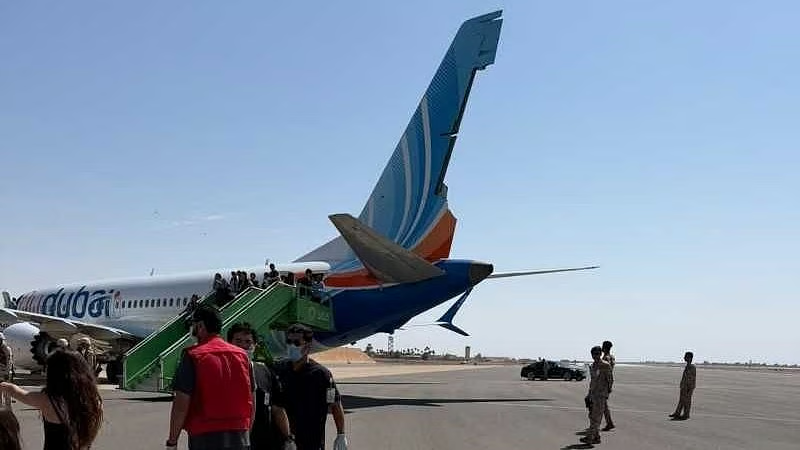
A harrowing midair struggle aboard flydubai Flight FZ1073 resulted in one of the most remarkable structural recoveries in modern aviation history. On Wednesday, September 30, 2026, a Boeing 737 MAX 8 carrying 174 passengers and crew members en route from Dubai to Tel Aviv plunged into a violent, uncontrolled dive near the Saudi Arabia-Jordan border. The plunge occurred when the aircraft’s Omani co-pilot launched a violent attack on Indian Commander Captain Smit Machchhar inside the cockpit. During the violent brawl, the flight controls were forced forward, pushing the commercial jet into an terrifying nose-dive where it dropped over 14,000 feet in under 30 seconds, reaching a peak descent rate of 23,000 feet per minute. Telemetry analysis revealed that the aircraft exceeded its structural maximum operating speed (VMO) by more than 100 knots, approaching near-supersonic velocity (MMO) before the crew regained control.
Despite the severe aerodynamic stress, extreme dynamic pressure (q), and high G-forces experienced during the drop and pull-out maneuver, the Boeing 737 MAX 8 airframe remained structurally intact. The primary reason the commercial jet did not suffer a catastrophic midair breakup lies in the robust structural safety margins and structural redundancy mandated by modern transport-category aircraft certification standards. Under Federal Aviation Administration (FAA) and European Union Aviation Safety Agency (EASA) airworthiness directives (such as FAR Part 25), commercial airliners are engineered with a minimum structural safety margin of 1.5 times the maximum expected limit loads. While (VMO) represents the operational speed ceiling, the ultimate structural limit speed (VDF/MDF) is designed significantly higher to withstand extreme overspeed scenarios without total airframe structural failure.
The immense aerodynamic drag generated during the high-speed plunge resulted in localized structural damage rather than a complete structural fragmentation. As the aircraft approached Mach speeds in the dense lower atmosphere, the violent aerodynamic force and asymmetric loads ripped away a significant portion of the aircraft’s vertical tail rudder. Aircraft designers deliberately engineer secondary control surfaces and non-primary fairings to yield or fail before critical primary load-bearing structures—such as the wing spars, fuselage carry-through joints, and wing-body carryover boxes—experience catastrophic structural failure. By shedding non-essential or secondary surfaces, the airframe released excess aerodynamic strain, preserving the integrity of the main fuselage pressure vessel and primary wing support spars.
The heroic actions of Captain Smit Machchhar and the deadhead relief crew aboard were crucial in preventing the aircraft from exceeding its structural yield limits. Despite sustaining severe stab wounds during the assault, Captain Machchhar maintained extraordinary composure, unlocked the reinforced cockpit door, and transmitted emergency codes 7700 and 7500. Passengers and off-duty crew members stormed the cockpit, subdued the assailant, and allowed off-duty pilots to immediately take the flight controls. The pilots executed a gradual, smooth pull-out maneuver from the steep dive, keeping the aircraft within recoverable G-force limits. Pushing a jet out of a high-speed dive too aggressively can generate extreme positive G-load forces that shear wings off the airframe; by carefully managing control inputs with enough altitude remaining, the crew stabilized the aircraft and successfully executed an emergency landing at Prince Sultan bin Abdulaziz Airport in Tabuk, Saudi Arabia.