
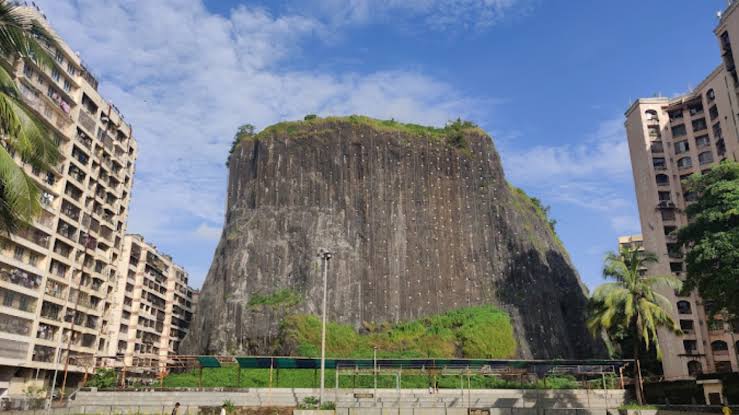
The scientific story behind Gilbert Hill began during the catastrophic volcanic events that created the Deccan Traps, one of the largest volcanic provinces on Earth. As superheated, molten lava squeezed out through fissures in the Earth’s crust, it spread across vast areas of western and central India. Over time, as this immense sheet of basaltic lava cooled and contracted, it underwent a physical transformation known as columnar jointing. The cooling lava shrank uniformly, fracturing into distinct, vertical hexagonal columns that formed a natural geometric grid. Millions of years of wind, rain, and soil erosion gradually wore away the surrounding softer terrain, leaving behind a stark, freestanding, columnated monolith standing tall amid what is now a dense metropolitan center.
Geologists around the globe consider Gilbert Hill an exceptional rarity. Structures featuring such well-defined, vertical columnar basalt rock are virtually unmatched worldwide. Similar rare columnar basalt formations can only be found in a few select global sites, most notably the Devils Tower in Wyoming, USA, and the Devils Postpile in California, USA. Named after the prominent 19th-century American geologist Grove Karl Gilbert, the hill in Andheri serves as an open-air natural textbook for volcanology and geology right in the middle of India’s commercial capital.
Beyond its immense geological and scientific worth, Gilbert Hill holds significant spiritual and cultural heritage for the local community. At the flat summit of the monolith, accessible via a steep set of stairs carved directly into the rock face, sit two historic shrines: the Gaodevi Temple and the Durgamata Temple. Set within a small greenery-covered plateau, these places of worship draw local devotees who trek up the rock face daily, offering a tranquil sanctuary and panoramic views of suburban Mumbai’s sprawling skyline amidst the city’s frantic noise.
Despite its world-class scientific importance, Gilbert Hill has faced severe environmental and anthropogenic threats over the past several decades. Throughout the 20th century, uncontrolled quarrying activities stripped away portions of the surrounding rock formations for road-building and construction material. Dense real estate development, informal settlements, and multi-story high-rises gradually encroached right up to the base of the hill. Over time, natural weathering, deep fissures, monsoon rainfall, and urban construction close to its base have caused rockfall hazards and structural instability, threatening both the monolith itself and the surrounding neighborhoods.
Recognizing the urgent need to protect this prehistoric landmark, the Central Government declared Gilbert Hill a National Monument in 1952 under the Forest Act, effectively banning commercial quarrying on the structure. Decades later, following sustained advocacy from geologists, historians, and environmental activists, the Municipal Corporation of Greater Mumbai (MCGM) designated Gilbert Hill as a Grade II Heritage Structure in 2007. This protective designation officially prohibited all construction and excavation within a designated buffer zone around the rock face.
In recent times, public interest in this dinosaur-era survivor has experienced a major resurgence. Prominent civic leaders, industrialists, and travel enthusiasts have frequently drawn social media attention to Gilbert Hill’s hidden presence, expressing astonishment that a landmark older than the Himalayas remains overlooked by mainstream tourism. These public discussions have triggered widespread calls among citizens and urban planners to transform the site into an organized geo-tourism destination complete with educational display boards, structural reinforcement, guided geological walks, and enhanced safety infrastructure to ensure the ancient monolith is safely preserved for generations to come.