June 3, 2026
With its historic IPO just days away, SpaceX stands at a pivotal crossroads. The question dominating global financial and aerospace circles is whether Elon Musk’s empire will remain a launch company after it begins trading on the public market. The definitive answer, drawn from the company’s S-1 filing and extensive analyst commentary, is no—SpaceX will not merely be a launch company; it is transforming into a vertically integrated tri-sector juggernaut spanning space transportation, global satellite internet, and bleeding-edge artificial intelligence infrastructure .
The IPO, targeting a staggering $1.75 trillion valuation with a listing expected as early as June 12 under the ticker “SPCX,” is not a celebration of past achievements but a massive fundraising mechanism to fuel an unprecedented cash-burn strategy aimed at dominating the future of connectivity and compute .
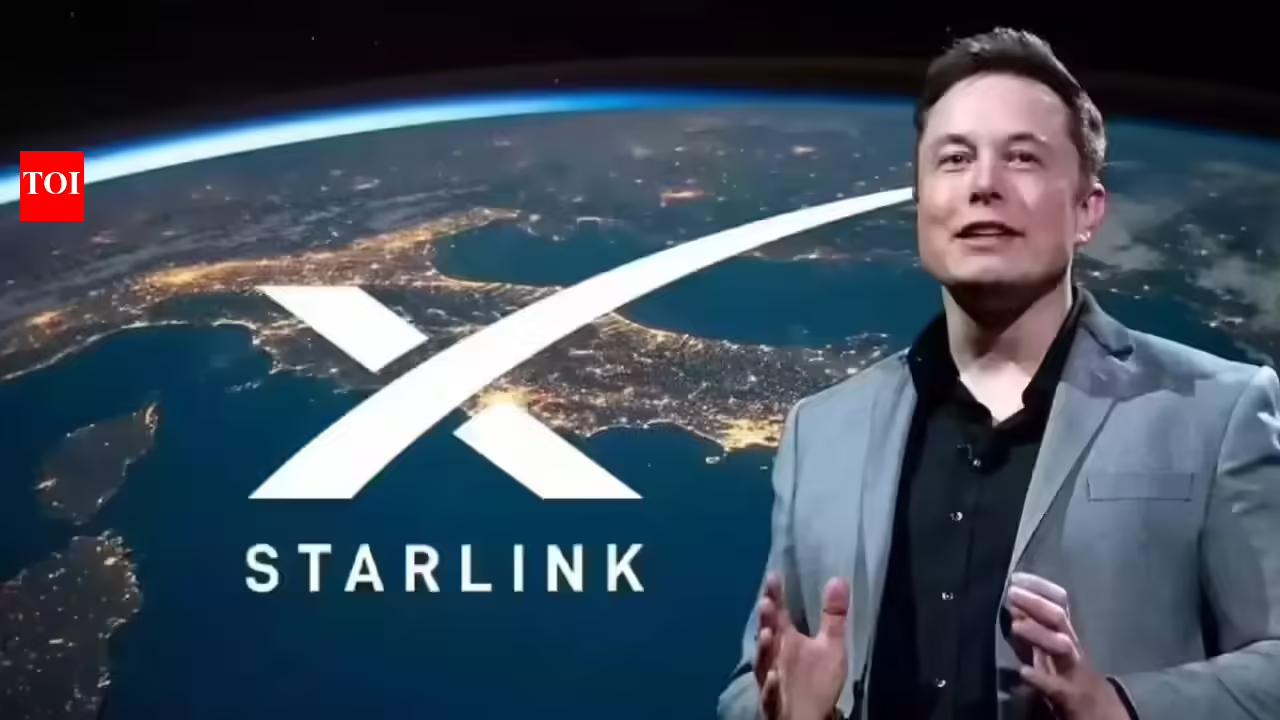
To understand the post-IPO entity, one must first look at the radical restructuring of its profit centers. For years, the narrative was that reusable rockets (Falcon 9 and Starship) were the product. The S-1 filing rewrites this story. Starlink has definitively become the financial engine, transforming SpaceX from a project-based contractor into a high-margin subscription service provider. In 2025, Starlink generated approximately $114 billion in revenue, accounting for roughly 61% of SpaceX’s total top line, driven by over 10 million global subscribers .
This segment is not just growing; it is profitable, posting billions in operating income that the company is immediately funneling back into capital expenditure. Morningstar analyst Nicolas Owens notes that while Starlink is a “cash engine,” the broader valuation rests on the strength of this segment, yet he warns that “we think the company has been significantly overvalued and investors will have opportunities to buy the stock at more attractive levels after the IPO” .
The traditional Space segment (launch services) , while still dominant in payload mass—launching 83% of all mass sent to orbit in 2025—is increasingly playing the role of strategic moat rather than primary profit driver . The revenue from flying NASA missions and commercial satellites is stable, but the immense research and development costs for the Starship program, which approached $30 billion in 2025, consume much of that income . However, analysts argue that this segment is the bedrock of the entire operation. According to a research note from国泰海通证券, the logic is clear: “With reusable rockets as the foundation, costs are lowered to build a satellite internet network to obtain cash flow, which is then invested in AI business to open up a broader market space, realizing SpaceX’s commercial闭环 (closed loop)” . Without the unmatched low-cost launch capability of Starship, the Starlink network cannot be replenished or expanded, and the more radical AI visions cannot be deployed.
The most controversial and transformative element of the IPO is the integration of xAI. By acquiring Musk’s AI firm earlier in 2026, SpaceX has pivoted hard into the artificial intelligence arms race. The financials here are stark and have split the investment community. The AI division is currently hemorrhaging cash, posting a staggering $24.7 billion operating loss in the first quarter of 2026 alone, driven by massive GPU purchases and the construction of supercomputers like Colossus . Yet, this is the division that justifies the trillion-dollar valuation.
The company has already secured a landmark deal with AI unicorn Anthropic, which will pay SpaceX approximately $12.5 billion per month through 2029 for access to its compute clusters . This suggests that SpaceX is positioning itself as an “AI cloud infrastructure provider” anchored in space. Financial commentator Jim Cramer highlighted this dynamic, pointing out that this deal “may dramatically change the financial structure of SpaceX’s AI business,” turning a loss leader into a massive revenue generator . However, skeptics abound. An analysis from AInvest warns that “the company is burning $4.3 billion a quarter to fund an AI bet that has already lost more money in three months than Starlink generated,” and argues that the accumulated deficit of $41.3 billion makes the $1.75 trillion valuation a “narrative play” rather than a value opportunity .
Looking beyond the immediate horizon of 2026, the IPO prospectus lays out a roadmap that moves SpaceX definitively away from the launchpad and toward deep-space and orbital infrastructure. The Starship rocket is scheduled to begin commercial payload missions in the second half of 2026, a capability that is central to Musk’s long-term thesis . Furthermore, the company is actively pitching the concept of orbital data centers—placing AI compute nodes in space to avoid terrestrial energy and regulatory constraints.
While Morningstar assigns a low probability (7%) to the “moonshot” success of this venture, the mere possibility is enough to keep the valuation narrative alive . TMF Associates analyst Tim Farrar argues that this is a strategic necessity, stating that “like Tesla, SpaceX’s valuation cannot easily be explained using conventional financial metrics. Instead, investors are being asked to buy into Musk’s broader vision of future industries that barely exist today” .
However, the transition to a public company introduces significant volatility and governance risks that did not exist in the private sphere. Unlike traditional IPOs that often allow early investors to cash out, the SpaceX IPO is a primary offering only; the company is selling new shares to raise capital (estimated at $75 billion), meaning existing shareholders cannot sell immediately . To appease those investors, SpaceX has implemented an aggressive lock-up expiration schedule, allowing insider sales to begin as early as 70 days post-IPO, rather than the standard 180 days . This could flood the market with supply and depress the stock price later in the year. Furthermore, the dual-class share structure will grant Elon Musk roughly 85% voting control, meaning public shareholders will be along for the ride regardless of the financial turbulence .