
May 16, 2026
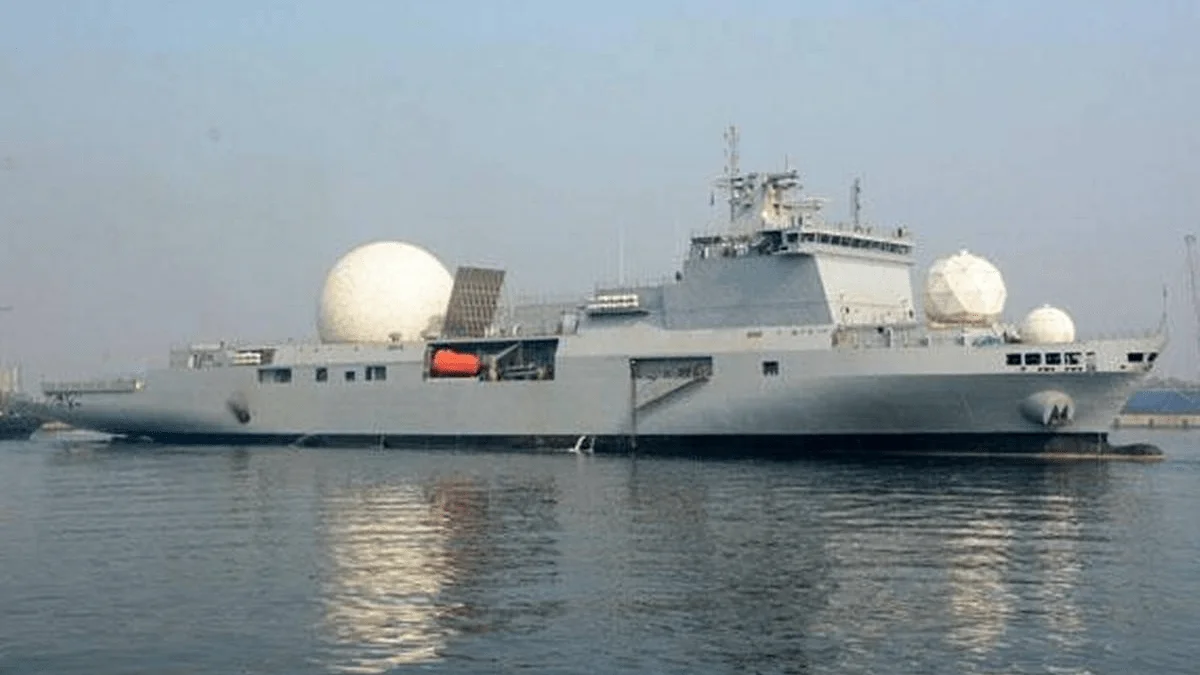
In an era where geopolitical friction rapidly shifts from territorial borders to high-tech intelligence showdowns, INS Dhruv (hull number A40) has emerged as the silent sentinel of India’s maritime and strategic deterrence. Commissioned on September 10, 2021, and operated under a tight-knit veil of secrecy, this 15,000 to 17,000-ton specialized vessel acts as a floating shield and an omniscient eye over the Indian Ocean Region and the Arabian Sea. The sheer gravity of its strategic significance was thrown into sharp relief just weeks ago in April 2026, when the Indian Navy deployed INS Dhruv to the Arabian Sea immediately following Pakistan’s declaration of a massive maritime exclusion zone for a strategic missile test.
Rather than engaging in a standard naval standoff, India utilized the ship to turn a neighbor’s highly sensitive weapons trial into an unprecedented masterclass in real-time intelligence gathering, demonstrating how sea-based surveillance defines modern national defense.The primary mandate of INS Dhruv is to function as a dedicated nuclear missile tracking and ocean surveillance ship, making India one of only five global powers—alongside the United States, Russia, China, and France—to possess such an elite capability. It was built indigenously by Hindustan Shipyard Limited (HSL) in deep collaboration with the Defence Research and Development Organisation (DRDO) and the National Technical Research Organisation (NTRO).
Because of the highly sophisticated nature of the technology onboard, the vessel does not belong to a singular branch; instead, it is operated by a joint crew of naval personnel, DRDO scientists, and NTRO technical experts. This multi-agency configuration ensures that data harvested by the ship is processed instantly and seamlessly woven into India’s central command and control structures.The most visually striking and technologically crucial features of INS Dhruv are the massive, white geodesic radomes mounted prominently above its superstructure. These domes conceal highly sensitive, state-of-the-art Active Electronically Scanned Array (AESA) radars operating in both the X-band and S-band spectrums. The S-band radar is tasked with long-range scanning and detecting multiple projectiles across thousands of kilometers, while the high-frequency X-band radar handles precision tracking, enabling the ship to lock onto smaller target signatures with pinpoint accuracy.
Together with long-range telemetry receivers, these sensors allow INS Dhruv to trace the exact flight trajectories, velocity, guidance profiles, staging sequences, and terminal performance of ballistic and hypersonic missiles. Reflecting on this technological marvel, a senior DRDO electronics scientist remarked, “The synthesis of multi-band AESA radars on a moving maritime platform gives us the capability to look through the clutter of the atmosphere and track high-speed threats from inception to impact, capturing data that land-based systems cannot reach.”Beyond tracking adversarial threats, INS Dhruv is a critical cornerstone for the calibration and advancement of India’s own Ballistic Missile Defence (BMD) network. When India conducts its routine academic and technical missile tests from the Integrated Test Range (ITR) at Abdul Kalam Island off the Odisha coast, projectiles frequently fly over vast oceanic stretches where ground-based radars experience line-of-sight limitations.
INS Dhruv positions itself directly beneath or adjacent to these flight paths to collect invaluable telemetry data and monitor missile re-entry vehicles. A defense researcher specializing in telemetry systems explained, “An indigenous missile’s evolution relies entirely on the precision of the telemetry data we gather during flight; by tracking the re-entry vehicle as it punches back into the atmosphere, INS Dhruv tells us exactly how our materials and guidance algorithms hold up under extreme thermal and kinetic stress.” This capacity to distinguish between different payload signatures and dummy decoys helps Indian planners constantly refine their interceptor algorithms to defeat complex countermeasure systems.The ship’s strategic utility extends well past the atmosphere into the domain of space surveillance and ocean floor mapping.
INS Dhruv is equipped to monitor Low Earth Orbit (LEO) satellites, which are extensively deployed by hostile actors for real-time military reconnaissance and communications. Given that India has already proven its anti-satellite (ASAT) capabilities, the real-time tracking of foreign assets provided by this ship adds an indispensable layer of space situational awareness. Furthermore, its ability to map ocean floors enhances the Indian Navy’s anti-submarine warfare capabilities, enabling the detection of stealthy enemy submarines navigating deep oceanic trenches. Commenting on the vessel’s multi-layered intelligence capabilities, a maritime security analyst stated, “Dhruv is not merely a tracking ship; it is a mobile, electronic fort that closes India’s security gaps across three domains simultaneously—oceanic depths, territorial skies, and low Earth orbit.”
The recent deployment in the Arabian Sea underscores why INS Dhruv represents a massive leap in India’s deterrence posture and technical transparency. When regional adversaries test advanced surface-to-surface missiles or sea-launched strategic platforms, they often rely on secrecy to mask the true capabilities of their weapons. By positioning INS Dhruv in international waters ahead of these launch windows, New Delhi effectively strips away that anonymity, capturing the exact electronic and kinetic signatures of the weapon. Experts note that this proactive posture alters the strategic calculus in South Asia, forcing adversaries to consider that any test they run will immediately be decoded and integrated into India’s defensive shield.
As a strategic defense analyst succinctly put it, “In modern warfare, data is the ultimate currency, and by deploying Dhruv to observe regional missile developments in real time, India ensures it maintains an unassailable edge in early-warning and strategic preparedness.” Ultimately, INS Dhruv stands as a testament to indigenous engineering, transforming India from a nation that merely reacts to regional threats into an active, technologically dominant force shaping maritime security.