July 11, 2026
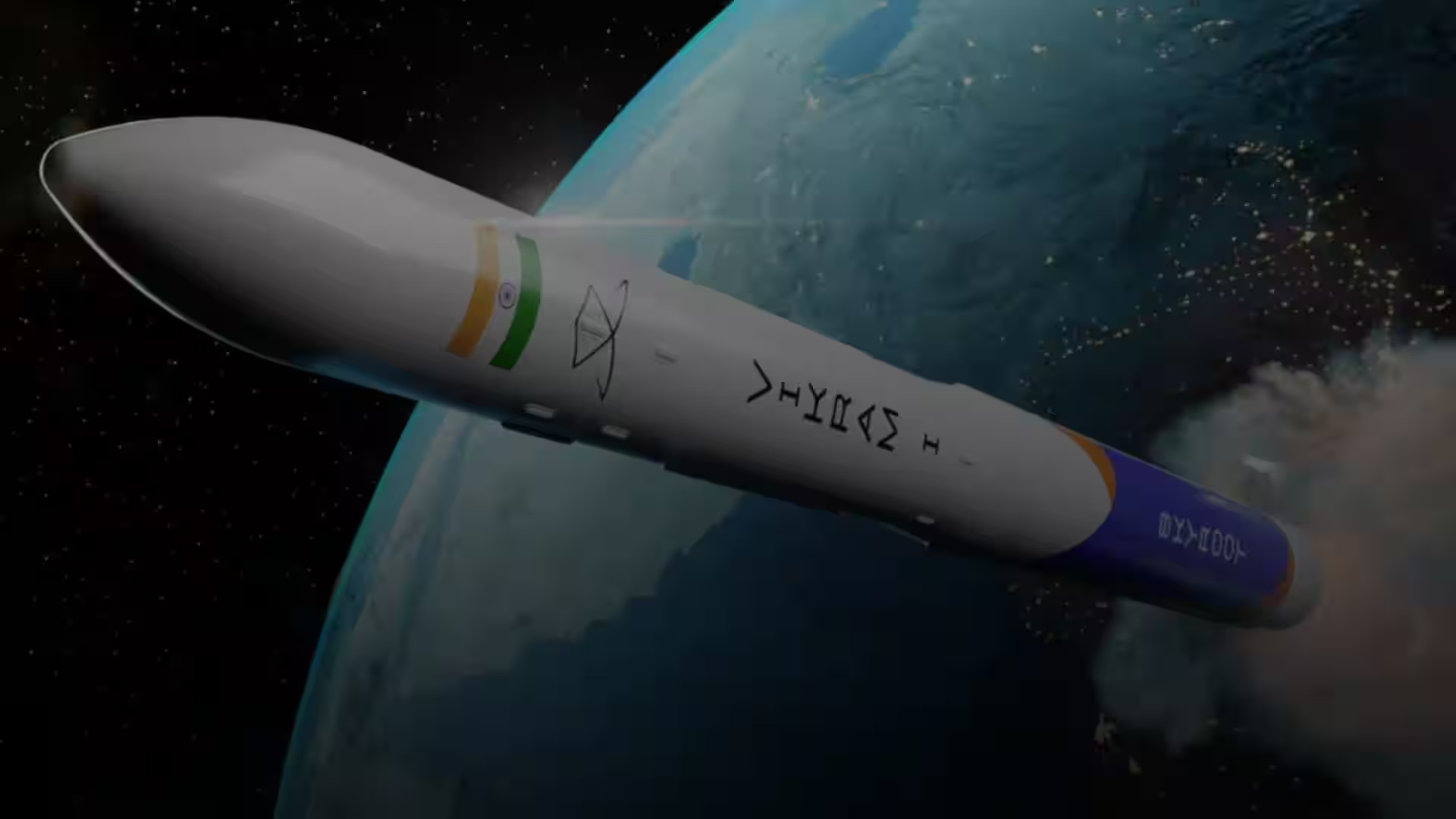
All eyes are on India’s burgeoning private space sector, with Skyroot Aerospace’s Vikram-I rocket poised for its historic maiden orbital flight, designated Mission Aagaman. The launch window, which opened on July 12 and extends to August 4, is being closely watched not just for its technological significance—marking India’s first privately developed orbital-class vehicle—but also for the remarkably diverse and eclectic mix of payloads it carries . From advanced in-orbit technology demonstrators to miniature 18-karat gold sculptures honoring India’s scientific giants, the payload manifest for Vikram-I is a testament to the evolving role of commercial space missions, showcasing a fusion of cutting-edge engineering, international collaboration, and unique artistic expression .
The central focus of this pioneering flight is to validate the Vikram-I rocket’s own systems. For the Hyderabad-based unicorn, the primary objective is not just deploying payloads but gathering critical in-flight performance data across all major subsystems, including propulsion, stage separation, guidance, navigation, and control . This data will be instrumental in refining the vehicle’s design for future commercial operations . However, nestled within the rocket’s carbon-composite structure is a suite of payloads that reflects the broad spectrum of possibilities now available in the new space age.
Among the most significant technological payloads is “Embrace,” developed by Cosmoserve Space, which features an in-orbit robotic arm. This technology is seen as a crucial step for future satellite servicing, inspection, and even debris removal, and will carry out its demonstration while remaining attached to Vikram-I’s payload deck . Another Indian startup, Grahaa Space, is flying “SOLARAS,” a 1U CubeSat designed to test emerging space technologies. Adding an international dimension, German company DCubed GmbH is contributing two technology demonstrators, “uD3PP” and “mD3RN,” highlighting the global interest in India’s growing launch capabilities . Skyroot is also flying its own in-house payload, “SCOPE,” which is intended to validate technologies developed by the company .
Beyond these serious scientific and engineering endeavors, the Vikram-I mission carries two payloads that capture the imagination, celebrating art, craftsmanship, and India’s scientific heritage in extraordinary ways. The first is “Cosmic Bloom,” developed by Cosmos Diamonds, a creation that features a diamond jewellery piece mounted on an aluminium base plate, symbolizing the intersection of luxury craftsmanship and space exploration. This is accompanied by an even more intricate payload: “Microart,” created by micro-sculptor Ajay Kumar Mattewada.
This awe-inspiring piece of art is a miniature rocket crafted from 18-karat gold, which contains microscopic sculptures of three of India’s most revered scientific visionaries: Sir C.V. Raman, Dr. Vikram Sarabhai (after whom the rocket is named), and former president Dr. A.P.J. Abdul Kalam. Each of these sculptures is a microscopic marvel, measuring just 700 by 980 microns—smaller than a grain of rice . The artwork, which was meticulously crafted and successfully passed stringent spaceflight qualification tests, is a poetic tribute to the foundational figures of India’s scientific and space programs, literally carrying their legacy into orbit .
This unique combination of payloads underscores a pivotal moment for India’s space sector. If successful, Skyroot Aerospace will cement its place as the first Indian private company to place payloads into orbit, a milestone that fundamentally reshapes the nation’s deep-tech landscape and opens a new chapter for its commercial space ecosystem. The mission demonstrates that private spaceflight is evolving beyond simple satellite deployment to become a versatile platform capable of serving universities, startups, international customers, technology developers, and even artists . The Vikram-I launch is more than a test of a rocket; it is a powerful showcase of India’s ambition to become a key player in the global commercial space market, proving that the future of space exploration is as diverse and innovative as the payloads it carries.