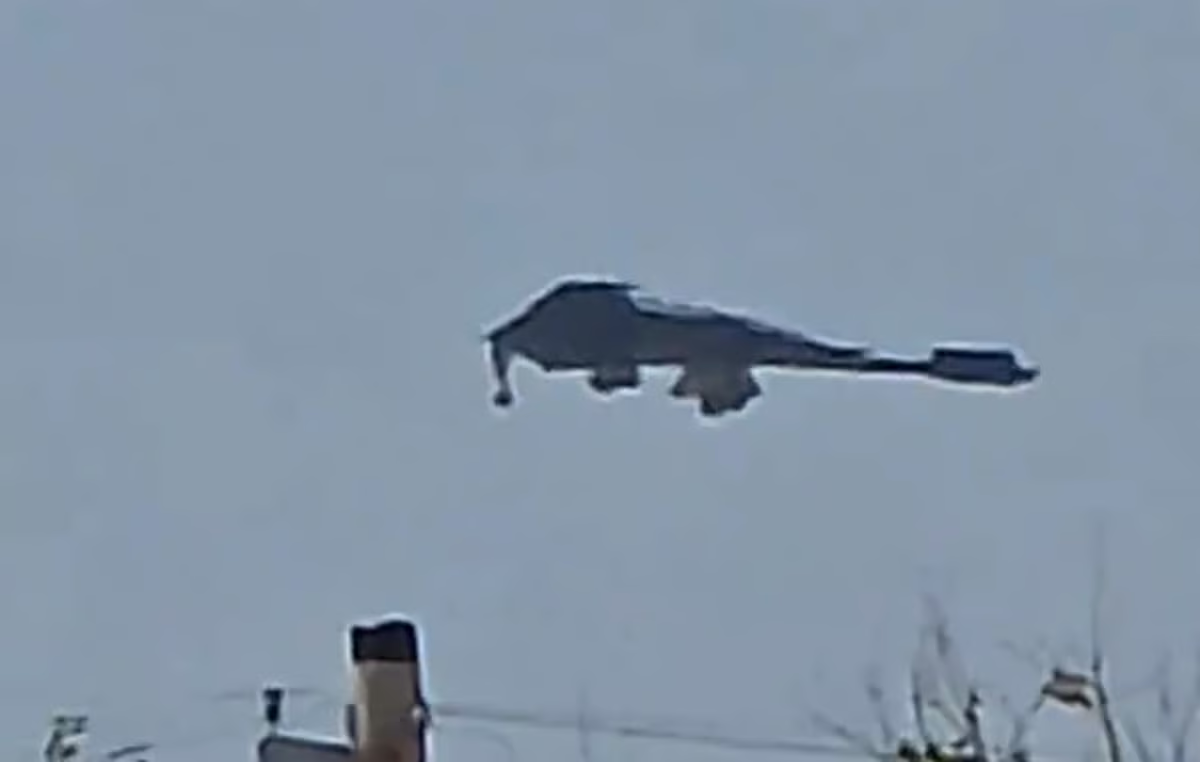
The skies above Kansas have become the center of intense speculation following the sighting of a mysterious, large gray aircraft flying near McConnell Air Force Base, with aviation experts and media outlets increasingly convinced it may be the highly classified B-21 Raider strategic bomber. The sighting occurred on August 11, 2026, when a witness captured video of the unidentified aircraft soaring through the airspace adjacent to the military installation. The footage, which quickly circulated across social media and news platforms, shows a large, gray plane with a design that closely resembles a stealth bomber, immediately prompting comparisons to the United States Air Force’s next-generation bomber program.
The emergence of this video has reignited public curiosity about the highly secretive B-21 Raider, a program that represents the future of America’s long-range strike capabilities and is developed under some of the strictest security protocols in the U.S. military. As the footage continues to be analyzed, the predominant theory among defense observers and media reports is that the public may have just been granted a rare, unauthorized glimpse of the B-21 in a real-world environment, potentially on a transit flight between test sites or operational bases.
The speculation is heavily fueled by the aircraft’s distinct profile and the location of the sighting. The plane was observed flying near McConnell Air Force Base in Kansas, a facility with deep ties to U.S. bomber operations, historically serving as a hub for B-52 Stratofortress and KC-135 Stratotanker aircraft. This connection makes the base a plausible location for a new bomber to appear, whether for crew familiarization, logistical stops, or operational testing. Reporting from the New York Post, which was widely cited by various media outlets, noted that the aircraft’s appearance fits the description of the B-21 Raider, the latest strategic bomber developed by Northrop Grumman.
The B-21 is not merely an incremental upgrade but is touted as a revolutionary platform, described by the Air Force as a “nuclear-capable stealth bomber” designed to penetrate the most sophisticated air defense systems in the world. With an average unit cost estimated at approximately $700 million, the bomber is one of the most expensive and advanced weapons systems ever developed, intended to eventually replace the aging B-2 Spirit and B-1 Lancer fleets. The visual evidence captured by the witness, showing a sleek, flying-wing design, aligns perfectly with the known aesthetic of the B-21, which prioritizes radar-evading stealth above all other characteristics.
The significance of this sighting extends beyond just the visual confirmation of a secretive aircraft; it touches upon the intense confidentiality surrounding the B-21 program, which remains at a maximum security classification level even as it progresses toward operational status. The Air Force has officially stated that the B-21 is expected to enter service within the next decade, marking a major milestone for U.S. strategic deterrence. However, the program’s development has been cloaked in remarkable secrecy compared to other military projects, with controlled releases of information and carefully staged photo opportunities.
This makes an unplanned public sighting such as the one over Kansas a significant event, offering aviation enthusiasts and defense analysts a rare piece of raw intelligence. The aircraft seen in the footage is likely a prototype or an early production model conducting a test flight, possibly between Edwards Air Force Base in California, where much of the testing occurs, and other military installations. The sighting highlights the challenge of maintaining operational security in the modern era, where civilian photographers and aviation trackers are constantly monitoring the skies, ready to capture images of any unusual or unknown aircraft.
While the B-21 theory dominates the discussion, the sighting comes at a time of general heightened interest in military aviation movements across the United States. The public and media are increasingly attuned to the flights of unusual military aircraft, whether due to geopolitical tensions or the natural curiosity surrounding next-generation technology. This is not the first time in recent months that a mysterious military jet has captured the public’s imagination; sightings of other rare aircraft, such as the E-4B “Doomsday Plane,” have also sparked widespread interest and speculation online.
The convergence of these events has created an environment where any anomaly in military air traffic is scrutinized for deeper meaning, with social media users often jumping to connect such sightings to international events or a perceived escalation of global tensions. However, the consistency of the reports regarding the Kansas sighting lends significant weight to the hypothesis that this particular aircraft was indeed the B-21, as the identification is not based on wild conjecture but on the aircraft’s unique visual profile, which differs substantially from the B-2 Spirit or any other known platform in the U.S. inventory.
In conclusion, the mystery aircraft filmed soaring over Kansas is widely believed to be the B-21 Raider stealth bomber, a cornerstone of the U.S. Air Force’s modernization strategy. The sighting on August 11 near McConnell Air Force Base has brought the highly classified bomber program into the public eye, highlighting its nuclear-capable stealth design and its staggering $700 million price tag. While the Air Force has not officially confirmed the identity of the aircraft, the visual evidence and contextual clues strongly support the theory that this was a test flight of the future of American air power. The event serves as a potent reminder of the ongoing, yet largely invisible, technological arms race and the immense resources being dedicated to maintaining strategic superiority in an increasingly complex world, promising a new era of stealth and capability that is expected to be fully unveiled within the decade.