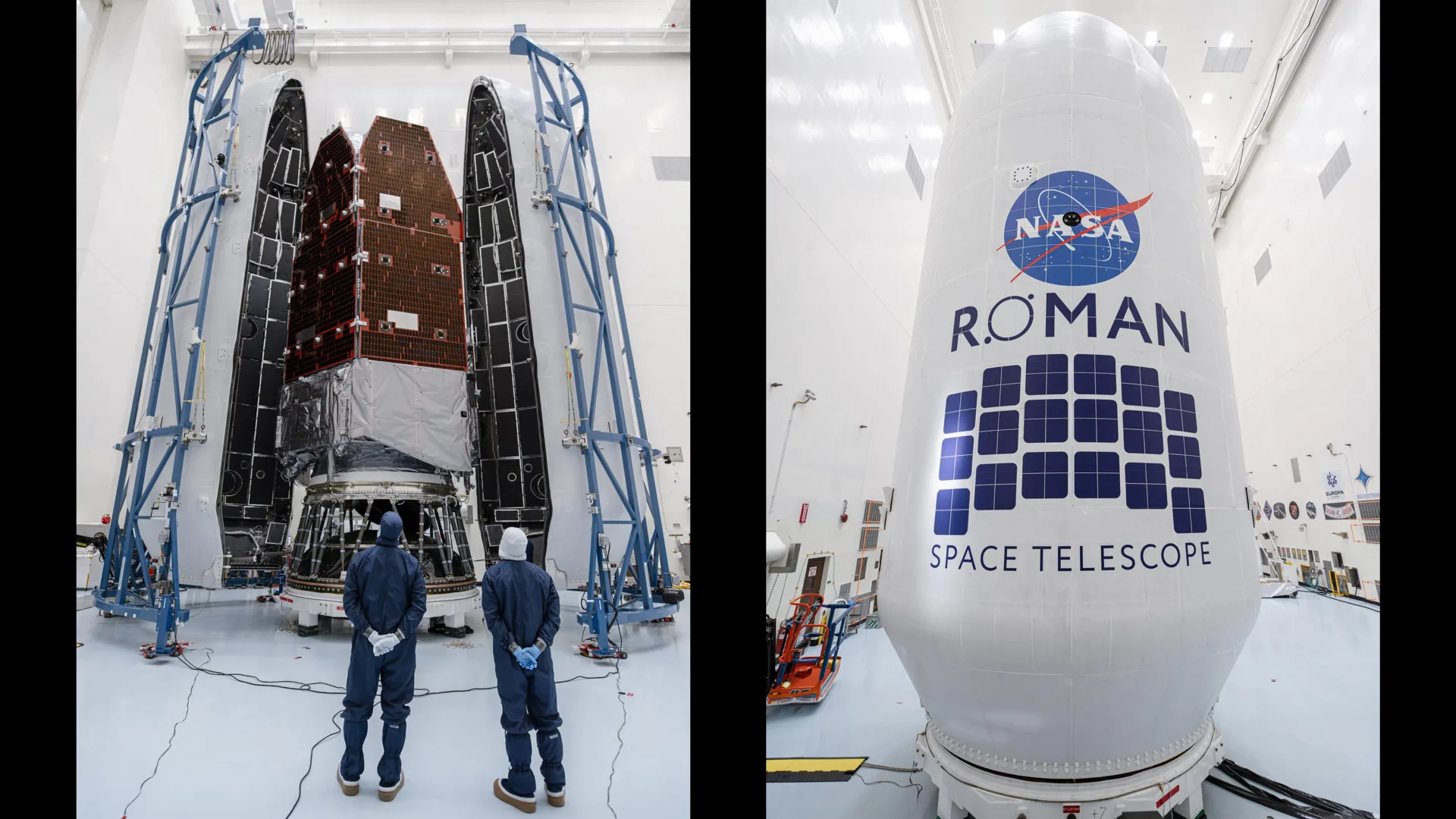
NASA is on the verge of a monumental leap forward in astrophysics with the Nancy Grace Roman Space Telescope, a revolutionary observatory that is officially ready for its launch aboard a SpaceX Falcon Heavy rocket. After completing its final prelaunch processing and successfully passing the critical Launch Readiness Review, the mission is targeting liftoff for no earlier than 7:26 a.m. EDT on Sunday, August 30, 2026. The launch will take place from the historic Launch Complex 39A at NASA’s Kennedy Space Center in Florida, marking the next major milestone in the agency’s ambitious science program. As a testament to its meticulous preparations, the observatory was recently transported to the SpaceX hangar at the launch pad, where it was mated to the powerful Falcon Heavy rocket that will carry it on its long journey. The launch will be a spectacular event, as the Falcon Heavy’s two side boosters are slated to return to Landing Zones 1 and 2 at Cape Canaveral, producing a series of thunderous sonic booms that will echo across Florida’s Space Coast.
Named in honor of Dr. Nancy Grace Roman, NASA’s first chief of astronomy and a pioneering figure often celebrated as the “mother” of the Hubble Space Telescope, this new flagship mission is poised to fundamentally transform our understanding of the cosmos. The spacecraft is an engineering marvel, built around a 2.4-meter primary mirror that shares the same diameter as Hubble’s but is designed for a vastly different purpose. Roman’s true power lies in its extraordinary wide field of view; with a single image, it can capture a patch of sky more than 200 times larger than Hubble, providing an unparalleled panoramic view of the universe. This capability is made possible by its primary science instrument, the Wide Field Instrument, a 300-megapixel infrared camera that will deliver crisp, high-resolution images at a breathtaking scale. Once operational, the telescope will produce a torrent of data, expected to beam down over 500 terabytes per year, a volume roughly equivalent to the total data collected by Hubble over its entire 35-year history.
The Roman Space Telescope is fundamentally a mission of discovery designed to tackle the most profound mysteries in modern astrophysics. Its primary scientific objectives are to investigate the nature of dark energy and dark matter, the invisible forces and substances that constitute over 95% of our universe. By conducting a vast survey of billions of galaxies, Roman will map the distribution of dark matter through a technique called weak gravitational lensing, observing how the gravity of this unseen matter warps the light from distant galaxies. This comprehensive map will trace how cosmic structures have formed and evolved over billions of years. To study dark energy, the mysterious force causing the universe’s expansion to accelerate, Roman will employ multiple methods. It will observe Type Ia supernovae to measure cosmic distances precisely and analyze the clustering of galaxies to understand the imprint of ancient sound waves, known as baryon acoustic oscillations. These combined approaches will provide the most detailed insights yet into how the universe has expanded over time, bringing us closer to understanding the fundamental physics at play.
Beyond its cosmological goals, Roman will be an exceptionally powerful exoplanet hunter, embarking on a mission to create a comprehensive census of planetary systems in our galaxy. With its immense field of view, it will peer into the heart of the Milky Way to monitor the brightness of hundreds of millions of stars. It is expected to discover over 100,000 new exoplanets, a massive leap forward from current known numbers. Roman will primarily utilize two techniques: gravitational microlensing, where the gravity of a star and its planets magnifies the light of a more distant background star, and the transit method, which detects the slight dimming of a star’s light as a planet passes in front of it. Furthermore, Roman is equipped with a state-of-the-art Coronagraph Instrument, a technology demonstrator designed to block the blinding glare of a host star, allowing astronomers to directly image giant, cool exoplanets in orbit around it. This technology paves the way for future missions aimed at finding and studying Earth-like planets.
After its launch, the observatory will embark on a five-year primary mission, with enough fuel to potentially extend its operations for another five years. It will travel one million miles (approximately 1.5 million kilometers) to the second Sun-Earth Lagrange point (L2), a gravitationally stable location in space where it will join the James Webb Space Telescope. Launching a full nine months ahead of schedule, Roman will quickly begin its surveys and is expected to generate a deluge of publicly available data that will enable a multitude of discoveries beyond its core science goals. The scientific community is already preparing, with over 100 research programs selected to study everything from “little red dots” and the formation of early galaxies to black holes and objects in our own solar system. The $4.3 billion mission represents a new era of space exploration, combining the sharp vision of Hubble with the panoramic survey power of a wide-field observatory, ready to rewrite textbooks and unveil the universe’s secrets.