
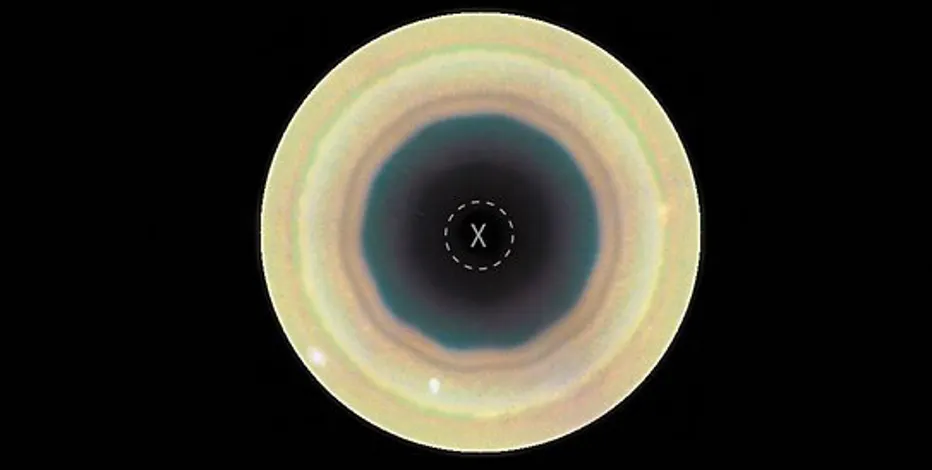
A colossal and enigmatic weather system has been discovered swirling in the clouds above Saturn’s south pole, marking only the second time such a geometric formation has been seen on any planet . Decades after the legendary hexagonal storm was first spotted at Saturn’s north pole, astronomers have confirmed the existence of a strikingly similar, yet distinct, giant atmospheric wave in the planet’s southern hemisphere—this time taking the shape of a near-perfect decagon, a 10-sided polygon . The discovery was made possible through a collaboration between professional scientists and amateur astronomers, utilizing data from ground-based telescopes and NASA’s Hubble Space Telescope, and was published on September 2, 2026, in the journal Science Advances . This finding challenges long-held assumptions about the uniqueness of Saturn’s northern hexagon and suggests the planet’s atmosphere is more dynamic than previously understood .
The story of this discovery began not with a large space observatory, but with the keen eyes of amateur astronomers. In 2024, observers Trevor Barry and Jean-Paul Oger noticed a subtle, undulating dark band encircling the southern pole in images they had captured from the ground . These observations were submitted to the Planetary Virtual Observatory Laboratory, a website managed by the University of the Basque Country in Spain, which collects ground-based images of solar system planets from observers all over the world . Intrigued by these hints, lead author Agustín Sánchez-Lavega of the University of the Basque Country and his international team turned to the Hubble Space Telescope’s extensive archive. “Given Saturn’s symmetry in its north-south jet stream system, we have been searching for a counterpart to Saturn’s northern hexagon on the south pole in Hubble images since 1990,” Sánchez-Lavega stated . “Images from NASA’s Cassini spacecraft, which orbited Saturn between 2004 and 2017, showed no inkling of a long-lived formation, either. The Hubble data confirmed the feature’s presence back to 2023” . By piecing together several years of Hubble observations as part of its Outer Planet Atmospheres Legacy (OPAL) program, the team found subtle hints of the structure beginning to emerge and develop into a clearly defined pattern .
The newly discovered decagon is a massive atmospheric phenomenon, measuring approximately 13,000 kilometers across, which is slightly wider than the diameter of Earth . It is a vast atmospheric wave riding on one of Saturn’s powerful eastward jet streams, centered around 60 degrees south latitude . The jet itself is a powerhouse, racing around the planet at roughly 420 kilometers per hour (260 miles per hour), while the decagonal wave pattern moves at a comparatively leisurely pace of about 10 kilometers per hour . Observations taken at different wavelengths of light, which probe different altitudes, revealed that the decagon’s shape extends vertically through multiple layers of Saturn’s atmosphere, confirming it is not just a superficial cloud-level feature but a deeply rooted atmospheric structure . “We’ve never seen anything quite like this in Saturn’s southern hemisphere,” said Amy Simon, study co-author and OPAL principal investigator at NASA’s Goddard Space Flight Center . “The northern hexagon has been there every time we’ve looked for more than 40 years. This feature is different — it appears to be strengthening, giving us the rare opportunity to watch a giant atmospheric pattern develop” .
The most compelling aspect of this discovery is that the decagon appears to be a new and evolving phenomenon, in stark contrast to its northern counterpart. The hexagon at the north pole, first glimpsed by the Voyager probes in the early 1980s, has proven to be a remarkably stable and long-lived feature, having been observed consistently for over 40 Earth years (more than one Saturnian year) . The southern decagon, however, was not present in any images from the Cassini mission, which ended in 2017, indicating that it must have formed sometime between 2017 and 2023, a period when Saturn’s south pole was tilted away from Earth and largely hidden from view . “The most intriguing part to me is that this seems to have just formed recently,” Simon remarked . “The question is, why did it suddenly form now when we haven’t seen one before?” . The decagon itself appears to be more unstable and perhaps not as robust as the hexagon, as it is still evolving and its position shifts slightly, migrating eastward, while the northern hexagon remains practically stationary .
The differences between the two polar polygons extend beyond their age and stability. While both are geometric waves riding on jet streams, they are not mirror images of each other. The southern decagon is situated at a less polar latitude than the northern hexagon, and its 10-sided geometry presents a puzzle as to why it differs from the north’s six-sided shape . “In addition to the difference in the number of sides,” Sánchez-Lavega explained, “the decagon is situated at a less polar latitude than the hexagon in the southern hemisphere, and is perhaps not as robust, as we have seen that it has formed” . Scientists are exploring several hypotheses for these differences, including a link to a large, nearby anticyclone—a high-pressure vortex dubbed a “Red Spot” (a temporary, smaller analog of Jupiter’s Great Red Spot) that sits just north of the decagon . Intriguingly, the decagon appears most pronounced near this vortex and least distinct on the opposite side of the planet, suggesting the storm could be forcing the wave’s formation . However, initial computer simulations attempting to recreate the decagon with a storm disturbance were unable to reproduce the observed phenomenon exactly, leaving the mystery unsolved .
The discovery of Saturn’s decagon has significant implications for planetary science. It suggests that the northern hexagon is not an isolated oddity but part of a broader atmospheric process that can generate polygonal shapes under certain conditions in both hemispheres . “This discovery suggests that the hexagon is not as extraordinary as previously thought and that, in fact, the conditions in Saturn’s atmosphere are such that polygonal waves can form in both hemispheres surrounding the polar regions,” said Sánchez-Lavega . “This is a highly interesting phenomenon that appears to be unique to Saturn, and we want to know why” . Co-author Leigh Fletcher from the University of Leicester, who measured the wind in the decagon using the European Southern Observatory’s Very Large Telescope, echoed this sentiment, stating, “Saturn still has the ability to surprise us” . “Given the season, Saturn’s southern hemisphere is emerging from more than a decade in winter darkness. Something has clearly changed during that long winter when we weren’t looking, presenting us with this stunning new feature around the South Pole” . The team plans to continue observing the decagon using Hubble and the James Webb Space Telescope to determine whether it will settle into a stable configuration like its northern cousin or continue to evolve and perhaps disappear . For the time being, as Sánchez-Lavega confirms, “all I can confirm is that the decagon is still there” . This dynamic and mysterious phenomenon offers a rare, real-time glimpse into the complex and powerful forces shaping the atmospheres of giant planets, providing a unique laboratory for understanding atmospheric dynamics not just on Saturn, but throughout the solar system and beyond .