
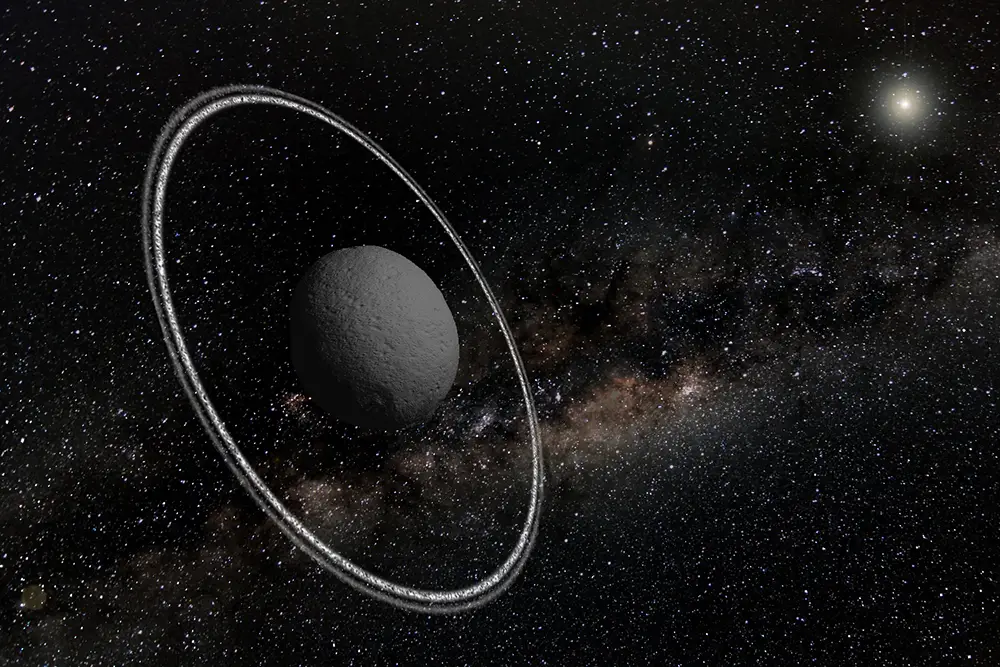
An international team of astronomers using the James Webb Space Telescope (JWST) has discovered, for the first time, that the two rings around the small Solar System body Chariklo are changing in opposite directions — a finding that challenges the long-held view that ring systems around small bodies are relatively stable. The study, published in Science Advances on September 9, 2026, was led by the Institute of Astrophysics of Andalusia (IAA-CSIC) and involved collaborators from Spain, Brazil, France, Hungary, and the United States .
Chariklo is a Centaur — a small body roughly 250 kilometers in diameter orbiting between Saturn and Uranus at nearly 17 times the Earth-Sun distance. In 2013, it became the first non-planetary body confirmed to possess rings, when astronomers detected two dense, narrow rings through stellar occultation observations . Stellar occultation is a technique that measures the brief dip in a star’s brightness when a body and its rings pass in front of it, allowing astronomers to study structures too small and distant to be photographed directly, even with JWST .
The breakthrough came from the first stellar occultation specifically predicted and successfully observed with JWST, which took place on October 18, 2022 . By comparing these near-infrared JWST measurements with data from other stellar occultations collected over the past decade, the team found striking changes in both rings.
The inner ring (C1R) has become significantly more opaque, with its opacity increasing by approximately 50% compared to previous observations . The researchers suggest this could reflect ongoing replenishment or dynamical restructuring of the ring material . The outer ring (C2R), in contrast, has shown a dramatic decrease in opacity, dropping by about 60% below the 2017 measurements . This apparent fading may indicate that the outer ring is undergoing depletion — losing material over time .
The study outlines two possible explanations for the outer ring’s weakening. One is that the ring is genuinely dissipating. If so, particle collisions could be producing smaller grains that are more easily lost; without effective confinement, these grains would be subject to increasing orbital eccentricities due to radiation pressure, eventually causing their orbits to intersect the inner ring . Alternatively, the discrepancy could arise from wavelength-dependent scattering: JWST observes in the near-infrared, while most previous data came from visible-light observations. However, the team’s radiative transfer modeling indicates that wavelength dependence alone cannot fully explain the changes after 2017, suggesting that at least some of the observed variations are real .
The findings have broader implications. Dusty, low-mass rings elsewhere in the Solar System — such as Saturn’s D, E, and F rings, Neptune’s Adams arcs, and Uranus’s λ ring — are known to exhibit temporal variability . The changes detected at Chariklo suggest that ring systems around small bodies may be far more dynamic than previously believed, possibly representing transient, evolving structures rather than permanent features .
“This unexpected behavior indicates that Chariklo’s ring system is dynamic and may be subject to more complex physical processes than previously thought,” said Pablo Santos-Sanz, the IAA-CSIC researcher who led the study . He added that the results “force us to rethink how they form, how they evolve, and what mechanisms maintain their stability” .
The observation itself was a scientific and technological milestone. Achieving it required extraordinarily precise knowledge of Chariklo’s orbit, the background star’s position (provided by ESA’s Gaia mission), and JWST’s own trajectory around the L2 Lagrange point, about 1.5 million kilometers beyond Earth . At the time of the occultation, Chariklo was moving relative to JWST at just 2.5 kilometers per second — an exceptionally low relative speed that provided unprecedented spatial resolution for studying the ring structure .
While the physical origin of the detected changes remains an open question — whether reflecting genuine temporal evolution, filter-related differences, or a combination of both — the study opens a new window for understanding how ring systems around small bodies form, evolve, and persist .