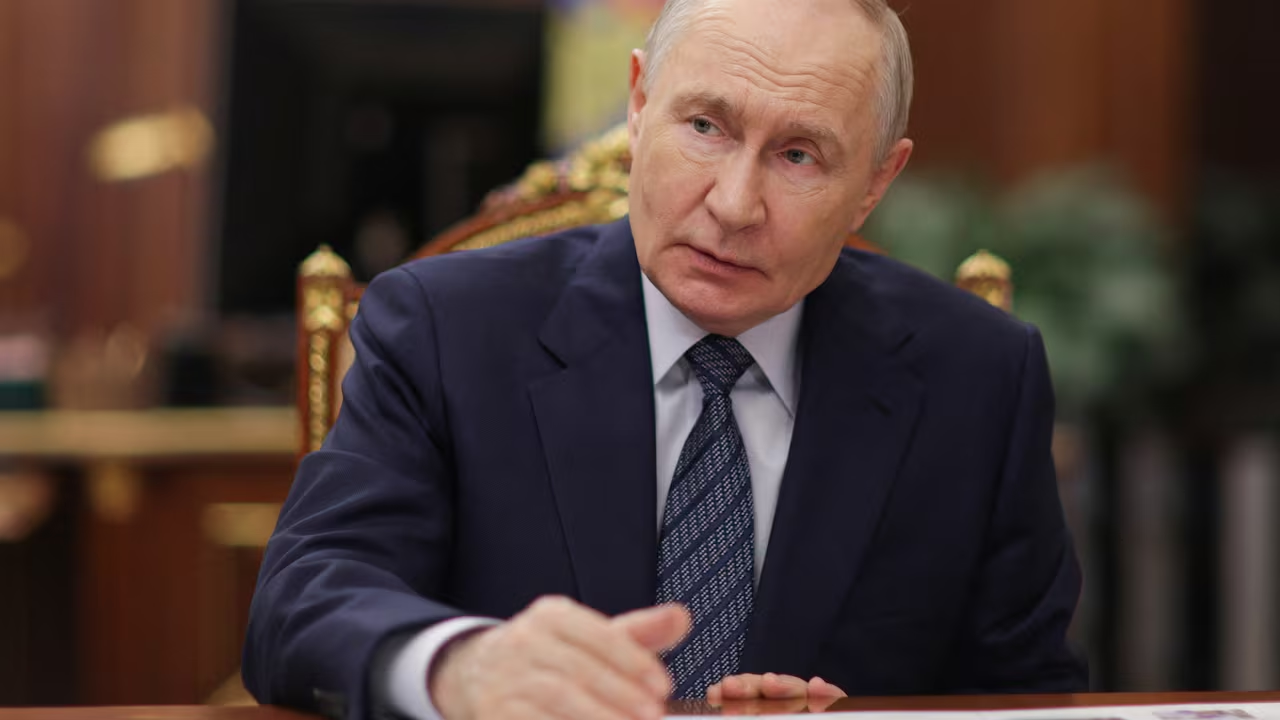
Russian President Vladimir Putin has issued a stark warning to the Russian populace, demanding that they must “be prepared for anything,” a statement widely interpreted as his clearest signal yet that he may be planning a significant escalation of the ongoing war in Ukraine. Speaking at the Kremlin during a meeting with outgoing deputies of the eighth State Duma, Putin framed the current historical moment as “one of the decisive stages in the history of our Motherland,” declaring that “the fate of our nation hangs in the balance.” He asserted that Russia is facing a “fateful turning point,” alleging that the West is attempting to sow chaos and destabilize Russia from within. However, he insisted that “they cannot win either on the battlefield or strategically.” The Russian leader called for national unity, emphasizing that Russia possesses sufficient strength, resources, and political resolve to thwart all attempts to hinder its development and to protect the security of the state and its citizens. These remarks align with a significant shift in Moscow’s official rhetoric; in July 2026, Kremlin spokesman Dmitry Peskov for the first time officially characterized the conflict as a “full-scale war,” moving away from the longstanding euphemism of “special military operation.” This linguistic change marks a fundamental recalibration of how the Russian state perceives and presents the war to its domestic audience, signaling that the Kremlin is preparing the public for a prolonged and potentially more intense confrontation.
Concurrent with Putin’s verbal warning, Russian military operations on the ground have demonstrated a tangible increase in combat intensity. The Russian armed forces launched a large-scale retaliatory strike against Ukraine, deploying an array of advanced weaponry, including the “Oreshnik” hypersonic ballistic missile, to target Ukrainian military command facilities, air force bases, and defense industrial enterprises. This heavy response followed a Ukrainian drone attack on a vocational school in the Luhansk region, which resulted in significant casualties. Military analysts suggest that Moscow’s decision to employ such a diverse missile arsenal is rooted in a broader strategic calculus. The underlying context includes a structural realignment of U.S. European security policy and a visible stalling of U.S.-led negotiation tracks, which Moscow interprets as a widening window of opportunity—a perceived weakening of Washington’s security commitments to Europe. This perception is reinforced by Washington’s stated shift in aid strategy, moving from unconditional grants to a “for-sale” model of military assistance, while also openly acknowledging that supporting Ukrainian strikes deep into Russian territory is aimed at forcing the Kremlin into a compromise. Russian Foreign Minister Sergey Lavrov has echoed this combative stance, bluntly stating that Russia’s “reserves of goodwill and hope have been completely exhausted.”
Despite this aggressive posture and the unmistakable hints of escalation, Moscow’s position on peace negotiations remains conspicuously contradictory. On one hand, Lavrov, shortly after declaring the depletion of goodwill, reaffirmed during a meeting with the U.S. Secretary of State that Russia remains open to resolving the conflict through political and diplomatic channels. Peskov similarly reiterated that Russia is not closing the door on peace talks. However, this professed openness appears largely tactical. The Kremlin has consistently maintained that a direct meeting between Putin and Ukrainian President Volodymyr Zelenskyy can only be productive at the final stage of drafting a peace agreement, effectively placing a precondition that makes substantive dialogue nearly impossible in the near term. Given that both sides remain intransigent on core territorial and sovereignty issues, the trilateral negotiation mechanism brokered by the United States has ground to a complete halt. Therefore, Putin’s call for the nation to “be prepared” operates less as a diplomatic overture and more as a declaration of resolve. It signals that, with negotiations in deadlock, Russia is bracing for a protracted, higher-intensity war of attrition. As Putin himself underscored, Russia will act “carefully but unswervingly” on the battlefield and “will certainly achieve its goals.”
The current state of the conflict has devolved into a grinding war of attrition and resource depletion, with both sides enduring enormous casualties and material losses, yet neither capable of achieving a decisive breakthrough in the foreseeable future. In this precarious equilibrium, Putin’s latest warning is likely designed to lay the psychological and political groundwork for a broader societal and economic mobilization. It prepares the Russian public for the possibility of additional conscription waves, deeper defense-industrial integration, and further sacrifices. Analysts from institutions such as Tsinghua University’s Center for Strategic and International Studies note that the prospect for a ceasefire remains bleak, with the conflict having entered a gray zone of “neither war nor peace.” Nevertheless, Putin’s unambiguous message makes it clear that Moscow prefers to leverage sustained military pressure to enhance its bargaining position, rather than seeking a premature compromise. Ultimately, the trajectory of this war will be decided by a stark equation: Russia’s stated determination to fight on, regardless of cost, versus the durability and consistency of Western military and financial support for Ukraine. For now, the Kremlin is signaling that it is ready for the long haul—and that every Russian citizen must brace for whatever comes next.