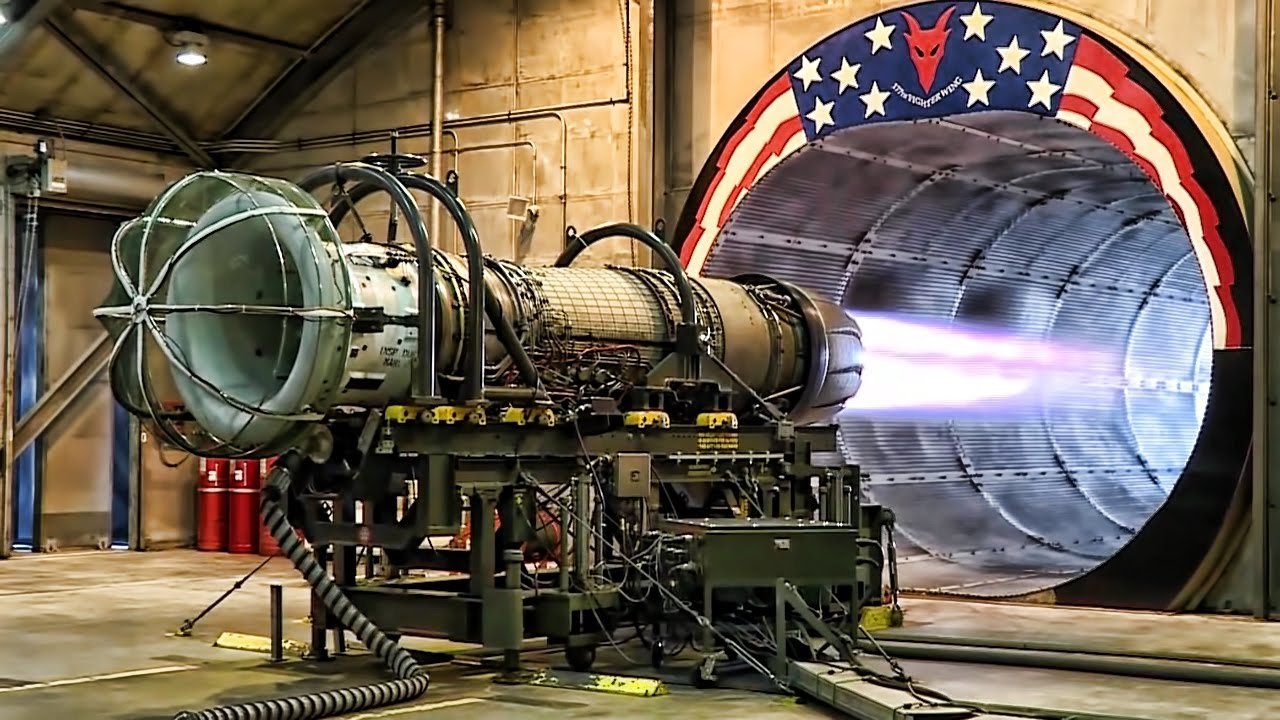
Before a single drop of aviation fuel is ever burned in flight, a new jet engine must endure a crucible of fire, ice, and simulated catastrophe. This multi-year odyssey of validation is designed to prove not just that an engine can generate thrust, but that it can survive the unimaginable. It is a rigorous gauntlet that begins in the quiet hum of a laboratory and ends in the deafening roar of a test cell, where every scenario short of a crash is simulated to ensure absolute safety and reliability. The entire process is a vast, complex undertaking that exists to compress a lifetime of potential dangers into a few months of controlled, data-rich experiments.
The journey starts at the component level, where individual parts like the high-pressure compressor and low-pressure turbine are pushed to their limits to validate aerodynamic models and material strength . Specialized facilities, like those at MTU Aero Engines, use powerful electric drive motors to spin compressors and bring them to the brink of a stall to see if theoretical performance matches reality . Once the individual pieces are proven, the full engine is assembled and moved to some of the world’s most advanced test beds. Here, it must prove its durability over hundreds of hours of running. One of the most grueling tests is the “Accelerated Mission Test” (AMT), a non-stop cycle of throttle slams that simulates 20,000 throttle transients from idle to maximum power—a far cry from the few hundred cycles demanded by older specifications . This is a demanding process, as the long, hot “dwells” at high power can cause stress rupture and creep in turbine blades, while the rapid transients inflict low-cycle fatigue on the entire structure .
However, to truly certify an engine for flight, engineers must create the sky inside a giant steel chamber. Altitude test facilities, such as those at the Arnold Engineering Development Center (AEDC) and NASA’s Propulsion Systems Laboratory, are critical for simulating flight conditions without the aircraft ever leaving the ground . These massive cells use powerful exhaust compressors to suck the air out of the chamber, mimicking the thin atmosphere at altitudes up to 90,000 feet, while powerful air supply systems can simulate speeds of up to Mach 6.0 . At the Rolls-Royce Testbed 80 in the UK, engineers don’t just simulate generic conditions; they can replicate the exact hot and dusty environment of a specific region, such as the Middle East, using real operational data gathered from engines flying there . This capability is crucial for ensuring the engine’s control systems and cooling designs function perfectly in the world’s harshest climates.
Beyond performance, an engine must prove it can withstand physical assault. The most dramatic of all tests involves the ingestion of foreign objects. To prove resistance to bird strikes, certification standards require specialized “bird cannons” to fire projectiles—usually inert gelatin substitutes—into the engine at speeds of 103 meters per second or more, replicating the impact of an actual bird during takeoff or landing . The goal is not to prevent damage, but to ensure that the engine can contain it; fan blades are designed to bend but not break, and they must remain housed within the reinforced Kevlar casing . This is tested to the extreme in the “blade-off” test, where a single fan blade is deliberately released via a small explosive charge while the engine is running at full power . The resulting massive unbalance creates forces that are calculated to simulate what would happen in a real catastrophic failure, proving the containment ring can stop a high-speed blade from ripping through the engine casing and endangering the aircraft .
Before an engine is cleared for final assembly on a production line, every single unit must pass a “Production Pass-Off” test. This is a vital quality control step that ensures each specific build meets its performance targets. During this final check, the engine is run to full power, and technicians use sophisticated instruments to monitor vibration, oil pressure, and exhaust gas temperatures, ensuring there are no leaks or anomalies . If an engine fails this inspection, it is sent back for rework, but if it passes, it is finally certified, a testament to the extraordinary journey it has undertaken through fire, ice, and artificial skies. Only after surviving this gauntlet does the engine earn its place on the wing, ready for the skies it was engineered to conquer.