
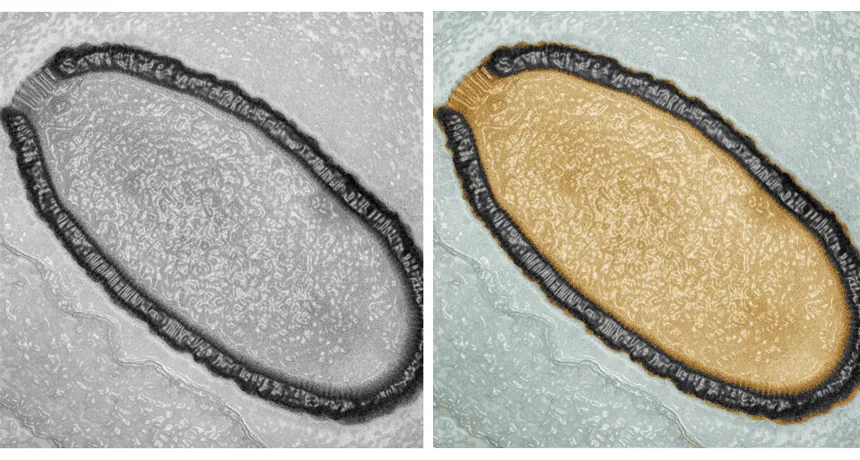
In a development that sounds like the opening scene of a science fiction thriller, an international team of scientists has successfully revived ancient viruses frozen in Siberian permafrost for nearly 50,000 years, raising profound questions about the potential public health threats buried beneath the Earth’s rapidly thawing ice. The research, which builds upon earlier discoveries of revived viruses from 2014 and 2015, isolated and reanimated 13 new pathogens from seven different ancient permafrost samples . Among the revived specimens was a virus estimated to be 48,500 years old, making it the oldest virus ever to be reawakened and establishing a chilling record for longevity in a dormant state . The team, composed of experts from France, Russia, and Germany, focused on “giant viruses,” a unique class of pathogens so large they are visible under a standard light microscope, and they successfully demonstrated that these ancient organisms remain infectious even after tens of millennia of being frozen solid .
The primary target of these resurrected viruses, and a key detail that tempers immediate alarm, is that they are only capable of infecting single-celled amoebas, specifically Acanthamoeba, and pose no direct threat to humans, animals, or crops . The researchers deliberately selected these amoeba-infecting viruses for biological security reasons; using them eliminates any biohazard risk and removes the need for the highest level of containment laboratories . As Professor Jean-Michel Claverie, a co-author of the study from Aix-Marseille University, explained, viruses are highly specific to their hosts, and there is “no chance that an amoeba-infecting virus could infect humans,” comparing the risk to that of a dog virus not infecting a person . By showing that these harmless viruses were still viable, however, the team indirectly proved a critical point: if amoeba viruses can survive this long, so too could other frozen viruses that have the potential to infect humans or animals . The very fact that they were able to isolate so many new viruses from their samples suggests that “infectious particles of viruses specific to many other untested eukaryotic hosts probably remain abundant in ancient permafrost” .
The driving force behind the reanimation of these “zombie viruses” is not scientific curiosity alone, but the alarming reality of climate change. A quarter of the Northern Hemisphere’s landmass is underlain by permafrost, a permanently frozen layer of soil that is now irreversibly thawing due to rising global temperatures . This thawing releases vast amounts of organic matter that have been frozen for up to a million years, including the dormant microbes and viruses that have remained in a state of suspended animation since prehistoric times . The research paper argues that the risk posed by these ancient pathogens has been underestimated and is “bound to increase in the context of global warming, in which permafrost thawing will keep accelerating, and more people will populate the Arctic in the wake of industrial ventures” . While the immediate threat from these specific, amoeba-infecting viruses is negligible, the study serves as a powerful and sobering warning, highlighting that the melting ice is effectively opening a Pandora’s box of ancient biological material that could have unforeseen consequences.
This scenario is not purely hypothetical; there is already a modern precedent for disease emerging from thawing permafrost. In 2016, a heatwave in the Yamal Peninsula of Siberia melted permafrost and exposed a reindeer carcass that had been infected with anthrax decades earlier . The resurrected bacteria spread, sickening dozens of people, killing one child, and leading to the culling of over 200,000 reindeer . This event, along with the discovery of the 1918 influenza virus’s RNA in the lungs of an Alaskan woman buried in permafrost, serves as a stark reminder that the “icy graveyard” can harbor pathogens that are anything but dead . Scientists like Dr. Brigitta Evengård from Sweden caution that while the risk is currently low, the permafrost could release antibiotic-resistant bacteria or well-known pathogens like poxviruses in the future, making it a true “Pandora’s box” .
The implications of this research extend beyond human health to the global environment itself. As these ancient microbial communities reawaken, they begin to consume the organic matter released from the thawing soil, actively releasing significant amounts of carbon dioxide and methane—potent greenhouse gases that will further accelerate climate change . This creates a dangerous feedback loop where the thawing ice, driven by warming, releases microbes that in turn produce more greenhouse gases, leading to even more warming. Furthermore, other recent studies have begun to explore the broader ecological risks, showing that viruses from ancient deep-sea sediments can revitalize and infect bacteria in terrestrial soil, thereby disrupting soil bacterial communities and damaging vital ecological functions . Even a threat to agriculture has been raised, with findings that a pathogenic bacterium causing potato soft rot can surge in population as permafrost thaws, posing a risk to food security . While the notion of a prehistoric “pandemic from the ice” is an unsettling one, experts maintain that the risk of a catastrophic human outbreak is currently low. However, the successful revival of these 48,500-year-old viruses is a profound scientific achievement that unequivocally demonstrates that the risk is real, and as our planet warms, the sleeping pathogens of the distant past are beginning to stir .